
Spices and aromatics
Common sorrel leaves
Common sorrel (Rumex acetosa) has a tart leaf used in salads and cooked dishes. UK growing guidance covers outdoor beds and containers, while the source does not give a numeric cold limit or a complete recipe or food-safety threshold.
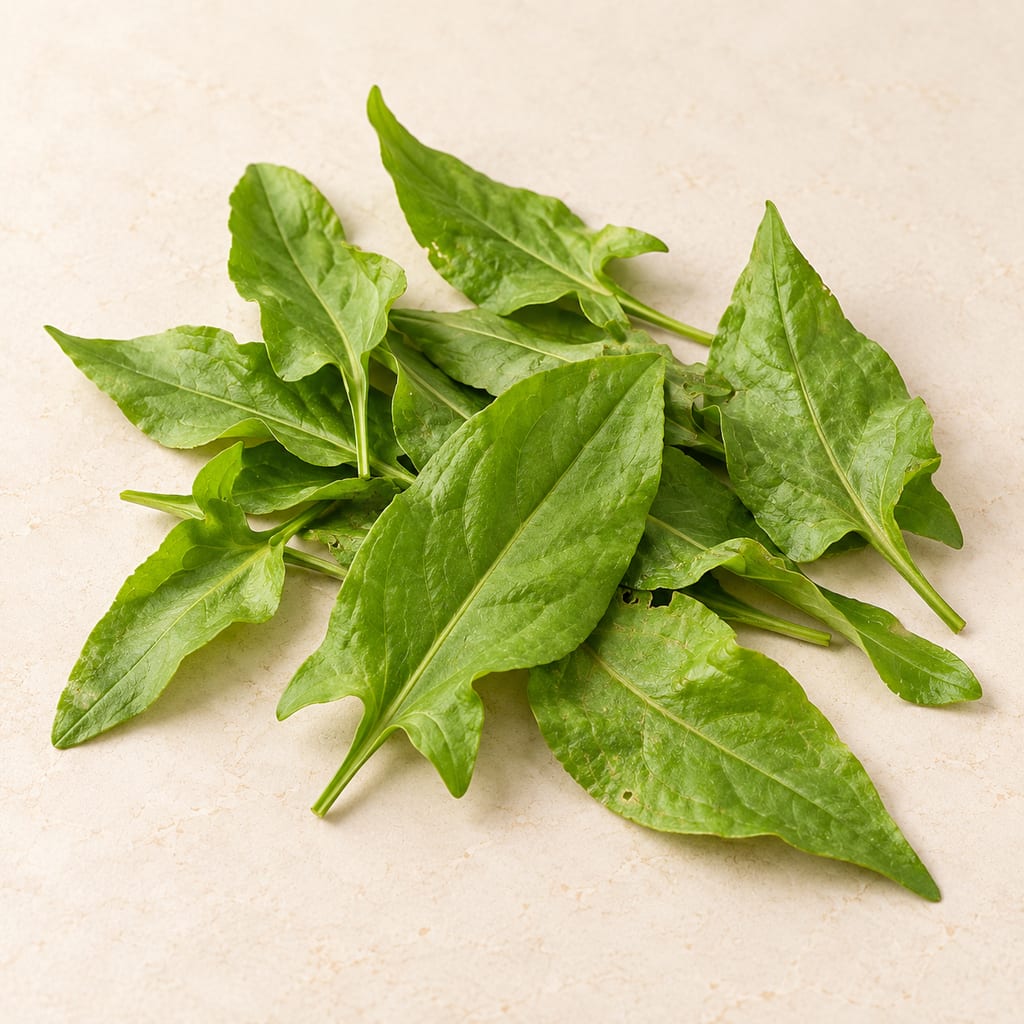
The name matters
Kew accepts Rumex acetosa L., a perennial native across temperate Eurasia and north-western Africa. Kew’s species profile describes common sorrel as native to the British Isles. The RHS distinguishes common sorrel from French or buckler-leaf sorrel (Rumex scutatus) and red-veined sorrel (R. sanguineus). Kew Grow Wild lists sheep’s sorrel as R. acetosella; the RHS notes that some Oxalis species also share the common name sorrel. A common name alone therefore does not identify this species.
What UK growing guidance says
The RHS guide discusses three sorrels grown for edible leaves and says all three are hardy throughout the UK. It gives no numeric survival temperature for common sorrel, so that regional statement should not be converted into a frost threshold. The guide recommends full sun or partial shade and fertile, moisture-retentive soil for leaf growth. It describes seed sowing indoors or outdoors; outdoor sowing is mid-spring to early summer at about 1 cm deep, with plants later spaced 20–30 cm apart. Young plants may be planted outdoors from spring to early summer.
For a small indoor start, RHS describes a warm, bright windowsill or propagator, germination around 15°C in one to two weeks, and potting seedlings individually. That propagator advice is seed starting, not greenhouse production guidance. The RHS container recommendation is a pot at least 30 cm wide and 20 cm deep with equal parts peat-free soil-based and multipurpose compost. Water young or newly planted plants during dry spells; containers need attention in warm weather and should not stay waterlogged over winter.
Sources for this section
Leaves in the kitchen
Kew’s species profile reports leaves used in sauces, salads and as a spinach leaf. RHS describes a sour, lemony or citrus tang, recommends regular picking of young leaves, and says they can be used in mixed salads, sandwiches, or cooked like spinach. Older leaves may become tough and bitter. These are reported uses, not a complete recipe: the sources do not provide one shared ingredient list, yield, cooking endpoint or storage method.
Kew describes the sour leaves as containing high levels of oxalic acid and says its presence may pose risks for people with rheumatic-type complaints or kidney or bladder stones. The page supplies no quantity or preparation-specific assessment. This article does not infer a safe amount, health effect, or safety difference between raw and cooked uses from that statement.
Sources for this section
What remains open
The inspected material does not establish a numeric cold or heat limit, greenhouse production method, regional yield, or validated household handling and storage guidance. Kew’s oxalic-acid wording lacks a concentration and an intake threshold. No complete source-specific dish was verified, so these descriptions should not be treated as step-by-step cooking instructions.
Sources for this section
Research gaps
Kew reports high oxalic acid but gives no amount, preparation effect, or food-safety threshold; no dose or clinical claim is inferred.
No complete, source-specific recipe with quantities, yield, ordered stages, endpoint and storage was verified.
The RHS all-UK hardiness statement has no numeric survival cutoff; no numeric frost or heat limit is established.
RHS seed-starting under a windowsill or propagator is not greenhouse production evidence; heated, unheated and tunnel growing remain unassessed.
Research status
The underlying plant account received a partial source review. Its review scope is described in the original plant article.
Sources for this section
Places
Unknown
Relationship not established · Place not establishedThe available research does not establish a single origin for this ingredient.
Community
No community contributions have been published for this entry yet.
Share what you made
Sign in to contribute. Published comments and photos are free to read.
Sources
Royal Botanic Gardens, KewIngredient research
Rumex acetosa L., Plants of the World OnlineCited in: The name matters; Leaves in the kitchen; What remains open; Research gaps
Royal Horticultural SocietyIngredient research
How to Grow SorrelCited in: The name matters; What UK growing guidance says; Leaves in the kitchen; What remains open; Research gaps
Grow Wild, Royal Botanic Gardens, KewIngredient research
Sensory and edible native plantsCited in: The name matters; Research gaps
FermenteaResearch provenance
Common sorrel: a sharp, leafy perennial: original plant researchCited in: Research status