
Substrates
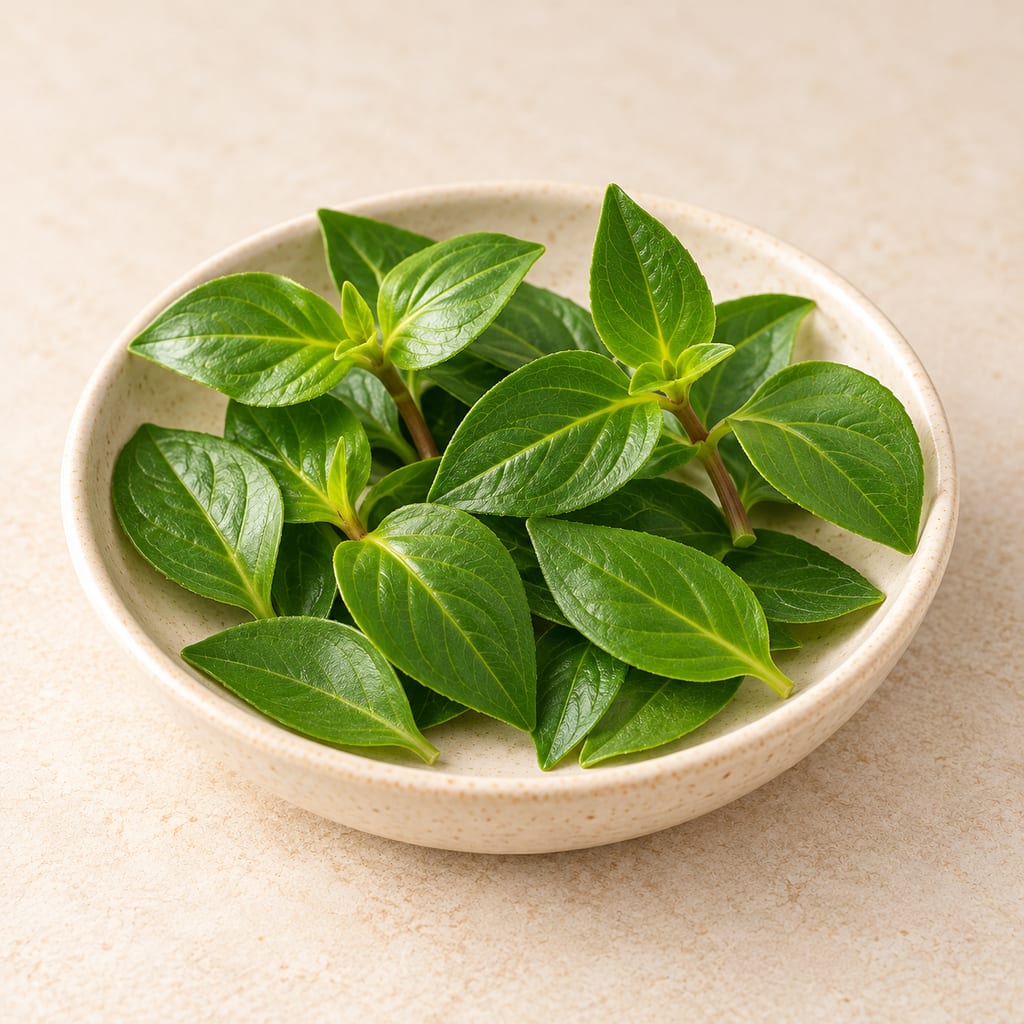
Rungia klossii greens
PNG crop references describe Rungia klossii leaves as a pot herb, often paired with highland pitpit. One historical Ndumba account records a specific community’s planting, food use and dietary restriction.
Accepted name and local names
Kew accepts Rungia klossii S.Moore and lists Justicia klossii (S.Moore) Mabb. as a homotypic synonym. Kew gives New Guinea as the native range. PROSEA lists the PNG names kenkaba, tani, moku and ainbe. Hays records ‘Honri’ for the plant in Ndumba, while French says the Rungia in his account had no common Tok Pisin or English name. These source-specific names are not a national name map or field identification key.
Food reports and community scope
PROSEA describes leaves used as a pot herb, often cooked with highland pitpit (Setaria palmifolia), and says leaves are sometimes eaten raw. French separately describes young leaf tips eaten raw or cooked, often with pitpit shoots. These are reports of use, not a safety assessment or complete recipe.
Hays’s 1981 article describes fieldwork in 1971–72 in Habi’ina village, an Eastern Highlands community he identifies as Tairora-speaking and Ndumba. In the species entry he names Rungia klossii, gives reference T.E. Hays 080 and the local name Honri, and reports planting in sweet-potato gardens and near houses. He says four named varieties were planted and that leaves and stems were eaten, except by men whose wives were pregnant or in early postpartum. The passage does not explain the restriction; it is not presented here as a medical effect or a rule for other communities.
Cultivation reports
PROSEA says the crop is most important in cool highlands at about 1,200–2,000 m, although it records occurrence from sea level to 2,700 m. It reports growth under shade or in the open and a preference for fertile, well-drained soil. Its cultivation account describes semi-hardwood cuttings 15–20 cm long, mixed planting with other food crops, and about 50 × 50 cm spacing in pure stands; it notes slow early growth and a need for substantial weeding. These are regional handbook descriptors, not a measured home-garden schedule.
The handbook reports shoot-tip harvest at 2–4 months, then at one- to two-month intervals for up to two years. It reports yields of 1–2 kg per plant per year, or 20–40 tonnes per hectare per year at 20,000 plants per hectare. The source does not establish a household yield. Hays’s account confirms planting near homes and in sweet-potato gardens in one community but gives no spacing, container method or protected-crop conditions. No household container trial or heated or unheated greenhouse protocol was found.
What remains unknown
No inspected source provides a complete measured cooking batch, an explanation for Hays’s community-specific dietary restriction, raw-food safety guidance, storage duration, current local germplasm or conservation status, frost or heat thresholds, irrigation schedule, container results, or greenhouse controls. ‘Pot herb’ describes culinary use; it does not mean that the plant was evaluated as a potted crop.
Research gaps
Hays’s Rungia account is one historical community record; its names and dietary restriction should not be generalized nationally.
The Hays source host returned 403 on this review pass; the species passage was rechecked from the previously retrieved original scan.
No full household cooking method with quantities, ordered steps, yield, endpoint and storage was found.
Raw-use reports provide no safety assessment or validated endpoint.
No frost or heat threshold, household container evidence, greenhouse settings or current conservation assessment was established.
Research status
The underlying plant account received a partial source review. Its review scope is described in the original plant article.
Sources for this section
Places
Unknown
Relationship not established · Place not establishedThe available research does not establish a single origin for this ingredient.
Community
No community contributions have been published for this entry yet.
Share what you made
Sign in to contribute. Published comments and photos are free to read.
Sources
Royal Botanic Gardens, Kew, Plants of the World OnlineIngredient research
Rungia klossii S.MooreCited in: Accepted name and local names; Research gaps
A.M. Gurnah; J.S. Siemonsma and K. Piluek (eds.), PROSEA FoundationIngredient research
Rungia klossii S. Moore, PROSEA Handbook 8: VegetablesCited in: Accepted name and local names; Food reports and community scope; Cultivation reports; What remains unknown; Research gaps
Terence E. Hays; Science in New Guinea 8(2) (1981), pp. 122–131Ingredient research
Some Cultivated Plants in Ndumba, Eastern Highlands ProvinceCited in: Accepted name and local names; Food reports and community scope; Cultivation reports; What remains unknown; Research gaps
Bruce R. French; ECHO Community, 2006Ingredient research
Food Crops of Papua New Guinea: An introduction to the crops, their importance and distribution in Papua New GuineaCited in: Accepted name and local names; Food reports and community scope; Cultivation reports; Research gaps
FermenteaResearch provenance
Rungia klossii, a highland leafy green: original plant researchCited in: Research status