
Substrates
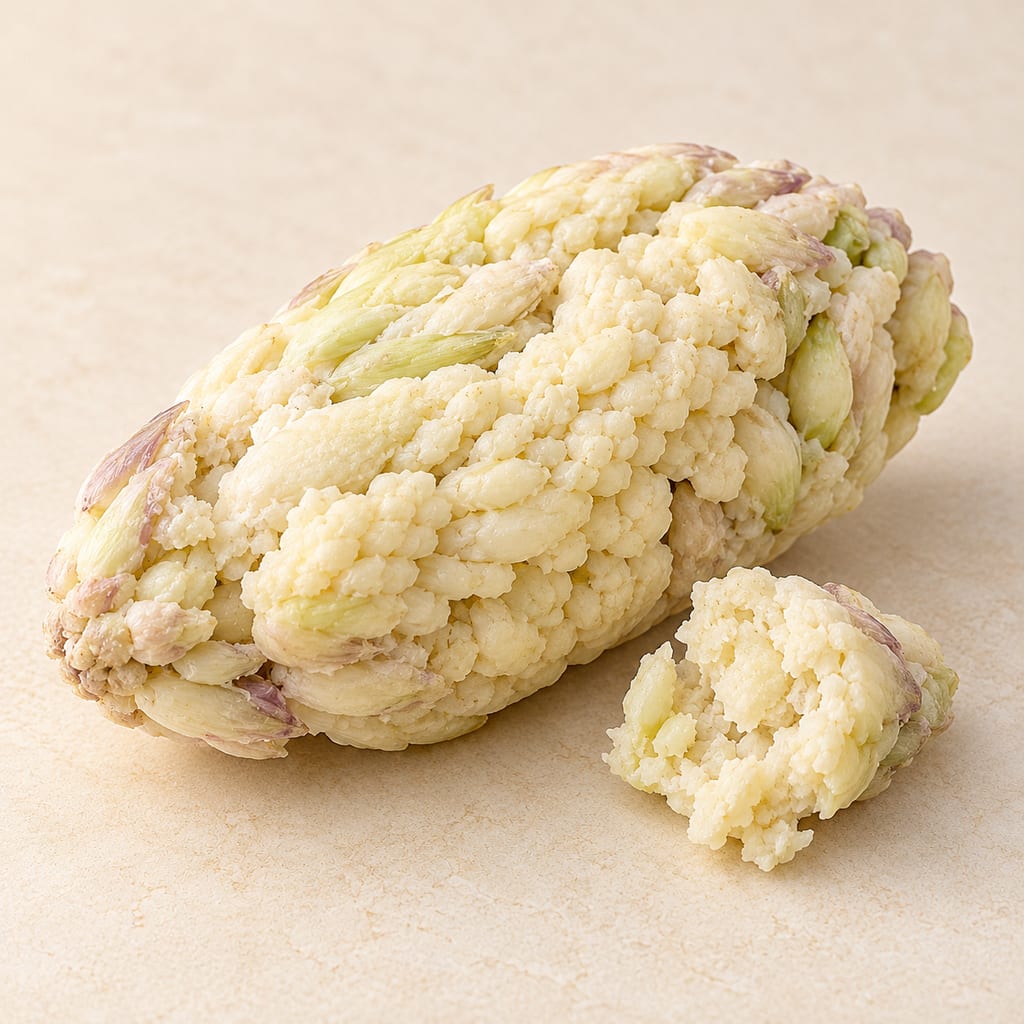
Duruka inflorescence
Fiji crop accounts call the edible inflorescence crop Saccharum edule; this crop-name concept remains unresolved in current botanical treatments.
Name and identity
Fiji crop accounts call duruka Saccharum edule. Kew currently lists Saccharum × edule Hassk. as an unplaced name, which it says cannot be accepted or placed in synonymy. The full PROSEA profile says the identity is debated and discusses several possibilities, including an unusual sugarcane form, a derivative of Saccharum robustum, or a hybrid involving S. robustum and Miscanthus floridulus. Older ITIS data reports S. edule as not accepted and S. robustum as accepted under its cited treatment. These different records do not identify a Fiji crop specimen or accession. Duruka is therefore discussed here as a Fiji source crop concept, not as a botanically settled accepted species.
Reported food parts and uses
PROSEA describes the edible part as a compact mass of underdeveloped inflorescences that remains enclosed in the upper leaf sheath. Its regional profile lists raw, cooked, steamed and roasted uses. A Fiji Ministry of Primary Industries guide excerpt lists soup, curry, roasting and lovo baking. These are reported food contexts, not one complete preparation method.
The University of Auckland Library item description for a 1986 Waqaniu-Rogers article calls duruka a favoured food plant grown throughout Viti Levu and describes its edible central core or unopened inflorescence. It mentions two types distinguished by outer-stem colour, but the description is clipped and the full article pages were unavailable.
Sources for this section
Fiji cultivation accounts
The Ministry’s Crop Farmer’s Guide reports year-round planting, 12,821 cuttings per hectare, rows 1.3 m apart with 0.3 m between plants, red types planted in October–November and green types in February–March, an 8–10 month harvest, and an average yield of 1,200 bundles per hectare. The 2014 Farm Management Manual gives 25,641 setts per hectare at the same spacing, a harvest eight months into the following crop season, and 1,800–2,560 bundles per hectare. These planting rates and yields conflict and are not reconciled here.
Regional growing context and a farm account
A 2012 Fiji Ministry of Primary Industries guide excerpt associates duruka with wet or intermediate zones, adequate rainfall and rich alluvial soils. It gives a March–May main season, says Pitpit Red appears from October, and reports up to 50,000 inflorescences or 3,500 bundles per hectare under stated optimum field and cultivation practices. The methods and denominator were not available for review. PROSEA reports cuttings or clump division and mixed-garden planting, but its timing statements differ between sections: harvest may start about five months after planting, while the agronomy section says plants take 6–9 months to develop fully. It also says little is known of S. edule ecological preferences; the following hot-humid habitat description is about S. robustum and is not treated as a duruka limit.
One Lautoka farm and remaining limits
A 2015 Fiji Times report describes a 21-acre duruka farm at Johnson Road, Vitogo, Lautoka. The farmer reports growing red and green forms, phase planting and six-month maturity on his farm; he also describes water constraints during a western dry spell and irrigation assistance. This is one farm account, not a replicated crop trial.
Sources for this section
Preparation and growing questions
The food accounts do not provide a complete household batch with quantities, yield, ordered stages, endpoint and storage conditions. No preparation is presented as an executable recipe or validated safety method. The reviewed record has no productive household-pot or greenhouse trial. SRIF's reported duruka tissue-culture work is laboratory germplasm evidence, not an edible container or protected-crop result. No universal frost, heat, light, soil pH, irrigation, storage or collection threshold is established.
Research gaps
The Fiji crop material has not been matched to a voucher or accession; Kew, PROSEA and older ITIS treatments differ, and the original Waqaniu-Rogers article pages were unavailable.
Ministry guide table text is search-extracted. Planting-unit rates, calendars and yields conflict and cannot be reconciled without original page layout and methods.
Food-use reports do not provide one complete household recipe, storage period or validated food-safety endpoint.
No Fiji crop-voucher study, productive container crop, heated or unheated greenhouse trial, or measured frost, heat, pH, light or irrigation threshold was established.
Sources for this section
- Saccharum × edule Hassk. | Plants of the World Online →
- Saccharum edule Hasskarl, PROSEA Handbook 8: Vegetables, record 2197 →
- Saccharum edule TSN 794760 | ITIS Report →
- Crop Farmer's Guide: A Farmer's Guide to a Better Harvest →
- Fiji Farm Management Manual 2014, Technical Information on Crops →
- Agriculture Investment Guide: Discovering Opportunities, Harvesting Potentials →
- The duruka master →
- Sugar Research Institute of Fiji Annual Report 2021 →
- Some Observations on Duruka, Saccharum Edule, in Viti Levu, Fiji, by A. Waqaniu-Rogers, Journal of the Polynesian Society 95(4), 475–478 →
Research status
The underlying plant account received a partial source review. Its review scope is described in the original plant article.
Sources for this section
Places
Unknown
Relationship not established · Place not establishedThe available research does not establish a single origin for this ingredient.
Community
No community contributions have been published for this entry yet.
Share what you made
Sign in to contribute. Published comments and photos are free to read.
Sources
Royal Botanic Gardens, KewIngredient research
Saccharum × edule Hassk. | Plants of the World OnlineCited in: Name and identity; Research gaps
P.C.M. Jansen; PROSEA Foundation, 1993Ingredient research
Saccharum edule Hasskarl, PROSEA Handbook 8: Vegetables, record 2197Cited in: Name and identity; Reported food parts and uses; Regional growing context and a farm account; Preparation and growing questions; Research gaps
Integrated Taxonomic Information SystemIngredient research
Saccharum edule TSN 794760 | ITIS ReportCited in: Name and identity; Research gaps
Fiji Ministry of AgricultureIngredient research
Crop Farmer's Guide: A Farmer's Guide to a Better HarvestCited in: Fiji cultivation accounts; Research gaps
Fiji Ministry of AgricultureIngredient research
Fiji Farm Management Manual 2014, Technical Information on CropsCited in: Fiji cultivation accounts; Research gaps
Fiji Ministry of Primary Industries; Pacific Agriculture and Forestry Policy NetworkIngredient research
Agriculture Investment Guide: Discovering Opportunities, Harvesting PotentialsCited in: Reported food parts and uses; Regional growing context and a farm account; Research gaps
Serenia Vilele, Fiji Times, 27 November 2015Ingredient research
The duruka masterCited in: One Lautoka farm and remaining limits; Research gaps
Sugar Research Institute of FijiIngredient research
Sugar Research Institute of Fiji Annual Report 2021Cited in: Preparation and growing questions; Research gaps
A. Waqaniu-Rogers; University of Auckland Library item via Digital PasifikIngredient research
Some Observations on Duruka, Saccharum Edule, in Viti Levu, Fiji, by A. Waqaniu-Rogers, Journal of the Polynesian Society 95(4), 475–478Cited in: Reported food parts and uses; Research gaps
FermenteaResearch provenance
Duruka, a Fiji crop concept: original plant researchCited in: Research status