
Substrates
Totora as food
Aymara records from Lake Titicaca describe totora as food, with separate reports of rhizomes and the basal tutura stem; later planting evidence comes from a wastewater lagoon.
Accepted name and source-specific names
Kew accepts Schoenoplectus californicus (C.A.Mey.) Soják, a perennial or rhizomatous sedge whose broad native range includes Bolivia. Kew lists Schoenoplectus tatora and Scirpus californicus subsp. tatora among its synonyms. Regional records may use tatora at a different rank; the name alone does not establish a separate plant or re-identify a local specimen.
The Aymara study uses totora and tutura in its account and figure caption. The linked workbook records a range of locality-specific names, including Chhullu, Miq’uchi, Sip’i and Tutura. These are source-context labels, not a field identification key or universal synonyms.
Reported food uses around Lake Titicaca
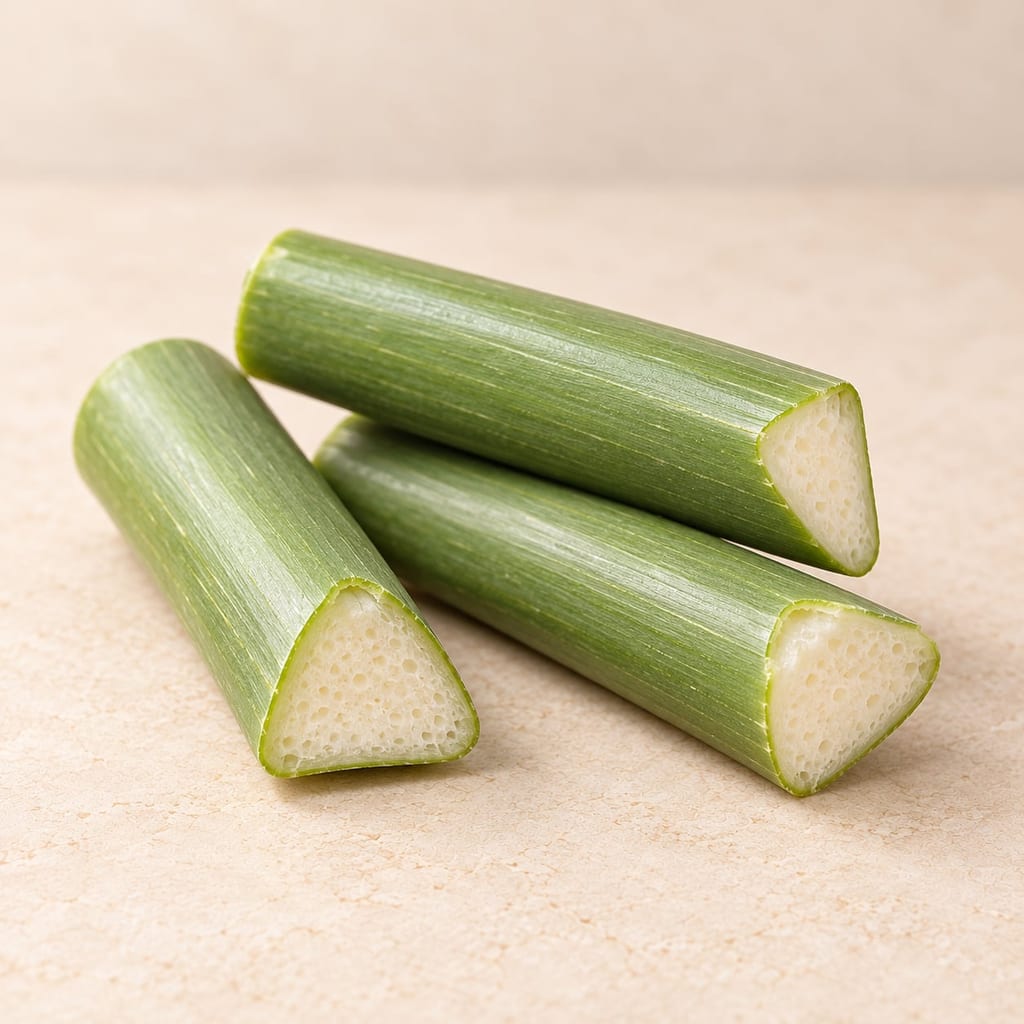
A 2026 study documents Aymara food knowledge gathered primarily in communities of La Paz Department around Lake Titicaca during fieldwork from 2001 to 2015. It reports 113 Schoenoplectus californicus food-use entries and names edible rhizomes. Its Figure 5 caption separately describes harvesting totora and consuming the basal portion of the tutura stem. The linked workbook codes basal leaf, rhizome and shoot records separately. These plant parts and statements should not be collapsed into one preparation account.
The article defines a record or entry as a coded use-report structured by taxon, plant part, process and informant. Its counts therefore describe documented reports, not 113 independent people or meals.
A planting account from a wastewater lagoon
A 2003 technical report describes totora planting at the Puchuckollo wastewater-treatment lagoon. Planting began on 5 January 1998 with clumps 0.6 to 0.7 metres tall and 5 to 10 stems; the report records one plant per square metre over substrate covered by 2 centimetres of water, followed by gradual flooding. The first stem harvests were recorded on 15 July and 1 October 1998. The report also records a 2000 pruning and later growth, and says totora specialists carried out planting, harvest and pruning.
These are observations from an engineered wastewater-treatment setting. They are not edible-crop performance, food-site quality evidence, or instructions for planting or harvesting totora at home.
Counts and other growing evidence
The article reports 113 entries. In the pinned workbook reviewed for the dossier, the Coded Data FOOD sheet has 113 records for this taxon, while a separate InputDataFig_4 aggregation reports 153, with different part counts. The article and workbook materials do not explain that difference, so the figures remain separate.
Other Bolivian records describe laboratory micropropagation and wetland extent or biomass. They concern in-vitro work and wetland ecology, not a productive food crop. The available evidence does not establish general climate, frost, soil, irrigation or harvest limits, or container or greenhouse growing methods.
Sources for this section
- From tradition to nutrition: wild and cultivated Aymara food plants as sustainable resources in the Andean neotropics of Bolivia →
- Aymara-Food interview data workbook, AymaraFoodGit_16_4_26.xlsx →
- Establecimiento in vitro de Schoenoplectus californicus (Cyperaceae) a partir de explantes foliares →
- Distribución y biomasa de la totora (Shoenoplectus californicus ssp.) en el Sitio Ramsar Uru Uru y Poopó, Bolivia →
Preparation and collection limits
The article and workbook document food-use and part records but do not provide a complete household batch with quantities, ordered preparation, endpoint and storage. The article's wetland contaminant discussion does not test food sites or establish that any particular totora is suitable to eat. This account does not provide preparation, harvesting or site-selection instructions.
Research gaps
The article and workbook aggregation difference, including their different part counts, has no confirmed explanation.
No individual workbook voucher code has been matched to a public LPB specimen record in this review.
No complete, locality-specific food preparation, food-site quality assessment, or storage evidence is available here.
No species-specific productive home, container or greenhouse protocol was found; the detailed planting account is from a specialist-managed wastewater lagoon.
Sources for this section
- Schoenoplectus californicus (C.A.Mey.) Soják →
- From tradition to nutrition: wild and cultivated Aymara food plants as sustainable resources in the Andean neotropics of Bolivia →
- Aymara-Food interview data workbook, AymaraFoodGit_16_4_26.xlsx →
- Proyecto de conservación de la biodiversidad del sistema TDPS: uso de totorales para la descontaminación en Bolivia. Informe final →
- Establecimiento in vitro de Schoenoplectus californicus (Cyperaceae) a partir de explantes foliares →
- Distribución y biomasa de la totora (Shoenoplectus californicus ssp.) en el Sitio Ramsar Uru Uru y Poopó, Bolivia →
Research status
The underlying plant account received a partial source review. Its review scope is described in the original plant article.
Sources for this section
Places
Unknown
Relationship not established · Place not establishedThe available research does not establish a single origin for this ingredient.
Community
No community contributions have been published for this entry yet.
Share what you made
Sign in to contribute. Published comments and photos are free to read.
Sources
Royal Botanic Gardens, Kew, Plants of the World OnlineIngredient research
Schoenoplectus californicus (C.A.Mey.) SojákCited in: Accepted name and source-specific names; Research gaps
Cocarico, Rivera, Beck, Rivera-Obón and Obón, Frontiers in Nutrition 13 (2026)Ingredient research
From tradition to nutrition: wild and cultivated Aymara food plants as sustainable resources in the Andean neotropics of BoliviaCited in: Accepted name and source-specific names; Reported food uses around Lake Titicaca; Counts and other growing evidence; Preparation and collection limits; Research gaps
Diego Rivera-Obón, Aymara-Food public repository, file revision 6a45c323e0856b658da54f06f3519404970b68d8Ingredient research
Aymara-Food interview data workbook, AymaraFoodGit_16_4_26.xlsxCited in: Accepted name and source-specific names; Reported food uses around Lake Titicaca; Counts and other growing evidence; Preparation and collection limits; Research gaps
Autoridad Binacional del Lago Titicaca; prepared by Fundación MEDMIN, April 2003Ingredient research
Proyecto de conservación de la biodiversidad del sistema TDPS: uso de totorales para la descontaminación en Bolivia. Informe finalCited in: A planting account from a wastewater lagoon; Research gaps
Pérez Guzmán and Limachi Quispe, Journal of the Selva Andina Biosphere 14(1) (2026)Ingredient research
Establecimiento in vitro de Schoenoplectus californicus (Cyperaceae) a partir de explantes foliaresCited in: Counts and other growing evidence; Research gaps
Choque Marca et al., Revista de Investigaciones Altoandinas 27 (2025)Ingredient research
Distribución y biomasa de la totora (Shoenoplectus californicus ssp.) en el Sitio Ramsar Uru Uru y Poopó, BoliviaCited in: Counts and other growing evidence; Research gaps
FermenteaResearch provenance
Totora in Aymara food records: original plant researchCited in: Research status