
Substrates
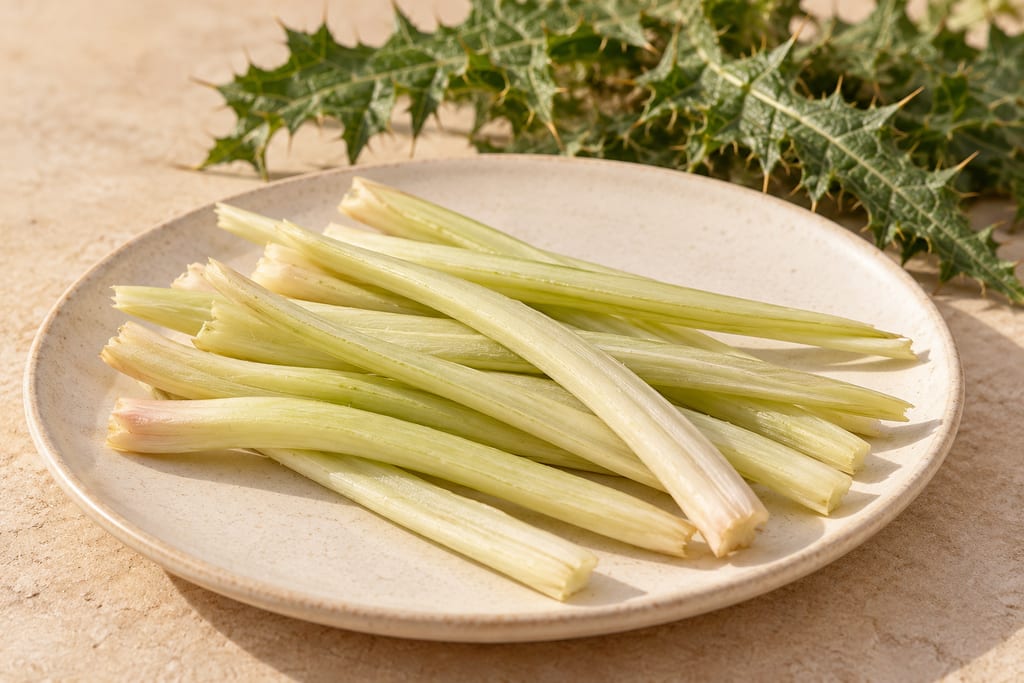
Spanish oyster plant greens
Algerian and Spanish sources report leaves, central leaf ribs and other regional food contexts. Historical gardens, weed observations, preliminary Spanish cultivation work and compiled cultivation reports are not a modern crop protocol or an identification or food-safety guide.
Name and scope
Kew accepts Scolymus hispanicus L. and describes a Mediterranean-to-western-Iran range and annual, biennial or perennial life cycle. In a Chlef survey, the species name is paired with WFO code 0000022425. That taxonomic record does not identify any individual gathered plant.
Names vary by source and place. Chlef reports Guernina and Assennan; a separate Beni Haoua account gives Guernina/Agheddou. The Algerian illustrated flora guide gives the Arabic name القرنينة, while Trabut’s 1906 Kabyle account uses Guernina and Thar’eddiouth. These are source-specific records; a shared or similar name does not identify a specimen.
Sources for this section
- Scolymus hispanicus L. | Plants of the World Online →
- The value of wild edible plants among rural communities in Chlef province (Algeria): A quantitative ethnobotanical survey →
- Traditional knowledge on the plant ingredients of an indigenous herbal dish from Beni Haoua region, northern Algeria →
- Guide illustré de la flore algérienne: Wilaya d’Alger →
- Scolyme (Trabut, Algérie Agricole, 1906) →
Chlef food reports
A 2023 survey in rural Chlef reports leaves of S. hispanicus under the names Guernina/Assennan. Its table lists the leaves cooked with other herbs and tchicha (coarse barley semolina), as salad, or cooked with egg/omelet. The discussion further names the central leaf rib for salad or omelet use. These are reported local food contexts, not a complete batch or preparation sequence.
The authors interviewed 100 people in March–April 2023 and say informants identified plants using mobile-phone photographs to reduce confusion among plants sharing common names. The study’s RFC and FC values are measures within that survey, not national prevalence or a current market estimate.
Beni Haoua and other regional accounts
A Beni Haoua study includes S. hispanicus as a wild herb in Khobbiz/Lahchich and identifies the leaf central rib in its table. Its discussion separately reports an omelet context after prior boiling and prickles removed. The publisher page redirects to login; these details are retained with that access limitation and should not be read as a validated method.
A 2017 Mostaganem thesis gives a different account: young late-winter rosettes may be eaten raw or cooked, and fleshy roots are described as edible, with a tender outer portion separated from a hard inner portion after cooking. Trabut’s 1906 Kabyle account instead says the root was not used in that particular context. These sources describe distinct regional and historical practices; they do not establish a single plant part or preparation for all communities.
Season and growing evidence
The Algerian weed guide AdvenAlg reports autumn–winter germination, flowering from April to September, seed reproduction and wind dispersal. Its account places the species in annual and perennial crops and describes a preference for sandy-loam soil fairly rich in nitrogen. These observations come from weed flora and management context, not a field trial for edible yield or a recommended garden regime.
Trabut’s 1906 account describes Kabyle household plots, heavy annual manuring before the rains and vigorous winter/spring leaf rosettes. This is a historical description, not current extension advice. Neither source gives a tested sowing rate, pH, irrigation quantity, container design, greenhouse regime or harvest yield.
Food and identification limits
The food reports identify different parts and source contexts: leaves or central ribs in the Chlef accounts, and roots or young rosettes in the Mostaganem thesis. No complete ingredient quantities, yields, timing, storage period or independently evaluated food-safety endpoint was found. The reported removal of prickles or prior boiling is an ethnographic detail, not proof of safe handling or a substitute for identification.
The plant is spiny, and common names may refer to more than one taxon. The cited studies do not supply a field key or voucher for the relevant food rows. This text cannot confirm a gathered specimen.
Sources for this section
- The value of wild edible plants among rural communities in Chlef province (Algeria): A quantitative ethnobotanical survey →
- Traditional knowledge on the plant ingredients of an indigenous herbal dish from Beni Haoua region, northern Algeria →
- Valorisation des plantes sauvages comestibles de l’ouest d’Algérie →
Spanish names and taxonomic scope
Kew accepts Scolymus hispanicus L. and lists two accepted subspecies, but the Spanish food rows and collected populations are not assigned to either. MITECO records cardillo, tagarnina and tagarnilla among Spanish names and warns that names may be shared across Scolymus and other cardoon-like plants. Kew treats Scolymus maculatus as a distinct accepted species. These names do not identify a gathered plant.
Spanish food reports
MITECO describes the basal-rosette midrib or penca as the usual food part after the leaf blade and spiny margins are removed. It also reports tender peeled stems eaten raw and describes boiling pencas in salted water before other uses. These are traditional reports, not validated preparation or storage controls.
The Madrid study interviewed 132 people in 60 villages during 1999–2002. Table 1 identifies Scolymus hispanicus under voucher 2081RM and local name cardillo: peeled basal leaves appear in stews (70 citations), salads (2) and a raw snack (1). One flower use is listed as a condiment. Counts are citations within that sample, not national prevalence or a standardized preparation.
Spanish growing evidence
MITECO reports occurrence in sandy and clay soils, acidic or basic, and says the cited habitat account prefers somewhat moist sandy sites. It gives occurrence up to 1,000 metres and flowering from May to July, with gathering mainly in early spring, often April and later in colder locations. These are habitat and seasonal observations, not a crop pH, water or yield recommendation.
The 2000 SEAE paper lists seven collected Spanish populations from Badajoz, Madrid, Segovia and Toledo at 450–1,000 metres. Its preliminary germination and field sowing work discusses autumn sowing as a possible way to obtain earlier production and extend collection, but does not identify the accession used in each test. MITECO also reports cultivation and marketing in parts of Andalusia, including Cádiz, citing a 2013 cooperative record and a 1943 catalogue. The inventory gives no production method, so this is not presented as a current crop protocol.
What remains open
Useful next evidence would include accessible page-level copies of the Beni Haoua article, specimen-linked local food records, measured dish batches, and modern edible-crop trials. The available Algerian weed observations and historical garden account do not resolve productive container or protected growing methods.
The Spanish MITECO cultivation statements remain compilation-level; no modern farm protocol, crop-yield result, mature container method, greenhouse method or validated food endpoint was established. Madrid voucher identifications were checked as printed rather than redetermined from specimens.
Sources for this section
- Scolymus hispanicus L. | Plants of the World Online →
- Traditional knowledge on the plant ingredients of an indigenous herbal dish from Beni Haoua region, northern Algeria →
- Valorisation des plantes sauvages comestibles de l’ouest d’Algérie →
- Scolyme (Trabut, Algérie Agricole, 1906) →
- AdvenAlg 1.0: Identification et Connaissance des Principales Adventices d’Algérie Méditerranéenne (Al Yasmina 2:3, 2021; issue running head: AdvenAlg 1.1) →
- Scolymus hispanicus L., entry in the Spanish Traditional Knowledge Inventory →
- Wild Food Plants Traditionally Used in the Province of Madrid, Central Spain →
- Adaptación al cultivo de dos especies silvestres comestibles de uso tradicional (Silene vulgaris y Scolymus hispanicus). Recolección, caracterización y evaluación agronómica →
- Scolymus maculatus L. | Plants of the World Online →
Research gaps
No inspected voucher links the cited Chlef or Beni Haoua food rows to a gathered specimen.
Beni Haoua publisher text could not be reopened during this pass; its selected table and discussion details come from the prior limited PDF/index inspection.
No complete recipe batch, quantities, yields, cooking endpoint, storage conditions or validated food-safety method was established.
AdvenAlg and Trabut provide weed-flora and historical-garden context, not modern productive-crop rates or recommendations; container and greenhouse performance remain undocumented.
Regional names and reported plant parts differ; no field-identification guide or specimen approval is provided.
The Spanish MITECO report cites a 2013 cooperative and a 1943 catalogue for cultivation and marketing in Cádiz, but those underlying records were not independently checked.
The SEAE population elevations are collection provenance, not tolerance limits; the accession behind each preliminary test is not identified.
The Madrid voucher rows were checked as printed; no specimen was independently redetermined.
The Spanish sources do not establish a complete recipe batch, validated boiling endpoint, safe raw-use method, storage limit, crop pH range, mature container crop or protected cultivation protocol.
Sources for this section
- Scolymus hispanicus L. | Plants of the World Online →
- The value of wild edible plants among rural communities in Chlef province (Algeria): A quantitative ethnobotanical survey →
- Traditional knowledge on the plant ingredients of an indigenous herbal dish from Beni Haoua region, northern Algeria →
- Valorisation des plantes sauvages comestibles de l’ouest d’Algérie →
- Guide illustré de la flore algérienne: Wilaya d’Alger →
- Scolyme (Trabut, Algérie Agricole, 1906) →
- AdvenAlg 1.0: Identification et Connaissance des Principales Adventices d’Algérie Méditerranéenne (Al Yasmina 2:3, 2021; issue running head: AdvenAlg 1.1) →
- Scolymus hispanicus L., entry in the Spanish Traditional Knowledge Inventory →
- Wild Food Plants Traditionally Used in the Province of Madrid, Central Spain →
- Adaptación al cultivo de dos especies silvestres comestibles de uso tradicional (Silene vulgaris y Scolymus hispanicus). Recolección, caracterización y evaluación agronómica →
- Scolymus maculatus L. | Plants of the World Online →
Research status
The underlying plant account received a partial source review. Its review scope is described in the original plant article.
Sources for this section
Places
Unknown
Relationship not established · Place not establishedThe available research does not establish a single origin for this ingredient.
Community
No community contributions have been published for this entry yet.
Share what you made
Sign in to contribute. Published comments and photos are free to read.
Sources
Royal Botanic Gardens, KewIngredient research
Scolymus hispanicus L. | Plants of the World OnlineCited in: Name and scope; Spanish names and taxonomic scope; What remains open; Research gaps
Merouane et al., Ethnobotany Research and Applications 30:63 (2025); author-uploaded full text hosted by ResearchGateIngredient research
The value of wild edible plants among rural communities in Chlef province (Algeria): A quantitative ethnobotanical surveyCited in: Name and scope; Chlef food reports; Food and identification limits; Research gaps
Merouane et al., Ethnobotany Research and Applications 34:4 (2026)Ingredient research
Traditional knowledge on the plant ingredients of an indigenous herbal dish from Beni Haoua region, northern AlgeriaCited in: Name and scope; Beni Haoua and other regional accounts; Food and identification limits; What remains open; Research gaps
Elhazati Mostefa, Université Abdelhamid Ibn Badis de Mostaganem, master’s thesis (2017)Ingredient research
Valorisation des plantes sauvages comestibles de l’ouest d’AlgérieCited in: Beni Haoua and other regional accounts; Food and identification limits; What remains open; Research gaps
Mairie de Paris, with support of the French Ministry of Foreign and European AffairsIngredient research
Guide illustré de la flore algérienne: Wilaya d’AlgerCited in: Name and scope; Research gaps
Pl@ntUse transcription of Trabut’s 1906 accountIngredient research
Scolyme (Trabut, Algérie Agricole, 1906)Cited in: Name and scope; Beni Haoua and other regional accounts; Season and growing evidence; What remains open; Research gaps
Choukry Kazi Tani; Al Yasmina, Revue de Botanique 2:3 (2021), with contributors Pierre Grard and Thomas Le BourgeoisIngredient research
AdvenAlg 1.0: Identification et Connaissance des Principales Adventices d’Algérie Méditerranéenne (Al Yasmina 2:3, 2021; issue running head: AdvenAlg 1.1)Cited in: Season and growing evidence; What remains open; Research gaps
MITECO, Inventario Español de los Conocimientos Tradicionales relativos a la BiodiversidadIngredient research
Scolymus hispanicus L., entry in the Spanish Traditional Knowledge InventoryCited in: Spanish names and taxonomic scope; Spanish food reports; Spanish growing evidence; What remains open; Research gaps
Economic Botany 59(2), 2005, pp. 122–136; New York Botanical Garden PressIngredient research
Wild Food Plants Traditionally Used in the Province of Madrid, Central SpainCited in: Spanish food reports; What remains open; Research gaps
IV Congreso de la Sociedad Española de Agricultura Ecológica, Córdoba, September 2000; author-uploaded full text on ResearchGateIngredient research
Adaptación al cultivo de dos especies silvestres comestibles de uso tradicional (Silene vulgaris y Scolymus hispanicus). Recolección, caracterización y evaluación agronómicaCited in: Spanish growing evidence; What remains open; Research gaps
Royal Botanic Gardens, KewIngredient research
Scolymus maculatus L. | Plants of the World OnlineCited in: Spanish names and taxonomic scope; What remains open; Research gaps
FermenteaResearch provenance
Scolymus hispanicus in Algerian and Spanish food and growing accounts: original plant researchCited in: Research status