
Substrates
Wild simsim greens
Tanzanian sources describe wild simsim as a leafy vegetable gathered and sometimes protected around homes. A printed SASS name resembles the accepted species name but has no voucher, so that row’s taxon remains unconfirmed.
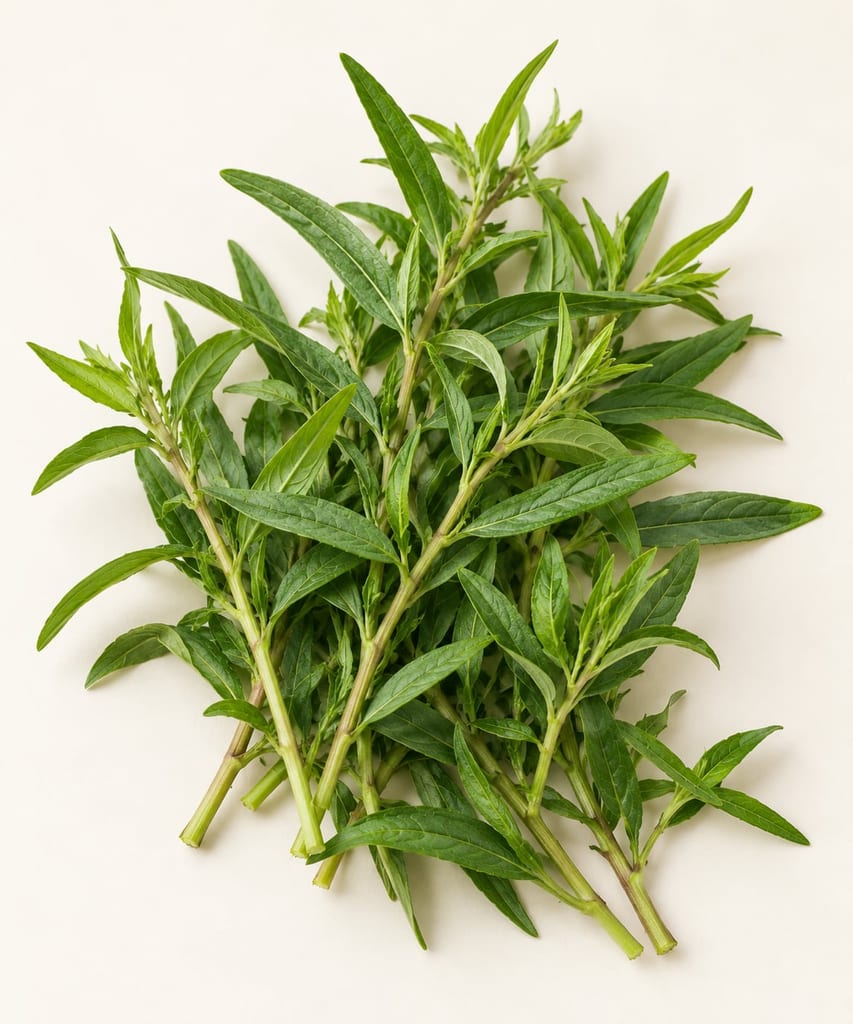
Accepted name and local labels
Kew accepts Sesamum angustifolium (Oliv.) Engl. and lists Sesamum calycinum var. angustifolium as a homotypic synonym. The SASS III table prints “Sesamus angustifolius” in a separate Mlenda (C) row alongside the name Wild simsim. That spelling is close to the accepted name, but the row has no voucher; it is a plausible name mapping, not a confirmed specimen identification. The Tanzania handbook separately titles its species entry Sesamum calycinum var. angustifolium (S. angustifolium). Yatsuka contrasts a Gogo preference for wild simsim with the Sandawe account of Ceratotheca sesamoides. These source labels should not be collapsed into one plant.
Sources for this section
- Sesamum angustifolium (Oliv.) Engl. | Plants of the World Online →
- Sustainable food systems through diversification and indigenous vegetables: An analysis of the Iringa and Dodoma areas in Tanzania →
- Relationships between Ceratotheca sesamoides and the Sandawe in Semi-Arid Area in Tanzania: Preservation and Sharing of the Dry Leaves →
- Edible Wild Plants of Tanzania →
Geography and collection seasons
Kew lists Tanzania within the accepted species’ native range; this range record is not a history of food use. The SASS III table reports spontaneous occurrence and April/May harvest for the Mlenda (C) category in Dodoma. The Tanzania handbook reports leaves collected in the rainy season and seeds in the dry season. Its entry gives a broad habitat and distribution account, while PROTA describes occurrence across several African countries. These records do not establish one calendar for all regions or identify the SASS household sample.
Food parts and reported uses
Ruffo and colleagues describe leaves chopped and cooked with other leafy vegetables, peas or beans to thicken a sauce eaten with a staple; they report a slippery texture and mild-to-sour taste. Their entry is explicitly named Sesamum calycinum var. angustifolium (S. angustifolium). PROTA’s broader African account describes cooked leaves and young shoots and notes that uses vary by country. It also mentions seed oil separately; this does not establish a leaf recipe or make oil and food-leaf evidence interchangeable.
Sources for this section
Growing and harvest reports
The Tanzania handbook describes occurrence in cultivated and waste areas, roadsides, grassland and sandy river soils from sea level to 2,000 m, and says plants are gathered wild but also protected or cultivated around homesteads. These are habitat and management reports, not a site preference or altitude optimum. PROTA says the plant is mostly collected wild and sometimes cultivated near houses or in fields. Its multi-country account describes a sunny position, seed propagation, seedlings thinned to about 20 cm and a first young-shoot harvest around six weeks after sowing. It says repeat cutting may continue up to about six times when water and soil fertility permit, and shoots become too woody when flowering and fruiting begin. These figures are source-specific guidance, not measured Tanzanian yields or guaranteed home timing.
Sources for this section
Limits and open questions
The inspected sources do not give a named hardiness scheme, tested frost limit, numeric soil pH, container dimensions, household irrigation schedule or greenhouse method. The reviewed accounts do not give a complete recipe with quantities, yield and cooking endpoint. The handbook’s dry-season storage description and PROTA’s food-use account do not validate a storage life or food-safety endpoint. A BRIT record documents one separately identified S. angustifolium specimen from Gombe Stream National Park, Kigoma, collected in 1998 at 775 m; it does not resolve the SASS table’s household row.
Sources for this section
- Sesamum angustifolium (Oliv.) Engl. | Plants of the World Online →
- Sustainable food systems through diversification and indigenous vegetables: An analysis of the Iringa and Dodoma areas in Tanzania →
- Relationships between Ceratotheca sesamoides and the Sandawe in Semi-Arid Area in Tanzania: Preservation and Sharing of the Dry Leaves →
- Sesamum angustifolium (PROTA) →
- Edible Wild Plants of Tanzania →
- Sesamum angustifolium specimen from Tanzania, G. Gobbo →
Research gaps
The SASS row prints Sesamus angustifolius without a voucher; it remains a plausible spelling-level crosswalk, not species confirmation.
The Tanzania handbook uses its stated taxonomic concept Sesamum calycinum var. angustifolium (S. angustifolium); no food batch is linked to a voucher specimen.
PROTA’s positive growing values are a multi-country synthesis, not a controlled Tanzania trial or guaranteed household protocol.
No named hardiness scheme, tested frost limit, numeric soil pH, container plan or greenhouse protocol was found.
Reported cooking and dried-leaf storage lack measured quantities, yield, endpoint and validated safety evidence.
The available sources do not establish current rules for gathering wild plants.
Sources for this section
- Sesamum angustifolium (Oliv.) Engl. | Plants of the World Online →
- Sustainable food systems through diversification and indigenous vegetables: An analysis of the Iringa and Dodoma areas in Tanzania →
- Relationships between Ceratotheca sesamoides and the Sandawe in Semi-Arid Area in Tanzania: Preservation and Sharing of the Dry Leaves →
- Sesamum angustifolium (PROTA) →
- Edible Wild Plants of Tanzania →
- Sesamum angustifolium specimen from Tanzania, G. Gobbo →
Research status
The underlying plant account received a partial source review. Its review scope is described in the original plant article.
Sources for this section
Places
Unknown
Relationship not established · Place not establishedThe available research does not establish a single origin for this ingredient.
Community
No community contributions have been published for this entry yet.
Share what you made
Sign in to contribute. Published comments and photos are free to read.
Sources
Royal Botanic Gardens, KewIngredient research
Sesamum angustifolium (Oliv.) Engl. | Plants of the World OnlineCited in: Accepted name and local labels; Geography and collection seasons; Limits and open questions; Research gaps
ECDPM and SASS III; chapter 3 by Barbara AiolfiIngredient research
Sustainable food systems through diversification and indigenous vegetables: An analysis of the Iringa and Dodoma areas in TanzaniaCited in: Accepted name and local labels; Geography and collection seasons; Limits and open questions; Research gaps
Haruna Yatsuka, Journal of African Studies 78:25–41Ingredient research
Relationships between Ceratotheca sesamoides and the Sandawe in Semi-Arid Area in Tanzania: Preservation and Sharing of the Dry LeavesCited in: Accepted name and local labels; Limits and open questions; Research gaps
P.C.M. Jansen, PROTA4U / Plant Resources of Tropical AfricaIngredient research
Sesamum angustifolium (PROTA)Cited in: Food parts and reported uses; Growing and harvest reports; Limits and open questions; Research gaps
Christopher K. Ruffo, Ann Birnie and Bo Tengnäs; RELMA Technical Handbook 27Ingredient research
Edible Wild Plants of TanzaniaCited in: Accepted name and local labels; Geography and collection seasons; Food parts and reported uses; Growing and harvest reports; Limits and open questions; Research gaps
BRIT Collections, Botanic Research Institute of Texas / Google Arts & CultureIngredient research
Sesamum angustifolium specimen from Tanzania, G. GobboCited in: Limits and open questions; Research gaps
FermenteaResearch provenance
Wild simsim (Sesamum angustifolium): original plant researchCited in: Research status