
Substrates
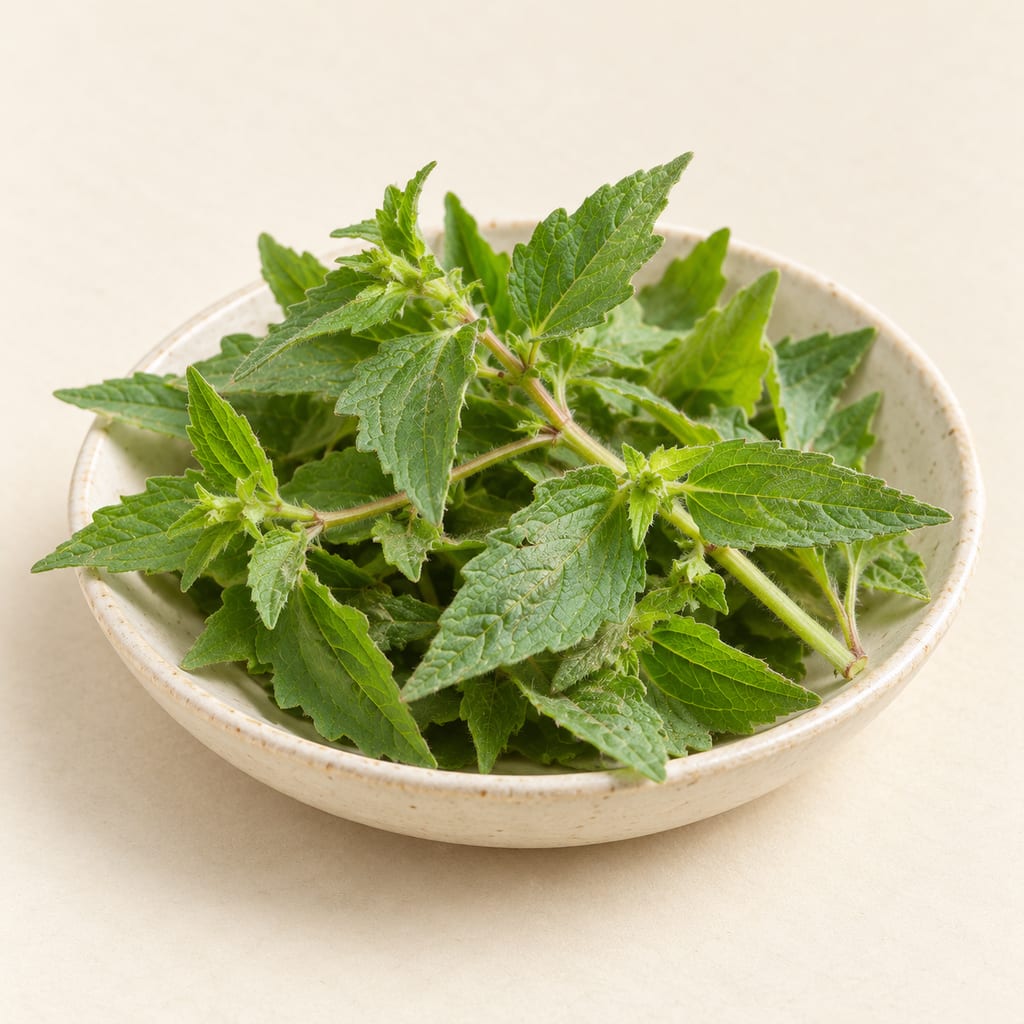
False sesame greens
Tanzanian sources document false sesame in distinct leafy-green traditions. The name mlenda also covers other plants, and reported cooking and growing details remain tied to their source communities and studies.
Accepted name and reported labels
Kew accepts Sesamum sesamoides and lists Ceratotheca sesamoides as a homotypic synonym. The SASS III table records a separate “Mlenda (B)” row as Ceratotheca sesamoides, while “Mlenda (C)” is printed as “Sesamus angustifolius.” Neither row includes a voucher, so the table records local categories and source labels rather than confirming collected specimens. Yatsuka identifies the plant discussed in the Sandawe account as Ceratotheca sesamoides and records the name betebeta.
Sources for this section
- Sesamum sesamoides | Plants of the World Online →
- Sustainable food systems through diversification and indigenous vegetables: An analysis of the Iringa and Dodoma areas in Tanzania →
- Relationships between Ceratotheca sesamoides and the Sandawe in Semi-Arid Area in Tanzania: Preservation and Sharing of the Dry Leaves →
Place and season
The sources document use in central Tanzania rather than a single origin story. SASS III reports spontaneous growth and April/May harvest for its Dodoma Mlenda (B) row. Yatsuka’s field account concerns Sandawe communities in a semi-arid area about 100 km north of Dodoma; it describes the local setting as receiving roughly 600 mm annual rainfall, with a rainy season from November to May. Slow Food associates mlenda mbata with Kongwa District in Dodoma and Singida and reports rainy-season leaf gathering. These places and calendars belong to their cited accounts, not to every population of the species.
Sources for this section
Food parts and uses
Yatsuka describes Sandawe use of fresh and dried leaves in mlenda eaten with ugali. Fresh leaves may be mixed with other gathered greens; the article contrasts this account with Gogo preference for wild simsim, Sesamum angustifolium. Slow Food lists leaves and flowers as food and describes boiled, sautéed and stewed preparations. These are separate regional reports; the shared dish name does not make the plants interchangeable.
Reported preparation
Yatsuka records a Sandawe cooking sequence in which water, salt and baking soda are brought to a boil before fresh leaves or powdered dried leaves are added and stirred rapidly. Groundnut or milk is mentioned in some preparations. The article gives no quantities, yield, measured endpoint or storage conditions, so this remains a descriptive account rather than a home recipe. Slow Food separately describes fresh leaves wilted in the sun before cooking, and dried leaves pounded with other dry vegetables and cooked into a thick paste with groundnut paste. Its reported drying and dry-season storage period is not a measured shelf-life or safety limit.
Growing evidence
The local sources describe spontaneous field occurrence and rainy-season collection. Yatsuka cites a habitat description of sunny, well-drained sandy ground; Slow Food reports sandy soils and an 800–1600 m altitude range in the mlenda mbata production area. Those figures describe reported places and habitat, not optimum conditions or a climate tolerance range. A Nigerian university backyard study grew Ceratotheca sesamoides for a composition experiment and sampled leaves at 6, 8 and 10 weeks; its experimental seed, spacing, watering and fertilizer conditions are not a Tanzanian or household growing guide.
Sources for this section
- Sustainable food systems through diversification and indigenous vegetables: An analysis of the Iringa and Dodoma areas in Tanzania →
- Relationships between Ceratotheca sesamoides and the Sandawe in Semi-Arid Area in Tanzania: Preservation and Sharing of the Dry Leaves →
- Mlenda mbata →
- The proximate and phytochemical composition of Sesamum indicum and Ceratotheca sesamoides Endl at different stages of growth →
Limits and open questions
The sources do not establish a named hardiness rating, frost limit, tested heat range, soil pH, household container method or greenhouse protocol. The 2019 processing study used laboratory heating and drying to examine composition; it did not validate a home preservation endpoint. No complete recipe with quantities and yield, source-confirmed specimen identity for the SASS table row, or independent food-safety assessment was found.
Sources for this section
- Sesamum sesamoides | Plants of the World Online →
- Sustainable food systems through diversification and indigenous vegetables: An analysis of the Iringa and Dodoma areas in Tanzania →
- Relationships between Ceratotheca sesamoides and the Sandawe in Semi-Arid Area in Tanzania: Preservation and Sharing of the Dry Leaves →
- Mlenda mbata →
- The proximate and phytochemical composition of Sesamum indicum and Ceratotheca sesamoides Endl at different stages of growth →
- Effect of processing on nutritional and anti-nutritional composition of false sesame (Ceratotheca sesamoides Endl.) and common bean leaves →
Research gaps
The SASS Mlenda (B) label has no voucher and does not identify a physical specimen; local names cross multiple species.
The Sandawe and Slow Food accounts are descriptive and do not give complete measured household recipes, yields or validated cooking/storage endpoints.
Reported drying and storage practices are not validated shelf-life or food-safety guidance.
No species-specific hardiness scheme, frost limit, numeric pH, household container or greenhouse protocol was established; Nigerian study conditions are not Tanzanian recommendations.
PROTA and the Slow Food Tanzania book page remain indexed-only in this review; no claims here depend on their detailed cultivation text.
The available sources do not establish current rules for gathering wild plants.
Sources for this section
- Sesamum sesamoides | Plants of the World Online →
- Sustainable food systems through diversification and indigenous vegetables: An analysis of the Iringa and Dodoma areas in Tanzania →
- Relationships between Ceratotheca sesamoides and the Sandawe in Semi-Arid Area in Tanzania: Preservation and Sharing of the Dry Leaves →
- Mlenda mbata →
- The proximate and phytochemical composition of Sesamum indicum and Ceratotheca sesamoides Endl at different stages of growth →
- Effect of processing on nutritional and anti-nutritional composition of false sesame (Ceratotheca sesamoides Endl.) and common bean leaves →
Research status
The underlying plant account received a partial source review. Its review scope is described in the original plant article.
Sources for this section
Places
Unknown
Relationship not established · Place not establishedThe available research does not establish a single origin for this ingredient.
Community
No community contributions have been published for this entry yet.
Share what you made
Sign in to contribute. Published comments and photos are free to read.
Sources
Royal Botanic Gardens, KewIngredient research
Sesamum sesamoides | Plants of the World OnlineCited in: Accepted name and reported labels; Limits and open questions; Research gaps
ECDPM and SASS III; chapter 3 by Barbara AiolfiIngredient research
Sustainable food systems through diversification and indigenous vegetables: An analysis of the Iringa and Dodoma areas in TanzaniaCited in: Accepted name and reported labels; Place and season; Growing evidence; Limits and open questions; Research gaps
Haruna Yatsuka, Journal of African Studies 78:25–41Ingredient research
Relationships between Ceratotheca sesamoides and the Sandawe in Semi-Arid Area in Tanzania: Preservation and Sharing of the Dry LeavesCited in: Accepted name and reported labels; Place and season; Food parts and uses; Reported preparation; Growing evidence; Limits and open questions; Research gaps
Slow Food Foundation for BiodiversityIngredient research
Mlenda mbataCited in: Place and season; Food parts and uses; Reported preparation; Growing evidence; Limits and open questions; Research gaps
O. M. Fasola and M. Ogunsola, Journal of Biology, Agriculture and Healthcare 4(6), 2014Ingredient research
The proximate and phytochemical composition of Sesamum indicum and Ceratotheca sesamoides Endl at different stages of growthCited in: Growing evidence; Limits and open questions; Research gaps
E. Kandonga et al., International Journal of Biosciences 15(2):519–531, 2019Ingredient research
Effect of processing on nutritional and anti-nutritional composition of false sesame (Ceratotheca sesamoides Endl.) and common bean leavesCited in: Limits and open questions; Research gaps
FermenteaResearch provenance
False sesame (Sesamum sesamoides): original plant researchCited in: Research status