
Substrates
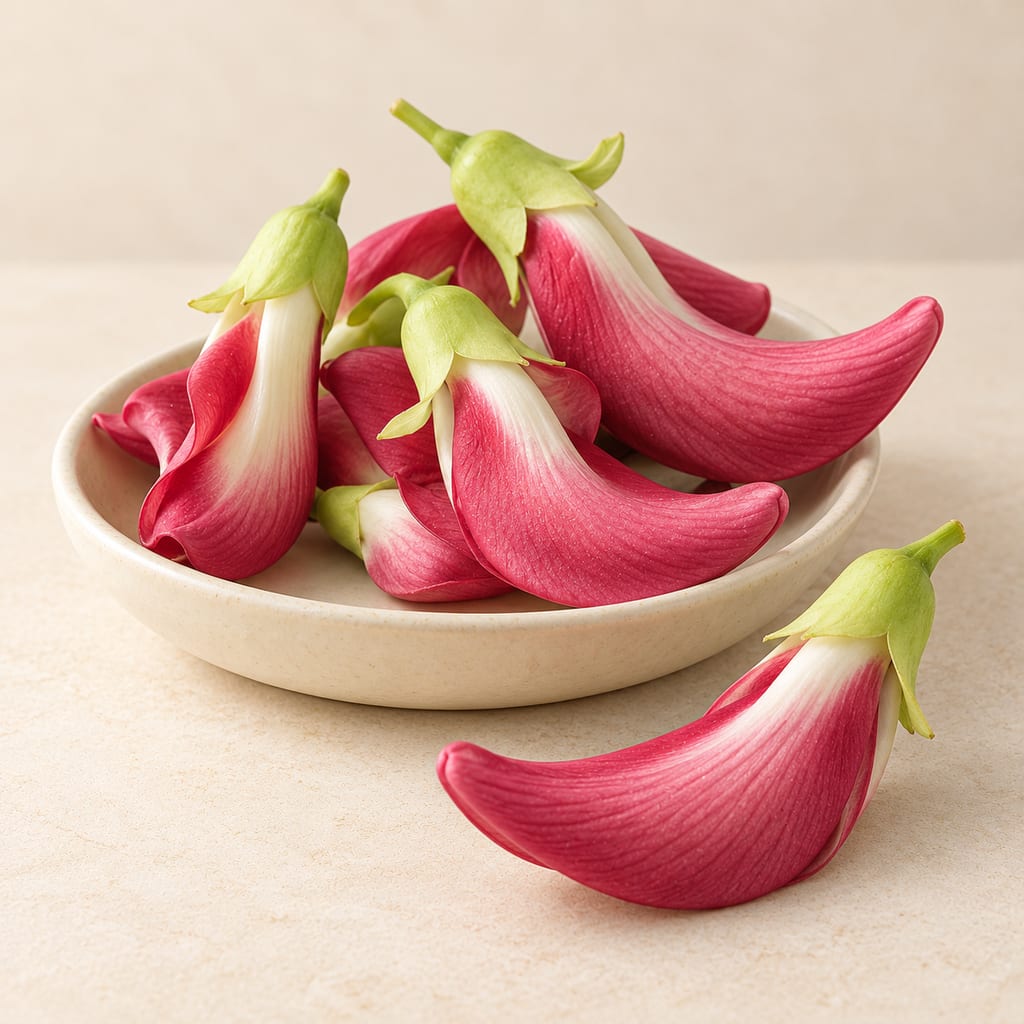
Katuray flowers
A source-linked account of katuray food uses in Philippine crop guides and an abstract-level regional survey, with conflicting field-spacing figures and incomplete household growing evidence.
Names and authorship
Kew accepts Sesbania grandiflora (L.) Poir. The DA and BPI guides use that authorship. A PCAARRD iVeg search excerpt prints (L.) Pers., but its full profile could not be retrieved; this is an excerpt-level citation difference, not evidence for a second plant identity.
The DA and BPI guides map katuray to Tagalog, Ibanag and Pangasinense; diana to Bisaya; katuday to Ilocano and Ibanag; gauai-gauai to Camarines, Capiz and Negros; kature to Pampango; and kambangturi to Sulu. These mappings are reproduced as the guides print them, not independently checked with each language community. BPI describes white, pink and red flower forms without a verified cultivar or accession crosswalk.
Food parts and regional accounts
The DA and BPI crop guides describe fresh flowers, young leaves and green or young pods as food. The BPI guide includes flower salad, bulanglang and adobong katuday as named source batches. These are documented dishes, not reviewed recipes or food-safety approval.
A 2019 abstract in the Transactions of the National Academy of Science and Technology Philippines describes research using community inventories, household and local-market surveys, ocular visits and focus groups across ten provinces. It reports the use of Sesbania grandiflora with Musa species in atsara and kinilaw in Iloilo and Capiz. The abstract does not provide recipe steps or ingredient quantities, so those pairings remain regional food-context reports rather than household methods.
Field growing reports
The BPI guide describes a full-sun tropical tree and gives an elevation range from sea level to 800 m, annual temperature of 24.3–26.7°C and annual precipitation of 4.8–22.5 dm as habitat or climate descriptors. These are not measured Philippine growing thresholds. The guide describes frost sensitivity without a measured temperature limit. It gives planting-hole dimensions of at least 45 cm deep and 30 cm across and says to water new seedlings and established trees frequently during flowering.
The guides describe propagation by seed, seedlings and cuttings, and BPI also mentions aerial sowing. BPI says flowering begins in the second year and seed develops about 40 days after pollination. Planting spacing conflicts within both guides: BPI gives 5 m by 5 m in its planting prose and 1.5 m by 2.0 m in its production table, so no spacing is recommended here.
Sources for this section
Harvest and crop limits
BPI describes picking flowers, buds, young pods or bunches by hand and mentions a special pole-hook for tall trees; it recommends harvesting mature pods promptly. The manual lists crop pests and diseases but does not provide an independently checked household diagnosis or current treatment guidance.
Sources for this section
What remains unresolved
The inspected guides do not give a numeric soil pH, a household edible-container or greenhouse protocol, or a month-by-month Philippine planting calendar. The cited annual climate and elevation figures are guide descriptors rather than tested tolerance limits. No Philippine invasive-status or conservation assessment was checked. The NAST report remains abstract-only, and the PCAARRD profile remains unavailable beyond its search excerpt.
Research gaps
Local-name mappings and flower-colour forms have not been independently verified with communities or matched to accessions or vouchers.
The NAST abstract identifies a ten-province survey and specific Iloilo/Capiz use contexts, but its methods, tables and participant-level scope were not inspected.
The DA and BPI planting prose and production tables conflict on spacing; no spacing figure is selected as a general recommendation.
No numeric soil pH, measured frost threshold, household container method, protected-crop method or month-by-month local calendar was established.
No Philippine invasive-status or conservation assessment was checked. Crop pest notes are not a current household treatment guide.
No dish received separate recipe-contract review or food-safety assessment.
Research status
The underlying plant account received a partial source review. Its review scope is described in the original plant article.
Sources for this section
Places
Unknown
Relationship not established · Place not establishedThe available research does not establish a single origin for this ingredient.
Community
No community contributions have been published for this entry yet.
Share what you made
Sign in to contribute. Published comments and photos are free to read.
Sources
Royal Botanic Gardens, KewIngredient research
Sesbania grandiflora (L.) Poir. | Plants of the World OnlineCited in: Names and authorship; Research gaps
Department of Agriculture, High Value Crops Development Program, PhilippinesIngredient research
Mga Katutubong Gulay ng Pilipinas (Indigenous Vegetables)Cited in: Names and authorship; Food parts and regional accounts; Field growing reports; What remains unresolved; Research gaps
Bureau of Plant Industry, Department of Agriculture, PhilippinesIngredient research
Katuray Production GuideCited in: Names and authorship; Food parts and regional accounts; Field growing reports; Harvest and crop limits; What remains unresolved; Research gaps
National Academy of Science and Technology PhilippinesIngredient research
Unfolding Indigenous Flower Vegetables in the PhilippinesCited in: Food parts and regional accounts; What remains unresolved; Research gaps
DOST-PCAARRD, iVegIngredient research
Katuray (Sesbania grandiflora)Cited in: Names and authorship; What remains unresolved; Research gaps
FermenteaResearch provenance
Katuray and vegetable hummingbird (Sesbania grandiflora): original plant researchCited in: Research status