
Substrates
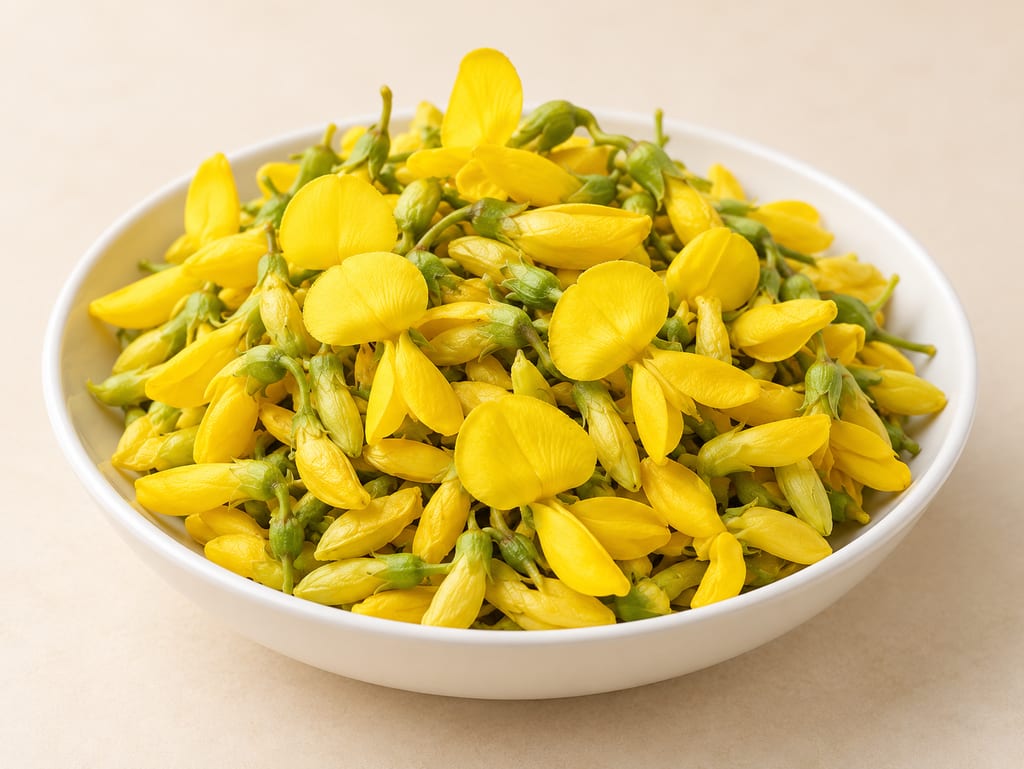
Snaô flowers
Cambodian accounts describe Sesbania javanica flowers as food, with separate reports of leaves. PROSEA records wetland habitat; a 2003 home-gardening handbook preserves a historical sowing row whose continuation cells cannot be reliably assigned.
Name and taxonomic scope
Kew accepts Sesbania javanica Miq. in Fabaceae and lists Cambodia in its broad native range. It records Sesbania triflora Span. as a nomen nudum. Sesbania grandiflora is a separate accepted species and is not treated here as the same food plant.
PROSEA records the Cambodian name snaô. Pascal Médeville's Cambodian food article gives the Khmer spelling ស្នោ and an approximate phonetic form, snao. A 2003 gardening handbook prints “Snor” in a table's variety field. The sources do not establish that these forms identify one cultivar, community label or voucher-backed plant.
Cambodian food accounts
PROSEA reports that flowers are prepared with sugar or salt and eaten in Cambodia. Médeville describes the flowers as an anluk accompaniment and as fritters; the article also mentions flowers preserved in vinegar. It describes a blanched-flower omelette with beaten egg and fish sauce. The account gives no measured quantities, complete sequence, cooking endpoint or storage conditions, so it is a record of food context rather than a reproducible method.
The same article says young leaves may be included in the diet during scarcity and are otherwise used as livestock fodder. PROSEA also lists leaves as forage and as a vegetable. These reports distinguish plant parts and contexts; they do not establish a standardized leaf preparation.
Sources for this section
A historical garden-table entry
Helen Keller International/Cambodia's 2003 home-gardening handbook has a row for Sesbania javanica under edible leaves and flowers. The row gives June–July sowing, direct sowing, a seed rate of 70 grams per 100 square metres, sowing depth of 2–3 centimetres, germination in 4–8 days, and spacing of 60 centimetres between lines and 40 centimetres between plants. The variety/name column reads “Snor.” These are entries in a historical Cambodian extension handbook, not results from a replicated trial or a current recommendation.
Text following the row is flattened across several table entries in the available mirror. It includes statements about keeping soil moist until germination, pruning intervals, crop duration and water demand, but the cells cannot be securely linked to S. javanica. Those continuation values are therefore left unassigned.
Habitat and limits of growing evidence
PROSEA describes S. javanica in permanent swamps or along watercourses, up to 500 metres altitude. This is a habitat account, not a tested Cambodian garden water depth or climate limit. The handbook row supplies historical outdoor sowing details but no container dimensions, greenhouse conditions, measured yield, pest guidance, soil class or pH.
A 2019 review cites Marie Alexandrine Martin's 1971 ethnobotany book for a Cambodia-labelled flower and donut account. The original book page was not accessible, so that historical reference remains secondary rather than a directly checked passage.
Unresolved food and preservation details
The vinegar reference is incomplete: none of the inspected accounts supplies a batch size, ingredient proportions, sequence, acidity, storage temperature or endpoint. The omelette account likewise omits amounts and timing. No pickling or storage procedure can be derived from these descriptions.
Sources for this section
Research gaps
The phonetic Khmer forms, the handbook's “Snor” field and the PROSEA name are not linked to a named community, cultivar accession or voucher.
The continuation text after the handbook's S. javanica row has ambiguous flattened table alignment; pruning, duration and water-demand statements remain unassigned.
The official HKI PDF returned 403; the readable text came from a mirror, and the row's page image was not independently inspected.
Martin 1971's original page was inaccessible; its flower-and-donut account is cited by a later review only.
No complete flower recipe, vinegar-preservation controls or storage endpoint was verified.
No modern Cambodian yield trial, soil or pH guidance, crop-temperature range, container method or greenhouse protocol was verified.
Sources for this section
Research status
The underlying plant account received a partial source review. Its review scope is described in the original plant article.
Sources for this section
Places
Unknown
Relationship not established · Place not establishedThe available research does not establish a single origin for this ingredient.
Community
No community contributions have been published for this entry yet.
Share what you made
Sign in to contribute. Published comments and photos are free to read.
Sources
Royal Botanic Gardens, KewIngredient research
Sesbania javanica Miq. | Plants of the World OnlineCited in: Name and taxonomic scope; Research gaps
PROSEA FoundationIngredient research
Sesbania javanica MiquelCited in: Name and taxonomic scope; Cambodian food accounts; Habitat and limits of growing evidence; Research gaps
Helen Keller International/Cambodia; Helen Keller WorldwideIngredient research
Handbook for Home Gardening in Cambodia: The Complete Manual for Vegetable and Fruit ProductionCited in: Name and taxonomic scope; A historical garden-table entry; Habitat and limits of growing evidence; Research gaps
Thalias HospitalityIngredient research
Product: Edible flowers of Cambodian gastronomyCited in: Name and taxonomic scope; Cambodian food accounts; Unresolved food and preservation details; Research gaps
The Botanical ReviewIngredient research
A Review of the Economic Botany of Sesbania (Leguminosae)Cited in: Habitat and limits of growing evidence; Research gaps
FermenteaResearch provenance
Snaô flowers and a historical Cambodian garden entry: original plant researchCited in: Research status