
Substrates
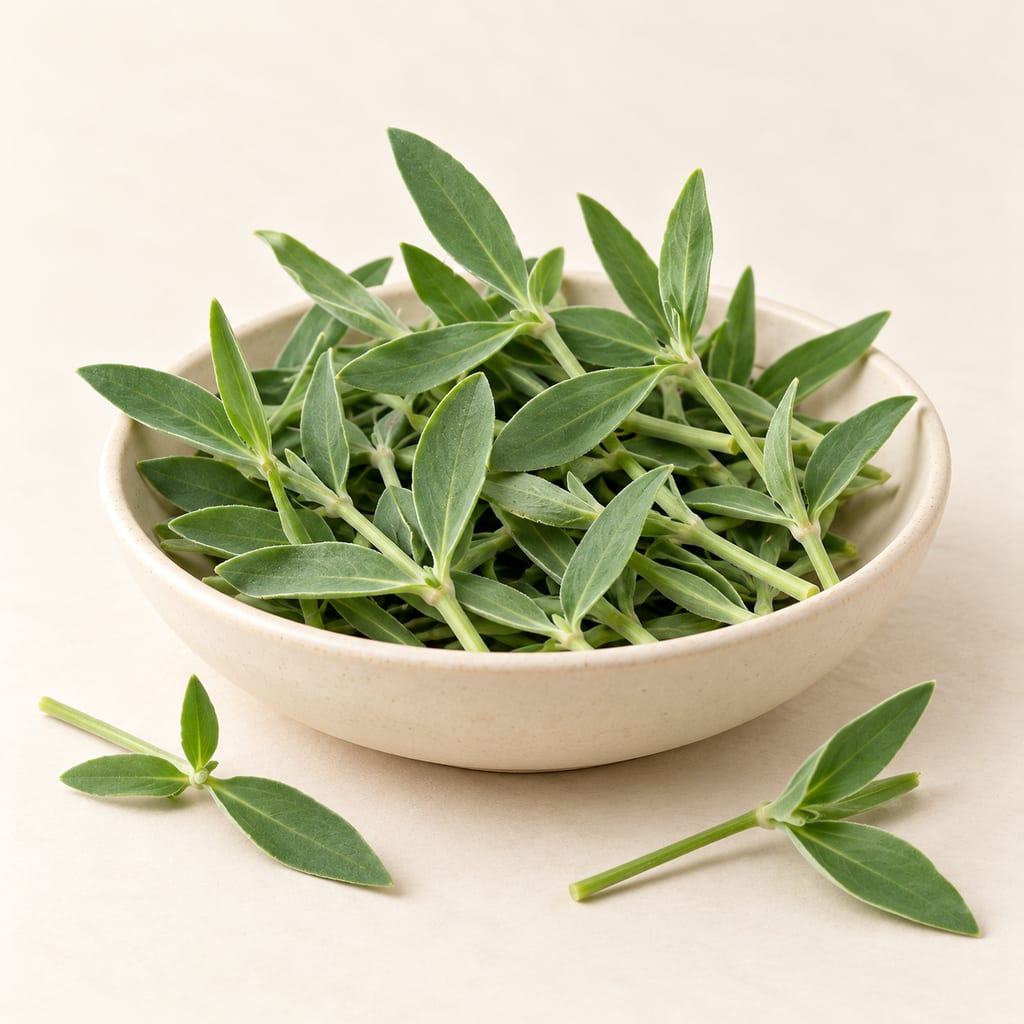
Bladder campion greens
Spanish sources report young leaves and stems in cooked dishes and some salads. A Murcia field study measured one regional seed lot under fertiliser treatments, but its dates conflict and do not establish home-growing or food-safety guidance.
Name and scope
Kew accepts Silene vulgaris (Moench) Garcke in Caryophyllaceae and lists accepted infraspecific taxa. The Spanish food sources and the Murcia seed lot do not identify a subspecies or cultivar. MITECO records names including colleja and collejas, but says some local accounts also use colleja for other wild leafy plants. A common name alone does not identify a specimen.
Food reports
MITECO reports young leaves and stems collected before flowering, with local and yearly timing that varies across autumn and spring, especially from February to April. It describes cooked uses including tortilla or scrambled-egg dishes, chickpea stew, rice, potato dishes, croquettes and dough preparations, along with some salad accounts. These descriptions are regional food records, not a single recipe.
A Madrid province study interviewed 132 people in 60 villages during 1999–2002. Its Table 1 lists voucher 86JT under collejas and conejuelas: leaves and young stems were reported in stews (70 citations) and salads (3). Those counts belong to the study’s purposive Madrid sample, not Spain-wide prevalence.
Cultivation evidence
A Murcia field study used a seed collection described only as coming from the region; it gives no accession, voucher or cultivar. Seed was sown in trays on 8 September 2003, and approximately one-month-old seedlings were transplanted on 6 October. The nursery used a shade structure; this was not a productive greenhouse treatment. The field experiment used drip irrigation and one-square-metre plots on clay-loam soil of medium fertility at Finca Experimental Tomás Ferro. The authors describe the site as Mediterranean with hot, practically dry summers. These are conditions at one experimental site, not tolerance limits or a home garden specification.
The study compared six fertilised treatments, T1–T6, with a seventh no-fertiliser control, T7. It reports T3 as highest in fresh biomass at the first cut and T4 at cuts two and three and cumulatively. Those rankings describe that site and seed lot. A 2000 SEAE conference paper separately reports preliminary collection and cultivation work on Spanish populations; it discusses autumn sowing as a possible way to obtain earlier production, but does not identify the accession used in each test.
MITECO says small-scale huerto cultivation is known and cites two earlier references. The entry gives no method details, so this remains a compiled report rather than a growing protocol.
Sources for this section
- Silene vulgaris (Moench) Garcke, entry in the Spanish Traditional Knowledge Inventory →
- Fertilización estratégica para producción de Silene vulgaris (Caryophyllaceae), una especie silvestre con alto potencial de uso alimentario →
- Adaptación al cultivo de dos especies silvestres comestibles de uso tradicional (Silene vulgaris y Scolymus hispanicus). Recolección, caracterización y evaluación agronómica →
Harvest timing conflict
The Murcia paper’s abstract labels the cuts C1, C3 and C3 and reports 55, 110 and 170 days after transplant. Its methods and results tables identify cuts 1, 2 and 3 and give dates of 30 November 2003, 30 January 2004 and 31 March 2004 after transplant on 6 October. The latter two dates are 116 and 177 elapsed days. The discrepancy is unresolved, so both accounts remain visible. The reported nitrate measurements do not validate a household food-safety endpoint.
Limits of food and growing reports
The MITECO and Madrid sources do not provide complete ingredient quantities, yields, ordered preparation, cooking endpoints or storage conditions. Some raw salad use is reported, but these accounts do not establish safe raw use or specimen identification.
No named hardiness scheme, frost threshold, pH range, mature-container result, greenhouse comparison, or pest-control method was found in these Spanish sources. Nursery trays and shade are not evidence for mature container or greenhouse production.
Sources for this section
- Silene vulgaris (Moench) Garcke, entry in the Spanish Traditional Knowledge Inventory →
- Wild Food Plants Traditionally Used in the Province of Madrid, Central Spain →
- Fertilización estratégica para producción de Silene vulgaris (Caryophyllaceae), una especie silvestre con alto potencial de uso alimentario →
What remains open
The seed lot’s identity below species level, the MITECO cultivation references, and crop response beyond the single Murcia site remain unresolved. A complete source-batched food method and its storage evidence are also absent.
Sources for this section
- Silene vulgaris (Moench) Garcke | Plants of the World Online →
- Silene vulgaris (Moench) Garcke, entry in the Spanish Traditional Knowledge Inventory →
- Fertilización estratégica para producción de Silene vulgaris (Caryophyllaceae), una especie silvestre con alto potencial de uso alimentario →
- Adaptación al cultivo de dos especies silvestres comestibles de uso tradicional (Silene vulgaris y Scolymus hispanicus). Recolección, caracterización y evaluación agronómica →
Research gaps
The MAPA seed lot has no accession, voucher or named cultivar, and the food records are not assigned to an infraspecific taxon.
The MAPA abstract and methods disagree on two cut intervals; no correction is inferred.
The MITECO small-garden statement cites references 44 and 48 without enough detail in the entry to reproduce a cultivation method.
No complete recipe batch, cooking endpoint, food storage limit or validated raw-use method was established.
No named hardiness scheme, measured frost or heat tolerance, pH range, mature container setup, greenhouse crop, or pest-control result was found.
Sources for this section
- Silene vulgaris (Moench) Garcke | Plants of the World Online →
- Silene vulgaris (Moench) Garcke, entry in the Spanish Traditional Knowledge Inventory →
- Wild Food Plants Traditionally Used in the Province of Madrid, Central Spain →
- Fertilización estratégica para producción de Silene vulgaris (Caryophyllaceae), una especie silvestre con alto potencial de uso alimentario →
- Adaptación al cultivo de dos especies silvestres comestibles de uso tradicional (Silene vulgaris y Scolymus hispanicus). Recolección, caracterización y evaluación agronómica →
Research status
The underlying plant account received a partial source review. Its review scope is described in the original plant article.
Sources for this section
Places
Unknown
Relationship not established · Place not establishedThe available research does not establish a single origin for this ingredient.
Community
No community contributions have been published for this entry yet.
Share what you made
Sign in to contribute. Published comments and photos are free to read.
Sources
Royal Botanic Gardens, KewIngredient research
Silene vulgaris (Moench) Garcke | Plants of the World OnlineCited in: Name and scope; What remains open; Research gaps
MITECO, Inventario Español de los Conocimientos Tradicionales relativos a la BiodiversidadIngredient research
Silene vulgaris (Moench) Garcke, entry in the Spanish Traditional Knowledge InventoryCited in: Name and scope; Food reports; Cultivation evidence; Limits of food and growing reports; What remains open; Research gaps
Economic Botany, vol. 59 no. 2 (2005), pp. 122–136Ingredient research
Wild Food Plants Traditionally Used in the Province of Madrid, Central SpainCited in: Food reports; Limits of food and growing reports; Research gaps
Seminario de Especialistas en Horticultura, Murcia 2004; ISBN 84-491-0657-7, pp. 519–529Ingredient research
Fertilización estratégica para producción de Silene vulgaris (Caryophyllaceae), una especie silvestre con alto potencial de uso alimentarioCited in: Cultivation evidence; Harvest timing conflict; Limits of food and growing reports; What remains open; Research gaps
IV Congreso de la Sociedad Española de Agricultura Ecológica, Córdoba, September 2000; author-uploaded full text on ResearchGateIngredient research
Adaptación al cultivo de dos especies silvestres comestibles de uso tradicional (Silene vulgaris y Scolymus hispanicus). Recolección, caracterización y evaluación agronómicaCited in: Cultivation evidence; What remains open; Research gaps
FermenteaResearch provenance
Silene vulgaris in Spanish food and cultivation records: original plant researchCited in: Research status