
Substrates
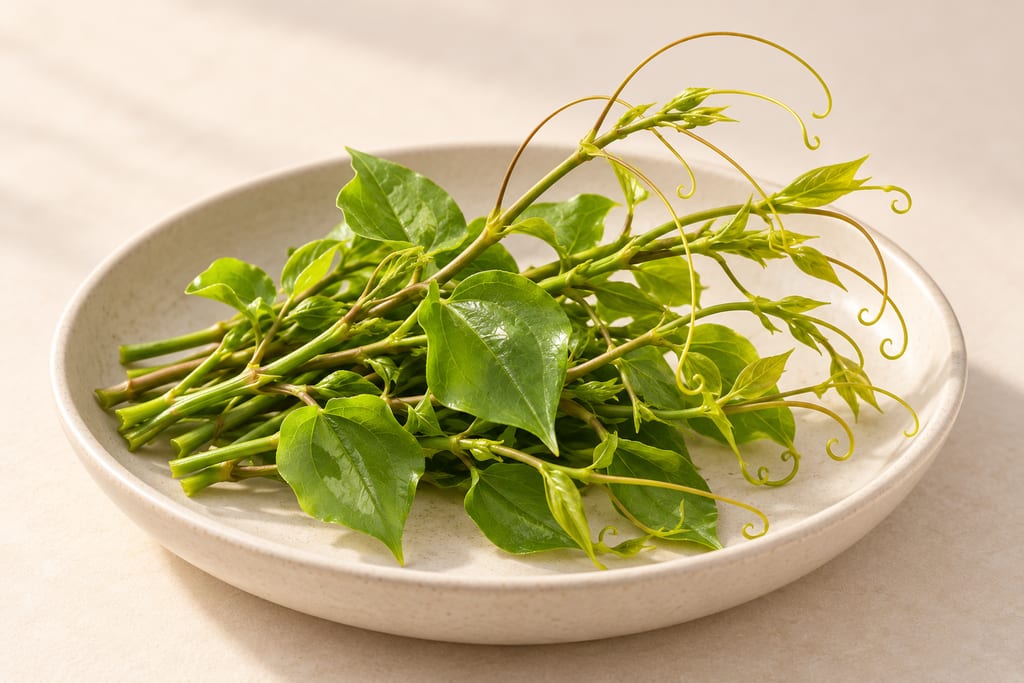
Ekala shoots
Georgian sources describe ekala as a wild food plant used in pkhali and report brine preparations. Names and plant-part labels vary by source; the food accounts do not establish a field identification or a productive growing method.
Name and taxon
Kew accepts Smilax excelsa L. in Smilacaceae and records Transcaucasia within its native range. The Georgian Academy encyclopedia identifies ekalghichi as S. excelsa but describes it in the lily family. These are different family placements in the sources; this account follows Kew for current taxonomy. Georgia Travel uses ekala and ekalghichi and reports dzigiri as a Megrelian name. The 2021 study records additional community-coded names, some of which the authors say are shared or under-differentiated. A name alone does not identify an individual plant.
Regional food records
Georgia Travel says ekala is used mainly in western Georgian cooking and lists names associated with several regions. The FAO atlas describes the product profile as Imereti and “nationwide”; that label is not a survey showing the same use in every region. A study based on spring 2018 fieldwork interviewed 136 people across seven ethnolinguistic groups in 14 northeast Georgian villages. A separate 2016 inventory reports a Svaneti and Racha-Lechkhumi context, while its title and methods use different geographic wording. These accounts retain their own locations and methods.
Sources for this section
Food parts and dishes
The sources do not use one uniform plant-part label. Georgia Travel describes newly emerged young stems; the Georgian Academy says young shoots; the 2021 table says “stems”; and the 2016 table prints “Branches.” The 2021 interview table reports stems boiled for mkhali and used in a brine-fermented food category. The 2016 inventory lists a food/Phkhali use. These are reported food practices, not a specimen crosswalk or permission to gather wild plants.
Recipe and preservation reports
Georgia Travel publishes a source-specific pkhali recipe with quantities and a preparation sequence; this article records that the account exists without reproducing its instructions. The same page separately describes jar storage and pickling, and the FAO atlas says households preserve ekala for year-round use. Those descriptions do not provide validated preservation controls or a verified storage endpoint. The interview table’s brine report is also descriptive, not a tested process.
Habitat and growing evidence
The Georgian Academy describes the climber in lowland and floodplain forests and sometimes tea plantations. The FAO profile also reports wild occurrence in gardens, fields, mountains and riverbanks, with collection after snowmelt and use into early summer. Georgia Travel gives a traditional April–May collection window before shoots harden. These are habitat and food-season accounts, not crop requirements. The reviewed sources do not establish a productive outdoor trial, propagation method, yield, pot culture or greenhouse system.
Sources for this section
Open questions
Food-use vouchers and a locality-by-locality match between vernacular names and specimens remain unresolved. The source set supplies no measured crop climate, frost response, soil or water requirements, container method, protected-crop protocol, or harvest-regrowth data. It also does not validate a preserved-food process. The linked CENN field guide could not be retrieved in the earlier source pass, so its indexed excerpt is not used here.
Research gaps
No voucher-level crosswalk connects all reported names and food uses to identified Georgian specimens.
No productive Georgian cultivation trial, yield, propagation, container or greenhouse protocol was established in the reviewed source set.
The reported pkhali recipe is not reproduced here; the jar-storage and brine reports do not establish validated preservation controls or a storage endpoint.
The CENN field-guide PDF retrieval failed; its indexed lead was not used as evidence.
Sources for this section
- Smilax excelsa L. | Plants of the World Online →
- ეკალღიჭი (Ekalghichi) →
- ეკალა (Ekala) →
- The Inextricable Link Between Food and Linguistic Diversity: Wild Food Plants among Diverse Minorities in Northeast Georgia, Caucasus →
- Medicinal and Food Plants of Svaneti and Lechkhumi, Sakartvelo (Republic of Georgia), Caucasus →
- Atlas of Origin Linked Food Products in Georgia →
Research status
The underlying plant account received a partial source review. Its review scope is described in the original plant article.
Sources for this section
Places
Unknown
Relationship not established · Place not establishedThe available research does not establish a single origin for this ingredient.
Community
No community contributions have been published for this entry yet.
Share what you made
Sign in to contribute. Published comments and photos are free to read.
Sources
Royal Botanic Gardens, Kew, Plants of the World OnlineIngredient research
Smilax excelsa L. | Plants of the World OnlineCited in: Name and taxon; Open questions; Research gaps
Georgian National Academy of Sciences, Georgian EncyclopediaIngredient research
ეკალღიჭი (Ekalghichi)Cited in: Name and taxon; Food parts and dishes; Habitat and growing evidence; Open questions; Research gaps
Georgian National Tourism Administration, Georgia TravelIngredient research
ეკალა (Ekala)Cited in: Name and taxon; Regional food records; Food parts and dishes; Recipe and preservation reports; Habitat and growing evidence; Research gaps
Pieroni, Sõukand and Bussmann, Economic Botany 74 (2020), Springer NatureIngredient research
The Inextricable Link Between Food and Linguistic Diversity: Wild Food Plants among Diverse Minorities in Northeast Georgia, CaucasusCited in: Name and taxon; Regional food records; Food parts and dishes; Recipe and preservation reports; Research gaps
Bussmann et al., Medicinal & Aromatic Plants 5(5), article 1000266 (2016)Ingredient research
Medicinal and Food Plants of Svaneti and Lechkhumi, Sakartvelo (Republic of Georgia), CaucasusCited in: Regional food records; Food parts and dishes; Research gaps
Food and Agriculture Organization of the United Nations, Rome (2019)Ingredient research
Atlas of Origin Linked Food Products in GeorgiaCited in: Regional food records; Recipe and preservation reports; Habitat and growing evidence; Open questions; Research gaps
FermenteaResearch provenance
Ekala in Georgian food accounts: Smilax excelsa: original plant researchCited in: Research status