
Substrates
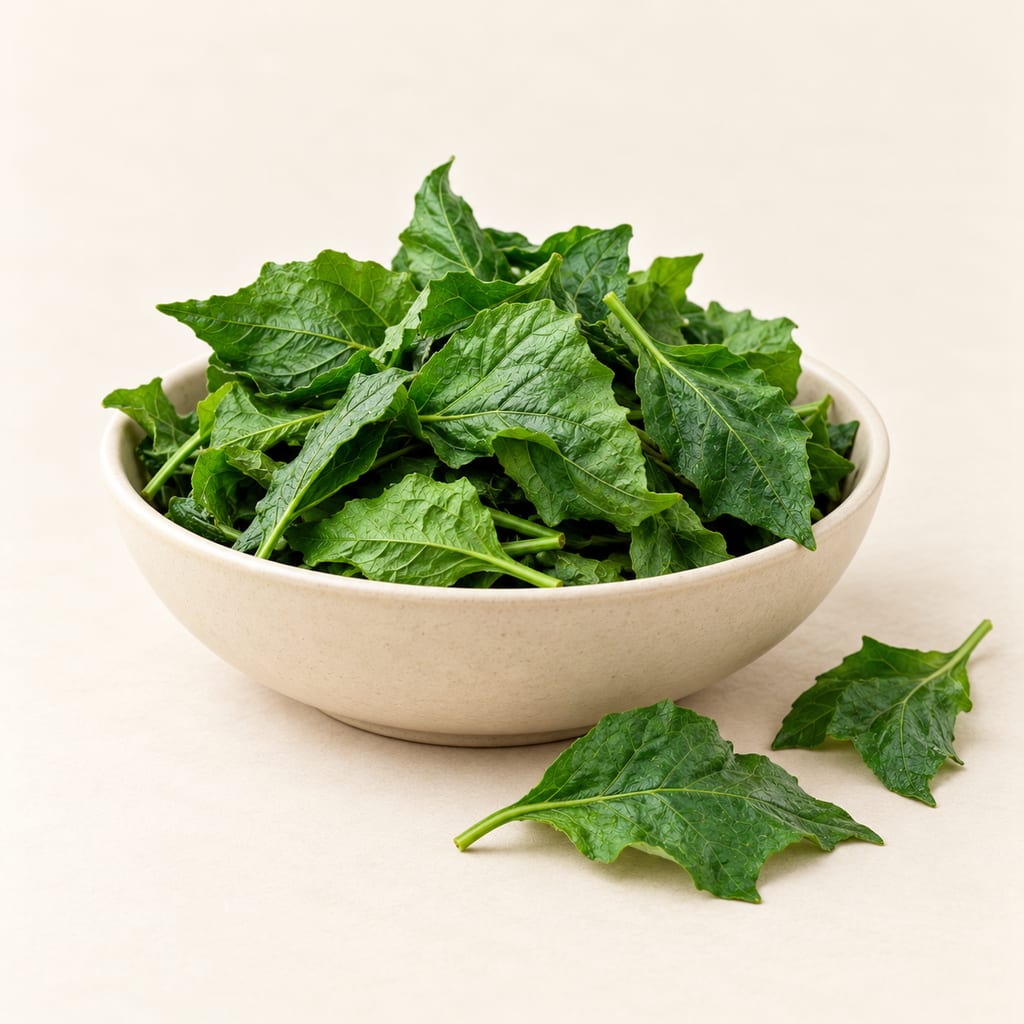
Nakati greens
Ugandan Nakati sources describe the leafy Shum group of a species that also includes fruit, dual-use and ornamental groups. Regional cultivation and a small pickling study offer context, but neither establishes universal crop limits or a validated home preservation method.
Species, groups and local naming
Kew accepts Solanum aethiopicum L. as a species. A Ugandan study distinguishes the Gilo group for fruit, Shum for leaves, Kumba for both fruit and leaves, and Aculeatum as ornamental; it records Nakati as the local name used for Shum in that setting. “Nakati” therefore does not identify every cultivar or food part within the species. The NARO repository record also pairs Nakati with S. aethiopicum.
The available evidence supports a contemporary Ugandan food and production context, not a complete account of the species’ origin or movement.
Food use and a small pickling study
The Ugandan Shum study describes leaves served with staple foods and reports a bitter flavour preferred in Buganda sauce with matoke. It also records a ceremonial association; the participatory study did not provide a standardized dish recipe. Its observations concern Shum/Nakati and should not be transferred to Gilo fruit or ornamental selections.
A 2023 study examined market leaves identified as Nakati in four salt and brine treatments. The paper reports washed, stem-separated and cut leaves in loosely closed jars with submerging weights, fermented for 14 days at room temperature. Its methods and figures describe the selected dry-salt treatment as 3% salt plus 2% sugar, while one results passage says 3% sugar. The paper also reports stability through three weeks in its abstract, methods and results, but its conclusion says three months were evaluated. Percentage basis and raw leaf mass are not stated. A 30-person untrained panel at Makerere scored fresh Nakati higher; the authors report 70% preferred fresh over pickled in that sample. These findings do not supply a household recipe or validated preservation endpoint.
Growing evidence and its limits
A Central Uganda labour study describes its study area using prior climate estimates of about 1,200–1,300 mm annual rainfall, average maximum/minimum temperatures around 27/17°C and 72–93% relative humidity. A separate Shum study reports two rainfall peaks and trial sowing in August at Wakiso and Luwero and November at Mukono. These describe study locations and trial timing, not plant tolerance limits or a national planting calendar.
NARO’s guide is specifically for seed production. It recommends an open, sunny field, well-drained loam, well-decomposed farmyard manure, and drainage channels in low-lying areas; sowing is described at rain onset or year-round where irrigation is available. It gives seed-crop spacing of 45 cm between rows and 30 cm between plants, a 1 cm furrow, and 100 m isolation from related Solanum crops or non-overlapping flowering for seed purity. It says seed harvest begins at 17–20 weeks. Those values are seed-production context, not leafy-harvest spacing, a home-garden isolation rule or a validated leaf-production schedule. The sources provide no frost scheme, temperature threshold, pH range, household container dimensions or greenhouse production method.
Known gaps
The inspected materials do not establish a complete household recipe, a repeatable leaf-harvest interval, post-harvest storage duration, or a food-safety endpoint for pickled Nakati. The pickling paper’s inconsistent sugar and storage statements remain unresolved; no pathogen challenge is reported. NARO’s detailed agronomy is for seed production, while the field-study climate figures are not controlled crop-response measurements. The material also does not identify a particular accession or determine whether advice for one Shum type applies to every Nakati sold or grown.
Sources for this section
- Nakati (Solanum aethiopicum): Seed Production Guide →
- Nakati (Solanum aethiopicum): Seed Production Guide →
- Farmer preferred traits and genotype choices in Solanum aethiopicum L., Shum group →
- Division of labour in nakati (Solanum aethiopicum) production in central Uganda →
- Pickling as a Preservation Technique for Solanum aethiopicum; An Edible Green Leafy Vegetable →
Research gaps
The Akoth et al. study has unresolved internal reporting conflicts: 2% versus 3% dry sugar and three weeks versus three months; it reports no pathogen challenge or validated home endpoint.
NARO spacing, sowing depth, isolation and 17–20-week timing concern seed production, not validated household leafy production.
The climate, rainfall and sowing dates are regional study context, not species tolerance thresholds or a national calendar.
No verified complete household dish recipe, leaf-storage life, pH range, frost/heat threshold, productive container scale or greenhouse protocol was established.
Sources for this section
- Solanum aethiopicum L. | Plants of the World Online →
- Nakati (Solanum aethiopicum): Seed Production Guide →
- Nakati (Solanum aethiopicum): Seed Production Guide →
- Farmer preferred traits and genotype choices in Solanum aethiopicum L., Shum group →
- Division of labour in nakati (Solanum aethiopicum) production in central Uganda →
- Pickling as a Preservation Technique for Solanum aethiopicum; An Edible Green Leafy Vegetable →
Research status
The underlying plant account received a partial source review. Its review scope is described in the original plant article.
Sources for this section
Places
Unknown
Relationship not established · Place not establishedThe available research does not establish a single origin for this ingredient.
Community
No community contributions have been published for this entry yet.
Share what you made
Sign in to contribute. Published comments and photos are free to read.
Sources
Royal Botanic Gardens, KewIngredient research
Solanum aethiopicum L. | Plants of the World OnlineCited in: Species, groups and local naming; Research gaps
National Agricultural Research Organisation (NARO) Information HubIngredient research
Nakati (Solanum aethiopicum): Seed Production GuideCited in: Species, groups and local naming; Growing evidence and its limits; Known gaps; Research gaps
National Agricultural Research Organisation / National Forestry Resources Research InstituteIngredient research
Nakati (Solanum aethiopicum): Seed Production GuideCited in: Growing evidence and its limits; Known gaps; Research gaps
Journal of Ethnobiology and Ethnomedicine / Springer NatureIngredient research
Farmer preferred traits and genotype choices in Solanum aethiopicum L., Shum groupCited in: Species, groups and local naming; Food use and a small pickling study; Growing evidence and its limits; Known gaps; Research gaps
African Journal of Agricultural ResearchIngredient research
Division of labour in nakati (Solanum aethiopicum) production in central UgandaCited in: Growing evidence and its limits; Known gaps; Research gaps
Journal of Advances in Food Science & Technology / I.K. PressIngredient research
Pickling as a Preservation Technique for Solanum aethiopicum; An Edible Green Leafy VegetableCited in: Food use and a small pickling study; Known gaps; Research gaps
FermenteaResearch provenance
Nakati and African eggplant (Solanum aethiopicum): original plant researchCited in: Research status