
Substrates
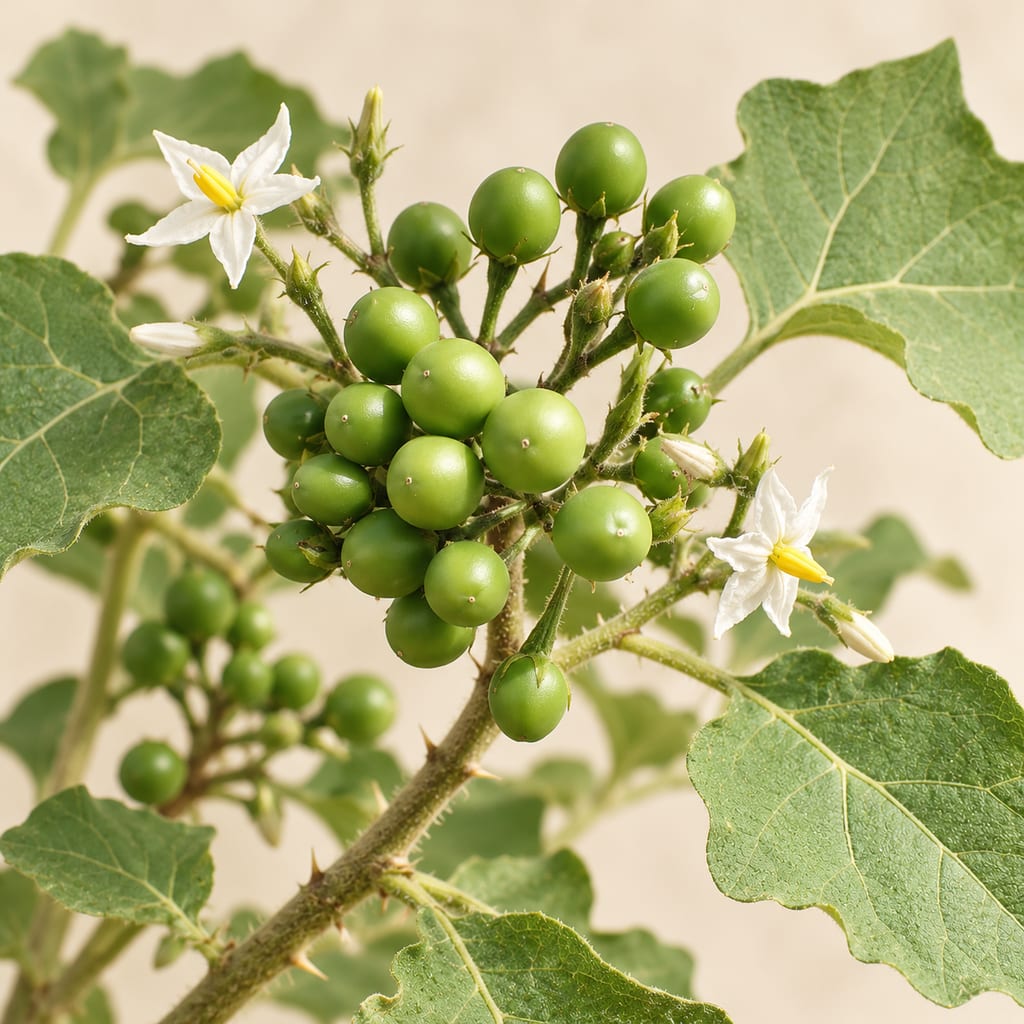
Solanum torvum fruit and leaves
An East Akim survey reports fruit and leaf use in soups and stews; a separate Cape Coast experiment grew a selected seed accession. External poisoning reports do not establish Ghanaian incidence or a safe preparation method.
Accepted name and scope
Kew accepts Solanum torvum Sw. in Solanaceae and lists its native range in tropical America, with Ghana in its introduced range. The broad wet-tropical biome label on Kew’s profile is not a growing threshold. A common name or photograph does not determine a particular specimen or its berry toxin level.
Sources for this section
East Akim food-use survey
Asiedu-Darko’s paper reports interviews conducted in 2007 in twenty randomly selected East Akim communities. All 332 respondents said they consumed S. torvum. Its table records fruit use for 52%, leaf use for 29%, and use of both for 19%. Respondents described stews and soups, including palm-fruit soup. These are local reports, not a measured recipe batch. The paper’s introduction, citing PROTA, repeats a broader account that the plant is grown as a home-garden crop in West and Central Africa; this broad literature statement is distinct from the East Akim survey results. In the survey, respondents said the plant was not cultivated and grew wild, while the authors observed it growing around almost all homes visited. These statements have different source scopes and do not establish that the species is never cultivated.
Names reported with communities
The 2010 paper associates “abedru” or “bedru” with Akyems, “kantose” with Kwahus, and “kwahu nsusua” with Ashantis. It does not map each word to a named language, and a shared name does not identify a specimen. The paper’s introduction says fruit is eaten raw or cooked and used in soups or sauces; it does not give quantities, ordered steps, cooking endpoints or storage. That general description is attributed to the article, which cites PROTA, rather than presented as a complete household method.
A separate Cape Coast field experiment
A University of Cape Coast experiment ran from February to December 2017, using a farmer-field or backyard accession selected because one plant supplied sufficient seed. Seedlings were kept in a nursery for about five weeks and transplanted in March. The trial’s outdoor design and observations belong to this site and year; they are not an East Akim garden schedule or evidence for every local plant.
What the growing study reports
At the Cape Coast site, the soil was a haplic acrisol sandy loam at pH 6.1, and the reported day length was about 11.30 to 12.40 hours. Researchers report preliminary poor germination for S. torvum and say they treated seeds with 500 ppm gibberellic acid overnight before sowing. The field trial used two randomized blocks and 1.2 by 1.2 m plant spacing. Those are study methods, not household instructions. Fruit harvest began when about half the fruits reached the authors’ maturity stage and continued for five to eight weeks, with weekly sampling of six central plants per plot. The paper says no major pests or diseases were encountered, but this one trial does not show general pest resistance. It gives no container or greenhouse method. The paper calls the trial rain-fed while also reporting about 50 mm of daily nursery watering and field irrigation of about 400 mm every 10 days without rain. The reporting remains unresolved and must not be used as a watering schedule.
Cooking assay and poisoning reports
The Cape Coast paper boiled fruit samples for 10 minutes in 100 mL of tap water in Pyrex flasks to measure potassium retention. It did not test toxins or pathogens and is not a recipe or safety validation. The CDC Yellow Book lists S. torvum susumber berries in a poisoning table and states that berry toxin amount cannot be reliably predicted and a safe preparation method is not known. Smith et al.’s abstract describes two poisoning outbreaks involving Jamaican-origin berries in New York and Toronto and reports that toxic berries appeared indistinguishable from non-toxic ones. These sources provide no Ghanaian case rate, safe serving amount or visual test.
Sources for this section
Limits of the available evidence
The available food accounts do not define a complete batch method, safe preparation endpoint or storage duration. The East Akim survey did not provide independently examined vouchers or map its community names to languages. The Cape Coast experiment is one site and seed accession, not a household growing guide; no named hardiness scheme, frost or heat tolerance, container scale or protected-crop method was established. The full Smith et al. article was not available for this review.
Sources for this section
- A survey of indigenous knowledge about food and medicinal properties of Solanum torvum in East Akim District of Eastern Region of Ghana →
- Agronomic biofortification of selected underutilised solanaceae vegetables for improved dietary intake of potassium (K) in Ghana →
- Solanaceous steroidal glycoalkaloids and poisoning by Solanum torvum, the normally edible susumber berry →
Research gaps
No voucher-backed identification of the East Akim food plants or language-by-name mapping was established.
The 2007 survey, a broad home-garden account cited second-hand in its introduction, and the 2017 experimental field crop have different scopes; they do not provide a national cultivation picture.
No complete source-batched recipe, validated safety endpoint, toxin-prediction method or Ghanaian poisoning-incidence estimate was established.
No species-wide climate limits, frost/heat tolerance, household container or greenhouse protocol was found in the reviewed sources. The full Smith et al. paper remains unavailable.
The broad West and Central African home-garden statement is cited by the 2010 paper to PROTA; that book was not separately inspected.
Sources for this section
- Solanum torvum Sw. | Plants of the World Online →
- A survey of indigenous knowledge about food and medicinal properties of Solanum torvum in East Akim District of Eastern Region of Ghana →
- Agronomic biofortification of selected underutilised solanaceae vegetables for improved dietary intake of potassium (K) in Ghana →
- Poisonings, Envenomations, and Toxic Exposures During Travel →
- Solanaceous steroidal glycoalkaloids and poisoning by Solanum torvum, the normally edible susumber berry →
Research status
The underlying plant account received a partial source review. Its review scope is described in the original plant article.
Sources for this section
Places
Unknown
Relationship not established · Place not establishedThe available research does not establish a single origin for this ingredient.
Community
No community contributions have been published for this entry yet.
Share what you made
Sign in to contribute. Published comments and photos are free to read.
Sources
Royal Botanic Gardens, KewIngredient research
Solanum torvum Sw. | Plants of the World OnlineCited in: Accepted name and scope; Research gaps
Ghana Journal of Agricultural Science 43(1):61–64 (2010); CSIR-Plant Genetic Resources Research Institute copyIngredient research
A survey of indigenous knowledge about food and medicinal properties of Solanum torvum in East Akim District of Eastern Region of GhanaCited in: East Akim food-use survey; Names reported with communities; Limits of the available evidence; Research gaps
Heliyon 4(8):e00750 (2018), DOI 10.1016/j.heliyon.2018.e00750Ingredient research
Agronomic biofortification of selected underutilised solanaceae vegetables for improved dietary intake of potassium (K) in GhanaCited in: A separate Cape Coast field experiment; What the growing study reports; Cooking assay and poisoning reports; Limits of the available evidence; Research gaps
CDC Yellow Book 2026; chapter dated April 23, 2025Ingredient research
Poisonings, Envenomations, and Toxic Exposures During TravelCited in: Cooking assay and poisoning reports; Research gaps
Toxicon 52(6):667–676 (2008), DOI 10.1016/j.toxicon.2008.07.016; PubMed abstractIngredient research
Solanaceous steroidal glycoalkaloids and poisoning by Solanum torvum, the normally edible susumber berryCited in: Cooking assay and poisoning reports; Limits of the available evidence; Research gaps
FermenteaResearch provenance
Solanum torvum in Ghana: food reports and cultivation evidence: original plant researchCited in: Research status