
Substrates
Colchic jonjoli flower clusters
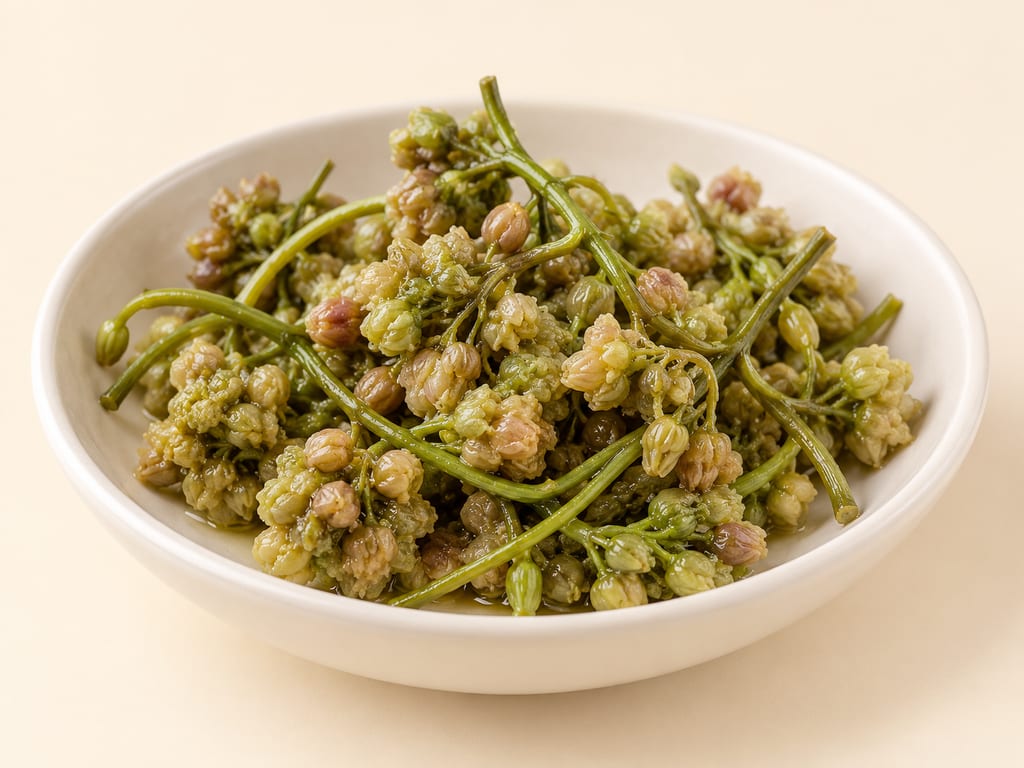
Colchic jonjoli is a Georgian food plant whose unopened flower clusters are reported pickled. Sources also use jonjoli for the distinct species Staphylea pinnata, leaving some food reports taxonomically mixed.
Species and regional name
Kew accepts Staphylea colchica Steven, a shrub or tree native to the western Caucasus, including Transcaucasia. Kew also accepts S. pinnata L. as a separate species. Georgian sources use Colchic jonjoli for S. colchica and jonjoli more broadly; the shared food name does not identify a specimen. A northeast Georgian ethnobotany study reports S. pinnata and S. colchica together among brine-fermented plants, and captions its pictured jonjoli as S. pinnata. The study covered 14 villages and seven linguistic communities in spring 2018, not all Georgia.
Food use and process limits
Georgian tourism and agriculture sources report unopened jonjoli flower clusters or buds pickled as a side dish. Georgia Travel also says the plant is used as an edible green, but does not specify the part. Its article describes more than one pickle account and includes amount and timing details, but omits essential process information such as brine concentration, acidity, temperature, a measured endpoint and validated storage. These descriptions document food use; they are not a complete household recipe or a preservation-safety assessment. The ethnobotany study’s species pairing and S. pinnata photo caption should remain visible when reading the broader jonjoli tradition.
Growing guidance and its scope
RHS’s species profile is ornamental guidance for UK gardens. It lists full sun or partial shade, moist but well-drained chalk, clay, loam or sand, and acid, alkaline or neutral pH. Its H5 rating is a UK scheme; RHS defines H5 as −15 to −10 °C. RHS suggests autumn seed in containers in a cold frame or softwood and semi-ripe cuttings with bottom heat. These profile values do not establish Georgian crop performance or food-bud yield. A Georgian horticulture article describes garden planting for jonjoli more generally, including moist structured soil, a 200–1,000 m “classic” zone and a 3 × 4 m spacing scheme. It discusses two Georgian jonjoli species and does not report a species-isolated trial, so its values should not be read as a measured S. colchica production prescription.
Conservation and open questions
Georgia’s 2014 official Red List assigns S. colchica VU under criteria A2d; B1b. A 2022 checklist by Georgian botanists gives a provisional regional LC assessment, while a 2023 National Botanical Garden abstract reports pressure on wild populations from intensive flower collection. The 2022 expert assessment is not evidence that the statutory list was replaced, and none of these sources establishes a current collection permit or site-specific rule. No harvest recommendation is made. A voucher-level link between food-use specimens and S. colchica, current collection permissions, productive-growing trials and a complete food-process source remain open.
Sources for this section
Research gaps
Jonjoli food reports are taxonomically mixed between Staphylea colchica and S. pinnata; no voucher-level evidence assigns every preparation to this species.
The 2014 official VU entry and 2022 provisional regional LC assessment differ; no superseding statutory list or current collection permission was verified.
No complete source-batched food method with endpoint and storage evidence was found.
Georgian garden advice is not a species-isolated replicated trial; no measured productive container or greenhouse evidence was found.
Sources for this section
- Staphylea colchica Steven | Plants of the World Online →
- Staphylea pinnata L. | Plants of the World Online →
- The Inextricable Link Between Food and Linguistic Diversity: Wild Food Plants among Diverse Minorities in Northeast Georgia, Caucasus →
- Jonjoli →
- Staphylea colchica | RHS Plant Profile →
- ჯონჯოლის ბაღის გაშენება, მწნილის დამზადება (Jonjoli garden establishment and pickle account) →
- საქართველოს „წითელი ნუსხის“ დამტკიცების შესახებ (Government Resolution No. 190, 20 February 2014) →
- The checklist of trees of Georgia (Caucasus) and their provisional regional assessment according to IUCN categories and criteria →
- Seed viability and ex-situ conservation of Staphylea colchica →
Research status
The underlying plant account received a partial source review. Its review scope is described in the original plant article.
Sources for this section
Places
Unknown
Relationship not established · Place not establishedThe available research does not establish a single origin for this ingredient.
Community
No community contributions have been published for this entry yet.
Share what you made
Sign in to contribute. Published comments and photos are free to read.
Sources
Royal Botanic Gardens, KewIngredient research
Staphylea colchica Steven | Plants of the World OnlineCited in: Species and regional name; Research gaps
Royal Botanic Gardens, KewIngredient research
Staphylea pinnata L. | Plants of the World OnlineCited in: Species and regional name; Research gaps
Economic Botany / Springer Nature; Andrea Pieroni, Renata Sõukand and Rainer W. BussmannIngredient research
The Inextricable Link Between Food and Linguistic Diversity: Wild Food Plants among Diverse Minorities in Northeast Georgia, CaucasusCited in: Species and regional name; Food use and process limits; Research gaps
Georgian National Tourism Administration, Georgia TravelIngredient research
JonjoliCited in: Food use and process limits; Research gaps
Royal Horticultural SocietyIngredient research
Staphylea colchica | RHS Plant ProfileCited in: Growing guidance and its scope; Research gaps
Agrokavkaz; Lali Goginava, page dated 3 February 2026Ingredient research
ჯონჯოლის ბაღის გაშენება, მწნილის დამზადება (Jonjoli garden establishment and pickle account)Cited in: Food use and process limits; Growing guidance and its scope; Research gaps
Legislative Herald of Georgia / Government of GeorgiaIngredient research
საქართველოს „წითელი ნუსხის“ დამტკიცების შესახებ (Government Resolution No. 190, 20 February 2014)Cited in: Conservation and open questions; Research gaps
Flora Mediterranea 32 (2022), N. Lachashvili, K. Kereselidze and Z. KikvidzeIngredient research
The checklist of trees of Georgia (Caucasus) and their provisional regional assessment according to IUCN categories and criteriaCited in: Conservation and open questions; Research gaps
XVII OPTIMA Meeting abstracts; Nino Melia, Tinatin Barblishvili, Laura Gabedava and Irakli Grdzelishvili, National Botanical Garden of GeorgiaIngredient research
Seed viability and ex-situ conservation of Staphylea colchicaCited in: Conservation and open questions; Research gaps
FermenteaResearch provenance
Colchic jonjoli (Staphylea colchica): original plant researchCited in: Research status