
Substrates
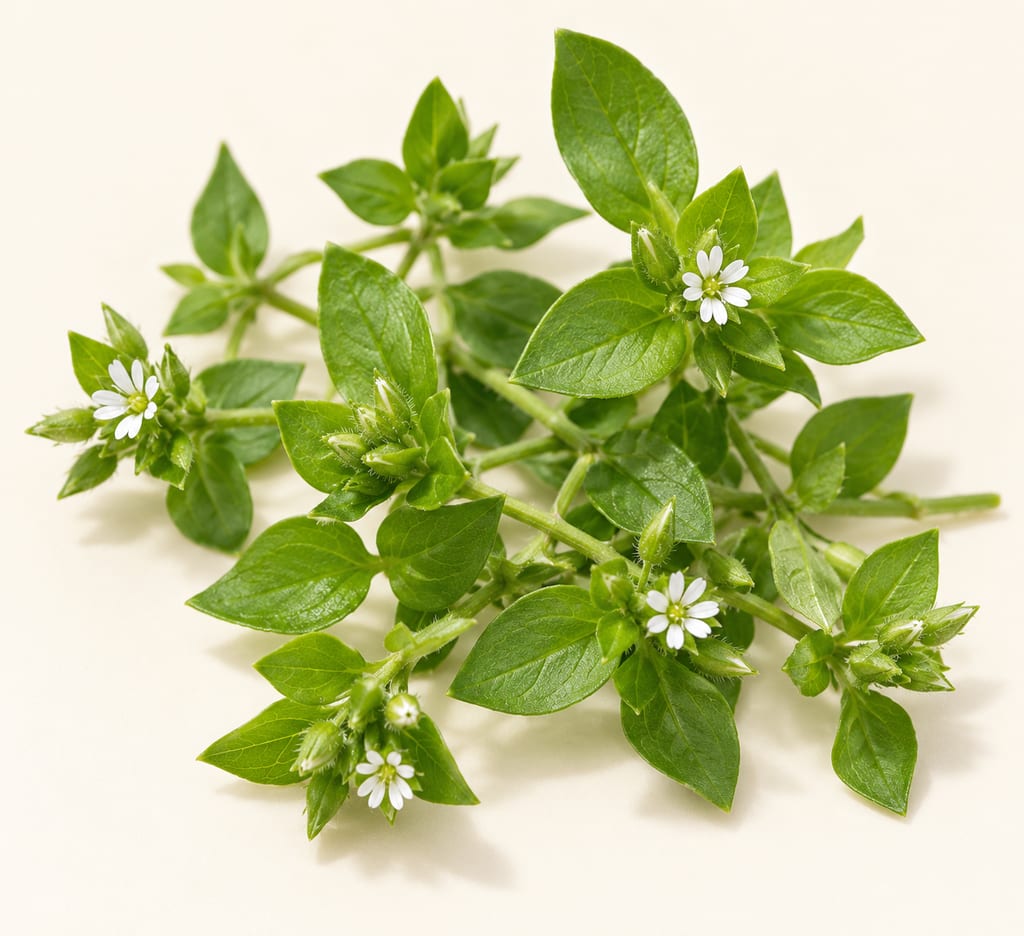
Common chickweed leaves
Common chickweed (Stellaria media) is a cool-season garden plant with documented food-use descriptions. UK and US sources describe where it grows and how it spreads, but do not establish a managed food-crop system or a complete recipe.
The species behind the name
Kew accepts Stellaria media (L.) Vill., an annual or biennial native across temperate Eurasia and northern and north-eastern tropical Africa. The RHS identifies it as common chickweed and describes a low, spreading plant with opposite leaves and small white flowers. The Woodland Trust also labels its food-use account specifically as Stellaria media. Other plants are called chickweeds, so these common-name descriptions are not a substitute for competent identification.
Food-use reports
The Woodland Trust lists leaves, stems, flowers and seeds as edible parts. It describes young leaves in salads with lemon and olive oil, blended into pesto, or served with fish or chicken; tiny flowers are suggested as a salad garnish. Iowa State Extension describes leaves, stems and flowers as eaten raw or cooked and compares the plant with spinach. These are source-reported uses and meal ideas, not a complete recipe or a validated preparation method.
Sources for this section
A garden weed is not a crop protocol
The RHS profile records full sun or partial shade and broad soil and moisture categories, and assigns the plant H7 in the RHS hardiness scheme for UK growing conditions. Its advice describes rapid spread by seed in garden borders and allotments. Iowa State describes it as a low-growing annual that colonizes bare ground and associates growth with moist, fertile soil. These sources describe horticultural profile fields and weed ecology; they do not provide sowing instructions, yield expectations, or a managed edible crop system.
Kew Grow Wild includes chickweed in a native-plant list and encourages growing native edible plants, while advising against picking and eating plants found in the wild because identification can be difficult and over-foraging may harm wild populations. The page is not an identification key or permission to collect from a particular site.
Preparation and evidence limits
The sources give no complete batch with quantities, yield, ordered cooking stages, endpoint or storage limit. They do not establish home greenhouse or container production, harvest intervals, or a food-safety protocol. The descriptions here preserve reported uses without turning them into instructions or an assurance that a gathered specimen has been identified correctly.
Research gaps
No complete source-specific recipe, quantities, yield, cooking endpoint or storage method was verified.
RHS hardiness and growing-condition fields describe UK horticultural profile categories, not productive edible-crop yield or a universal survival guarantee.
No managed crop guidance was found for sowing, productive harvest, containers or greenhouse systems; weed ecology is not substituted for those instructions.
No full identification key, food-safety protocol or jurisdiction-specific collection permission was established.
Research status
The underlying plant account received a partial source review. Its review scope is described in the original plant article.
Sources for this section
Places
Unknown
Relationship not established · Place not establishedThe available research does not establish a single origin for this ingredient.
Community
No community contributions have been published for this entry yet.
Share what you made
Sign in to contribute. Published comments and photos are free to read.
Sources
Royal Botanic Gardens, KewIngredient research
Stellaria media (L.) Vill., Plants of the World OnlineCited in: The species behind the name; Research gaps
Royal Horticultural SocietyIngredient research
Stellaria media, RHS Plant ProfileCited in: The species behind the name; A garden weed is not a crop protocol; Preparation and evidence limits; Research gaps
Woodland TrustIngredient research
Edible weeds: foraging in your gardenCited in: The species behind the name; Food-use reports; Preparation and evidence limits; Research gaps
Iowa State University Extension and OutreachIngredient research
ChickweedCited in: Food-use reports; A garden weed is not a crop protocol; Preparation and evidence limits; Research gaps
Grow Wild, Royal Botanic Gardens, KewIngredient research
Sensory and edible native plantsCited in: A garden weed is not a crop protocol; Preparation and evidence limits; Research gaps
Royal Horticultural SocietyIngredient research
Chickweed: garden weed adviceCited in: A garden weed is not a crop protocol; Research gaps
FermenteaResearch provenance
Common chickweed: food reports and garden ecology: original plant researchCited in: Research status