
Substrates
Miding fern shoots
Sarawak sources describe young Stenochlaena palustris fronds as a vegetable and give regional cultivation guidance for nursery propagation, wet field sites and harvest.
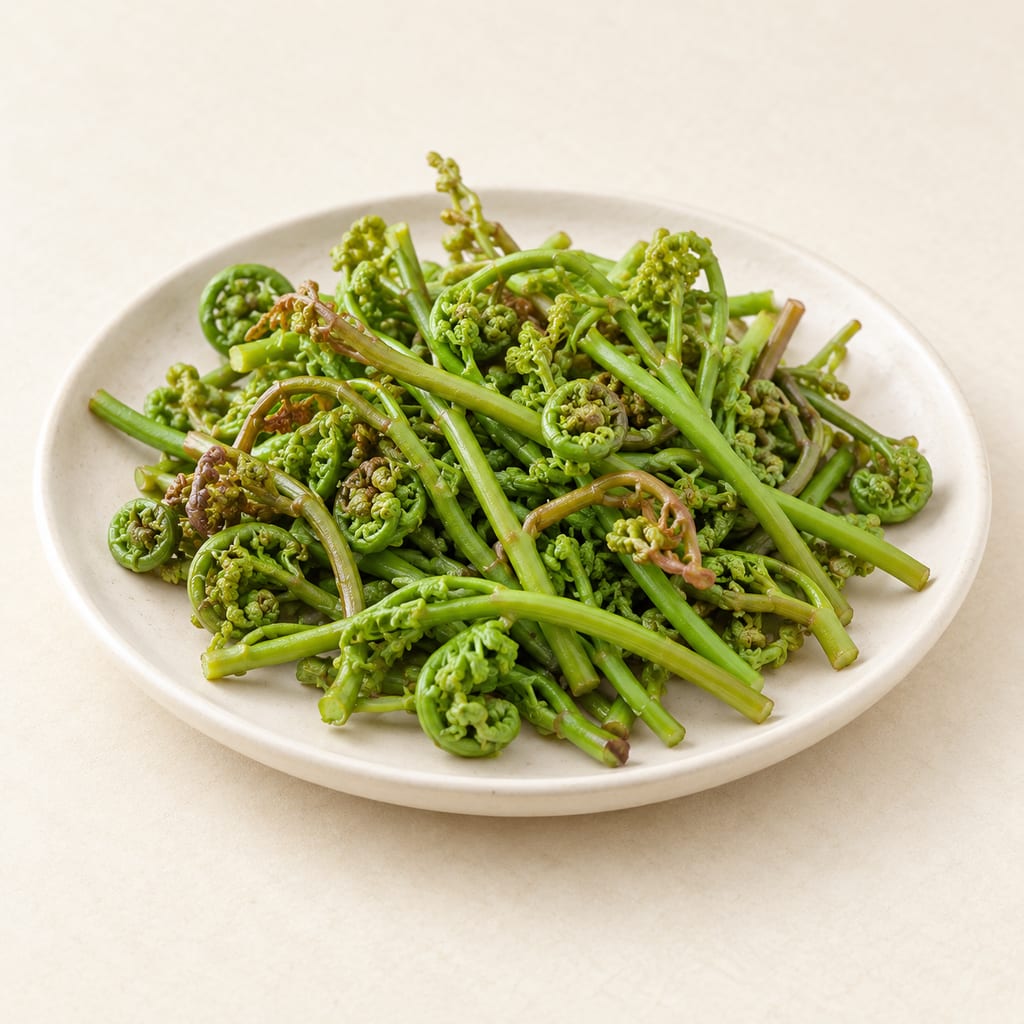
Names and food parts
Kew accepts Stenochlaena palustris (Burm.f.) Bedd. and classifies it in Aspleniaceae. Sarawak Department of Agriculture and PROSEA use the same species name but print Blechnaceae, an older family treatment. Sarawak sources call it miding or paku miding; PROSEA also records Malaysian paku ranu and the spelling miding. Generic paku is not enough to identify a fern as this species. Sarawak DoA describes soft young fronds, with or without opened leaflets, as a traditional vegetable and says small-leaved fertile fronds bearing spores are usually not eaten. PROSEA separately describes croziers and young red leaves as food, cooked after withering. Neither account is a complete recipe or a field-identification key.
Sarawak cultivation guidance
Sarawak Department of Agriculture describes propagation from spores or rhizomatous stems. Its field guidance specifies 25–30 cm cuttings with 2–5 nodes, frequent nursery watering and gradual exposure to sun after about 2–3 weeks; it says the cuttings can be transplanted to the field after about 3–4 months. The page advises moist-to-wet sites but also says excessive water restricts frond growth. It gives 60 × 60 cm spacing in two rows or 30 cm in one row, with 1.5–1.8 m access lanes, plus support options for climbing growth. It reports pruning old leaves and shoots every six months and harvesting young fronds every three days. This is undated Sarawak extension guidance, not a household container protocol or a food-safety method.
Sources for this section
A separate Sarawak field-study abstract
Ole Mertz’s 1999 article abstract reports a Sarawak study of fertilizer response, shade and open-field conditions, and market value for S. palustris and the different fern Diplazium esculentum. It says S. palustris yields were higher than D. esculentum yields in both shaded and unshaded conditions. The abstract also reports that the possible-profitability assessment needed further analysis; its economic context is historical. The full article was not inspected; these older economic figures are not current or household advice, and findings about D. esculentum do not identify or describe S. palustris.
Sources for this section
What remains unresolved
The inspected sources do not provide a complete home recipe, validated processing endpoint, water-contamination threshold, safe field identification key, or legal collection assessment. They also do not establish mature container production, a greenhouse protocol, frost limits or a current nationwide commercial status. The Sarawak DoA page was directly read in the earlier dossier research pass; a fresh retrieval timed out during this publication review.
Research gaps
The food accounts are descriptive and do not give complete recipes, storage limits or validated processing controls.
The Sarawak cultivation figures are source-specific extension advice; mature container and protected-crop methods remain unassessed.
Neither food use nor the spore-bearing-frond note is a complete identification key or proof of safety at a particular site.
The DoA page has no displayed publication date, and a fresh retrieval timed out during this review; its content is carried forward from the earlier direct reading.
Current harvest permission, water-quality and contamination criteria, and qualified food-process review remain open.
Research status
The underlying plant account received a partial source review. Its review scope is described in the original plant article.
Sources for this section
Places
Unknown
Relationship not established · Place not establishedThe available research does not establish a single origin for this ingredient.
Community
No community contributions have been published for this entry yet.
Share what you made
Sign in to contribute. Published comments and photos are free to read.
Sources
Royal Botanic Gardens, Kew, Plants of the World OnlineIngredient research
Stenochlaena palustris (Burm.f.) Bedd.Cited in: Names and food parts; Research gaps
Department of Agriculture SarawakIngredient research
Miding (Penanaman Miding)Cited in: Names and food parts; Sarawak cultivation guidance; What remains unresolved; Research gaps
Plant Resources of South-East Asia (PROSEA), Handbook 15(2): Cryptogams: Ferns and fern alliesIngredient research
Stenochlaena palustris (Burm.f.) Bedd., PROSEA record 3210Cited in: Names and food parts; What remains unresolved; Research gaps
Ole Mertz; Tropical Agriculture 76(1), University of the West IndiesIngredient research
Cultivation potential of two edible ferns, Diplazium esculentum and Stenochlaena palustrisCited in: A separate Sarawak field-study abstract; What remains unresolved; Research gaps
FermenteaResearch provenance
Miding fern (Stenochlaena palustris): original plant researchCited in: Research status