
Substrates
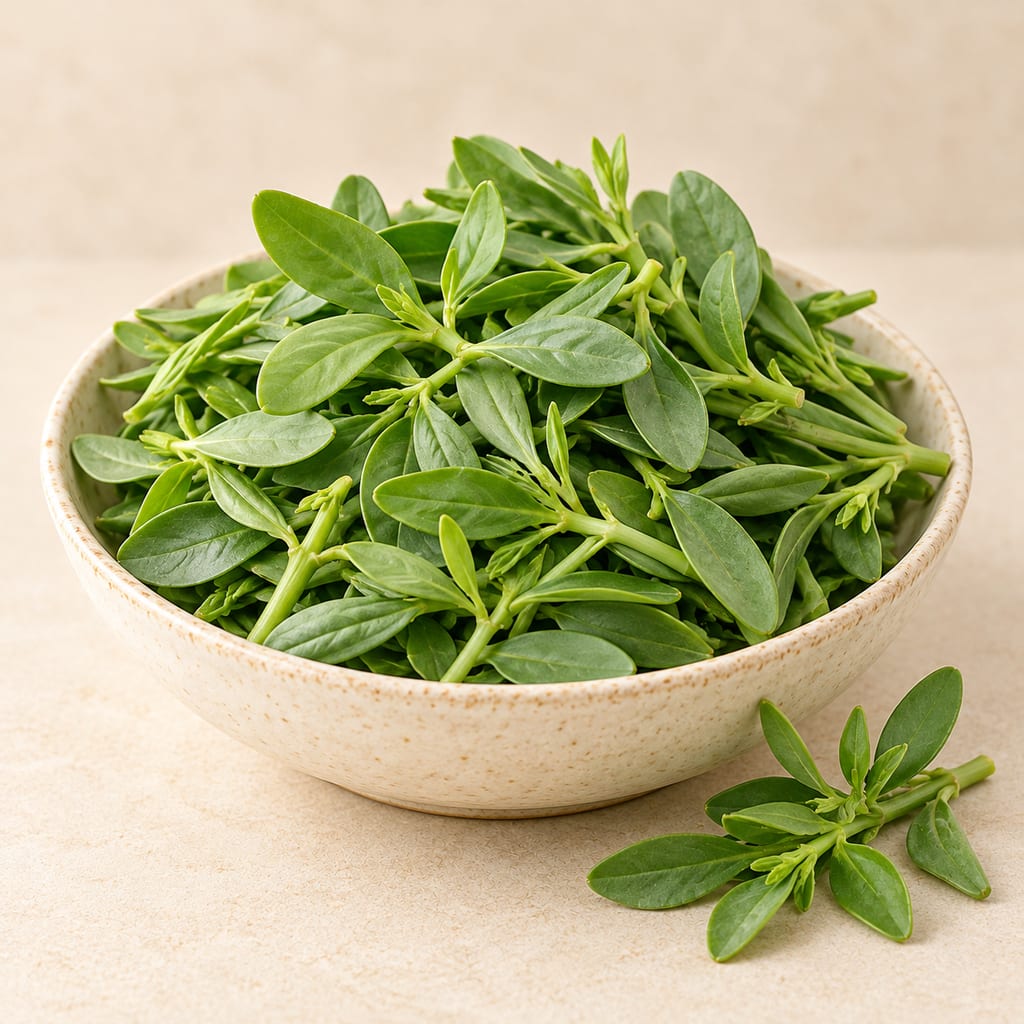
Waterleaf greens
Waterleaf leaves and shoots are recorded as cooked vegetables and sauce thickeners in Nigeria, and in Thai soup and fried dishes; growing reports vary by source and setting.
Names and species scope
Kew accepts Talinum fruticosum (L.) Juss. and lists Talinum triangulare (Jacq.) Willd. among its synonyms. Singapore NParks follows that treatment. PROTA’s older waterleaf profile is headed T. triangulare and lists “T. fruticosum auct. non (L.) Juss.” in its synonym field. That notation is a taxonomic-concept caveat; it does not prove that every older T. triangulare food account describes an unrelated plant. The regional reports below stay attributed to the name and concept used by each source. NParks lists “Waterleaf,” “Ceylon Spinach” and “Surinum Purslane”; common names are not specimen identifications.
Sources for this section
Regional food reports
The Singapore National Parks Board records Southern Nigerian use of leaves and young shoots as a cooked vegetable and sauce thickener, and Thai use of leaves fried or added to soup with minced pork. Its page is an agency species profile, not a full recipe. PROTA’s T. triangulare account describes leaves in soups and stews in West and Central Africa, including gbure with Corchorus olitorius in southern Nigeria and waterleaf with eru (Gnetum leaves) and fufu in Cameroon. Those reports are retained as source-specific food context under PROTA’s taxonomic treatment; they are not combined into one recipe or attributed to a single origin.
Sources for this section
Growing reports by setting
NParks describes the plant as perennial in Singapore, lists full sun and moderate water, and reports harvest from 40–55 days after sowing through six months at two-week intervals. These are Singapore horticulture-page fields, not universal crop guarantees. PROTA’s T. triangulare profile describes humid growth near 30°C, faster growth in rainy periods, smaller plants in exposed sites and reduced leaf growth above 35°C or under drought; its regional concept remains qualified as above. It reports seed and 10–15 cm cutting propagation, with a November first planting in Cameroon and Nigeria.
A 2022 AKSU study tested four watering intervals in a screen-house at Akwa Ibom State University from October to December 2020. Its experimental bags held topsoil and poultry manure, received two 10–15 cm cuttings and 0.35 litres per watering event. The researchers compared 1-, 3-, 5- and 7-day intervals across 40 units. At nine weeks, the 7-day treatment had greater fresh weight than the 3-day treatment, while the paper found no significant interval effect on plant height or leaf number. This single experimental result is not a household irrigation schedule, a container-growing recommendation or a greenhouse protocol.
Range records do not settle culinary history
Kew codes tropical and subtropical America as the native range and lists Nigeria, Ghana and Cameroon among introduced areas. NParks labels the native distribution Tropical Africa while marking the plant non-native and cultivated-only in Singapore. These database fields disagree on broad native status; neither establishes the origin of the regional dishes. Kew describes the species as annual, while NParks reports it as perennial in Singapore. The difference is retained with each source’s scope rather than converted into a single life-cycle rule.
Sources for this section
Preparation and limits
The inspected pages describe food uses but do not supply a complete, measured household recipe with quantities, yield, ordered steps, endpoints and storage. NParks gives no cooking sequence; PROTA’s country-specific descriptions are not full recipes. The AKSU study is an agronomy experiment, not a food-preparation source. Under its T. triangulare concept, PROTA reports soluble oxalates, hydrocyanic acid and nitrates/nitrites, and cautions about infant foods and quantity. The profile supplies no measured basis, human serving threshold or validated household processing control; this text does not turn its cautions into a dose or cooking instruction. No medical benefit or food-safety guarantee is claimed.
Research gaps
No complete Nigerian, Thai or Cameroonian recipe batch with quantities, yield, steps and storage was verified.
PROTA’s older T. triangulare profile has a stated taxonomic-concept caveat; local specimens or a source-level taxonomic crosswalk are absent.
Kew and NParks conflict on broad native distribution; Singapore lifespan reporting does not establish life cycle elsewhere.
No universal frost, heat, pH, soil, household container or heated/unheated greenhouse protocol was established. The AKSU screen-house trial is one research setting.
Composition cautions in PROTA do not provide validated human limits or a preparation endpoint.
Research status
The underlying plant account received a partial source review. Its review scope is described in the original plant article.
Sources for this section
Places
Unknown
Relationship not established · Place not establishedThe available research does not establish a single origin for this ingredient.
Community
No community contributions have been published for this entry yet.
Share what you made
Sign in to contribute. Published comments and photos are free to read.
Sources
Royal Botanic Gardens, Kew, Plants of the World OnlineIngredient research
Talinum fruticosum (L.) Juss.Cited in: Names and species scope; Range records do not settle culinary history; Research gaps
National Parks Board, Singapore, Flora & Fauna WebIngredient research
Talinum fruticosum (L.) Juss.Cited in: Names and species scope; Regional food reports; Growing reports by setting; Range records do not settle culinary history; Preparation and limits; Research gaps
P.C.M. Jansen; Plant Resources of Tropical Africa; Pl@ntUseIngredient research
Talinum triangulare (PROTA)Cited in: Names and species scope; Regional food reports; Growing reports by setting; Preparation and limits; Research gaps
Arit O. Efretuei, Fidel E. Akpaninyang and Okon J. Ekwere; AKSU Journal of Agriculture and Food Sciences 6(2):92–99Ingredient research
Effect of Different Watering Intervals on Water Leaf (Talinum fruticosum) Growth and Foliage YieldCited in: Growing reports by setting; Preparation and limits; Research gaps
FermenteaResearch provenance
Waterleaf (Talinum fruticosum): original plant researchCited in: Research status