
Substrates
Dandelion greens
POWO accepts Taraxacum sect. Taraxacum and places Taraxacum officinale in its synonymy; Kew describes the common British dandelion as an aggregate of many apomictic microspecies. Food and growing sources use dandelion names at different levels, so this article keeps each report within its source's scope.
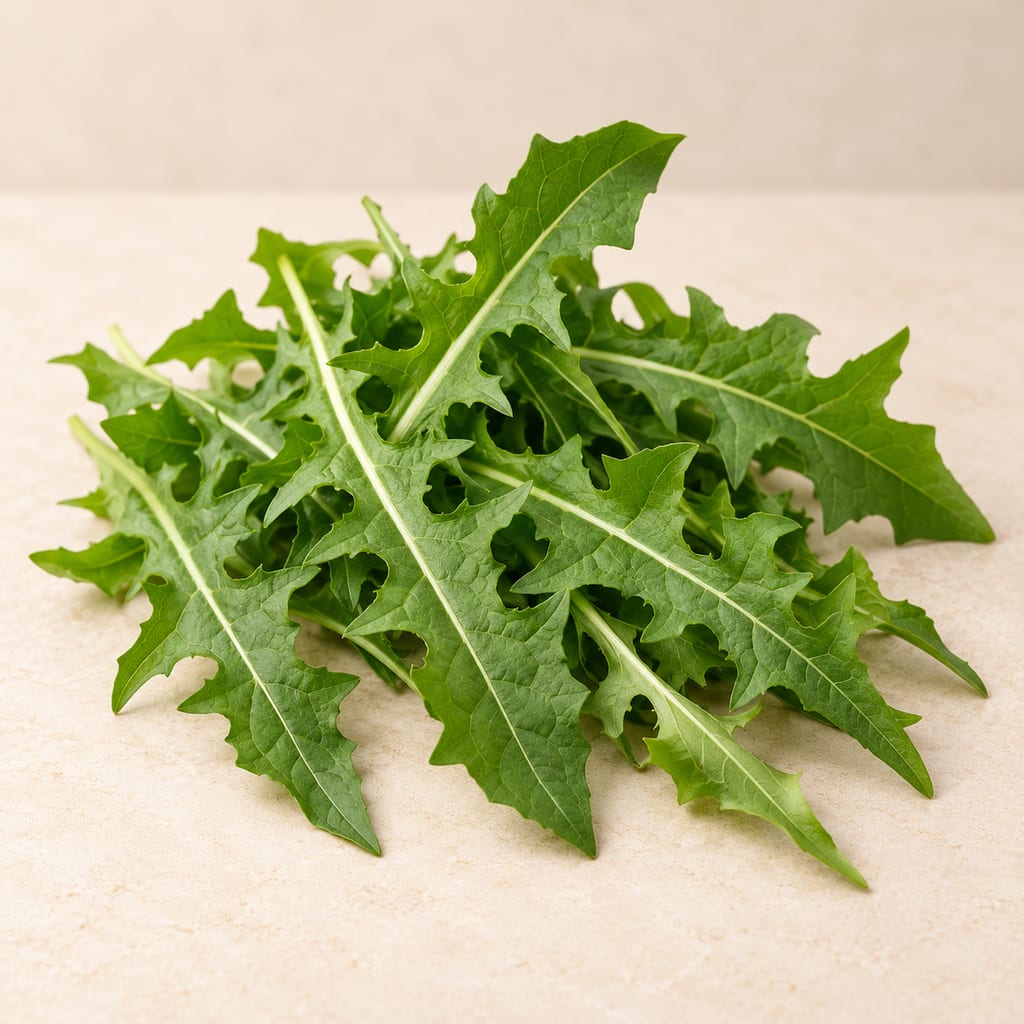
One familiar name, several taxonomic treatments
Kew’s Plants of the World Online accepts Taraxacum sect. Taraxacum at section rank and lists Taraxacum officinale F.H.Wigg. among its synonyms. Kew’s linked species profile uses the binomial but says common British dandelions are usually treated as an aggregate, T. officinale agg., comprising about 200 apomictic microspecies. Kew also notes that the specimen used to describe the species is a Lapland microspecies unlike many plants in British lawns and along paths. These records do not make every plant called dandelion the same identified species.
The RHS has separate pages headed T. officinale and T. officinale agg. Both list H7, but their native-to-GB/Ireland fields differ: Yes on the binomial page and No on the aggregate page. The pages' labels and fields are retained as separate source treatments.
Food reports stay with their source labels
Kew’s British profile reports young leaves and inflorescences in salads or stir-fries, blanched hearts, flowers used for dandelion wine, and bitter roots dried as a coffee substitute. It also mentions a thick-leaved seed variety sold for salad growing. Wisconsin Extension, writing under the name T. officinale, describes leaves, buds, flowers and roots as food; it says young leaves are most flavorful before the first flower buds appear and reports early-spring root use. These accounts do not identify individual plants to microspecies.
Andorra Turisme describes spring dandelion-leaf salads as a characteristic food in Canillo and nearby Catalan Pyrenees communities. Its French page uses the common name pissenlit and does not give a botanical specimen determination. The regional account is useful evidence for a place-linked food tradition, but it does not prove that every dandelion dish uses the same microspecies.
What the garden sources describe
For UK garden conditions, the RHS profile lists full sun or partial shade; chalk, clay, loam or sand; acid, alkaline or neutral pH; and moist-but-well-drained or well-drained soil. Its H7 category is defined in the UK scheme as hardy in the severest European continental climates below −20°C. That profile category is not a measured survival threshold for every microspecies or a food-crop guarantee.
Wisconsin Extension gives a more detailed local sowing example: sow on the surface or just covered from early spring, four to six weeks before the last frost, through late summer; it reports germination in about ten days at 55°F. Its garden spacing is six to nine inches between plants and twelve inches between rows. For a head start, it describes a cold frame or indoor sowing, then seedlings moved into individual pots deep enough for the taproot before planting out in early summer. The article says a crop may be ready in 85 to 95 days. Those figures belong to the Wisconsin guidance, not a universal schedule. A cold frame or indoor seed start is not evidence of greenhouse production.
Kew also describes sowing seed directly outdoors or into deep pots and notes that roots and wind-carried seed help the plant persist and spread. These are group-level garden observations; the sources do not give a productive container yield or a controlled greenhouse method.
Limits and unresolved points
Wisconsin Extension notes that heat and insufficient moisture can make leaves more bitter, that sap can cause contact dermatitis in susceptible people, and that plants intended for food should not have been treated with pesticides. Its root-regrowth and seed-dispersal notes describe garden behavior, not a way to identify or clear a gathered plant. No inspected source links a particular food report to a voucher-identified British microspecies or establishes that a site is suitable for gathering.
The Andorran and RHS pages contain recipe material, but neither is reproduced here as an executable recipe. The Andorran ingredient is identified by a common name, while the RHS syrup article starts with roasted root without specifying the roasting conditions. No general storage period or validated preparation endpoint is established for the plant group.
Research gaps
Food-use sources do not provide voucher-level identification of the plants to British Taraxacum microspecies; common-name matches remain group-level reports.
RHS profile pages give conflicting native-to-GB/Ireland values for the binomial and aggregate records. Both say H7, an RHS UK scheme category rather than a measured universal survival limit.
The Wisconsin sowing and crop timing figures are regional Extension guidance; no comparable cultivar-specific field, mature-container or greenhouse production trial was verified.
The Andorran pissenlit account and RHS root-syrup page do not establish a taxon-specific complete recipe, universal storage period or food-safety endpoint. Local collection permissions and site contamination are not assessed.
Sources for this section
Research status
The underlying plant account received a partial source review. Its review scope is described in the original plant article.
Places
Unknown
Relationship not established · Place not establishedThe available research does not establish a single origin for this ingredient.
Community
No community contributions have been published for this entry yet.
Share what you made
Sign in to contribute. Published comments and photos are free to read.
Sources
Royal Botanic Gardens, KewIngredient research
Taraxacum sect. Taraxacum F.H.Wigg. | Plants of the World OnlineCited in: One familiar name, several taxonomic treatments; What the garden sources describe; Research gaps
Royal Botanic Gardens, KewIngredient research
Taraxacum sect. Taraxacum: General information | Plants of the World OnlineCited in: One familiar name, several taxonomic treatments; Food reports stay with their source labels; What the garden sources describe; Limits and unresolved points; Research gaps
Royal Horticultural SocietyIngredient research
Taraxacum officinale | RHS Plant ProfileCited in: One familiar name, several taxonomic treatments; What the garden sources describe; Research gaps
Royal Horticultural SocietyIngredient research
Taraxacum officinale agg. | RHS Plant ProfileCited in: One familiar name, several taxonomic treatments; What the garden sources describe; Research gaps
University of Wisconsin–Madison Division of ExtensionIngredient research
Dandelion, Taraxacum officinaleCited in: Food reports stay with their source labels; What the garden sources describe; Limits and unresolved points; Research gaps
Andorra TurismeIngredient research
Salade de pissenlitsCited in: Food reports stay with their source labels; Limits and unresolved points; Research gaps
Royal Horticultural SocietyIngredient research
DandelionCited in: Limits and unresolved points; Research gaps
FermenteaResearch provenance
Dandelion: a changing taxonomic group with regional food and garden records: original plant researchCited in: Research status