
Substrates
Fluted pumpkin greens
Kew accepts Telfairia occidentalis. Nigerian sources describe ugu and leaf, shoot and seed-kernel food uses, alongside institutional field-growing guidance whose regional scope and limits remain important.
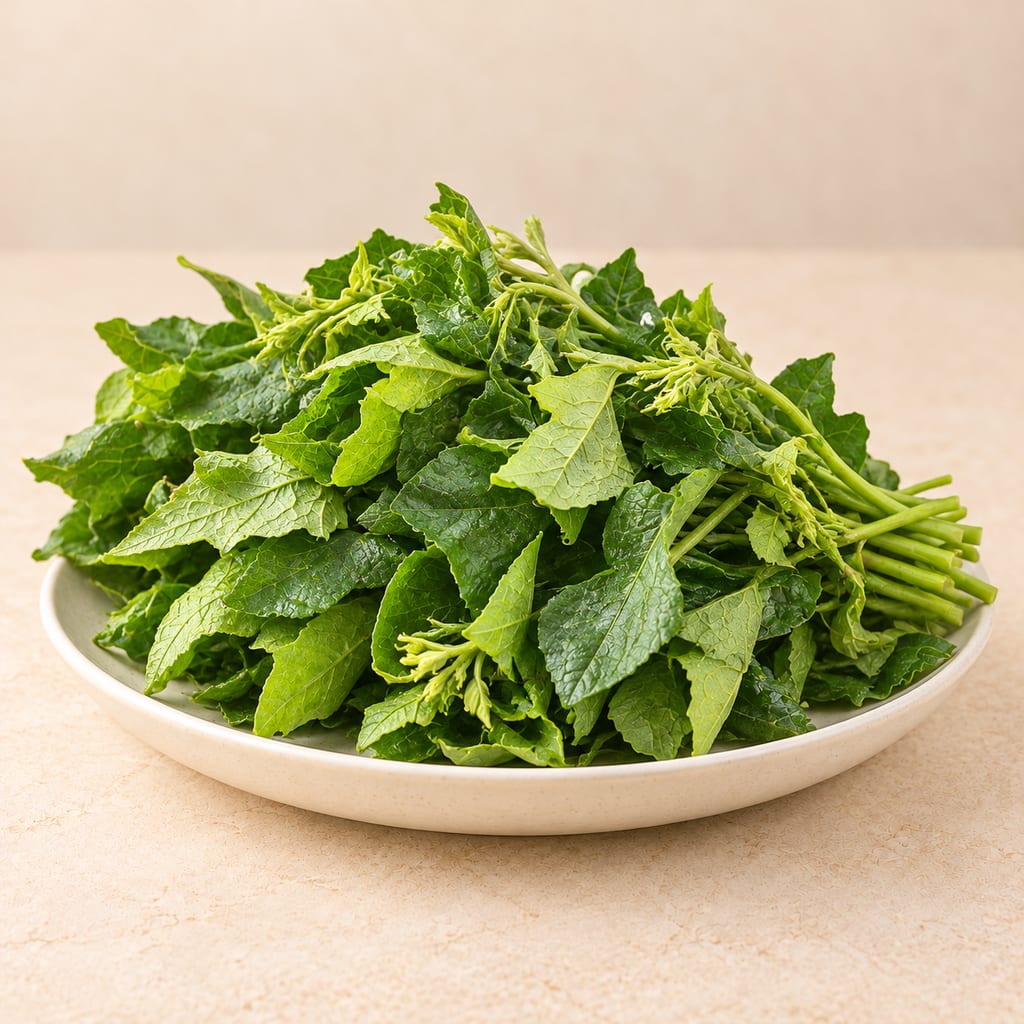
Names and regional scope
Kew accepts Telfairia occidentalis Hook.f. and describes a climbing tuberous geophyte whose native range extends from western tropical Africa to southwestern Uganda, including Nigeria. NIHORT’s guide uses the name ugu in its title. These sources support the taxon and a common-name association, but do not identify every plant or seed sold as ugu.
Sources for this section
Food accounts
The FAO/CINE Igbo chapter documents food systems in four southern Nigerian states. Its table pairs Telfeiria occidentalis, “fluted pumpkin” and “ugu,” marks a rainy-season entry, and reports use for soups and other dishes. The table is a regional use record, not a complete recipe. Akoroda’s abstract describes leaves, succulent shoots and seed kernels as ingredients in Igbo soups; the full publisher article was not inspected for this review.
Growing guidance from NIHORT
NIHORT says the crop is mainly seed-propagated and gives March–November for rain-fed cropping and November–March for irrigated dry-season cropping in its Nigerian guide context. It recommends moist, well-drained, fertile soil and states pH 6–7.5; these are guide recommendations, not independently measured universal limits. It describes shaded beds or trays, transplanting, field staking and vine harvest from about five weeks, followed by intervals of three to four weeks under good management. The guide’s tray and nursery information is propagation guidance, not productive pot evidence.
Sources for this section
Regional history and selected lines
Akoroda’s 1990 abstract frames the plant as endemic to southeastern Nigeria and discusses its Igbo food and cropping role; this historical framing is narrower than Kew’s current broad native-range record. The 1983 Tropical Agriculture abstract reports six selected high-leaf-yield lines among those studied and disease observations in a 116-plant set. Its full methods and trial tables were not available through the journal page, so those statements do not support current cultivar selection or crop performance claims.
What remains open
The inspected food records do not provide quantities, yield, ordered preparation steps, storage duration or a food-safety endpoint. NIHORT’s cool, damp handling language concerns harvested vines being transported to market; its seed storage discussion concerns planting viability. Neither supplies a household food-storage period. No mature container or greenhouse trial was found in the reviewed sources.
Research gaps
A complete, attributed household food preparation with plant part, quantities, sequence, yield, storage and preparation-specific hazard evidence.
Full Akoroda and Atiri/Varma methods and tables, including selected-line identity and trial context.
Mature container and protected-crop production evidence; the NIHORT nursery trays are not productive pot trials.
Current location-specific conservation, collection rules and market/seed accession identification.
Sources for this section
- Telfairia occidentalis Hook.f. →
- Guide to the Production of Telfairia occidentalis (Ugu) →
- The Igbo traditional food system documented in four states in Southern Nigeria, in Indigenous Peoples’ food systems →
- Ethnobotany of Telfairia occidentalis (Cucurbitaceae) among Igbos of Nigeria →
- Development of improved lines of Telfairia occidentalis Hook. f. resistant to mosaic disease →
Research status
The underlying plant account received a partial source review. Its review scope is described in the original plant article.
Sources for this section
Places
Unknown
Relationship not established · Place not establishedThe available research does not establish a single origin for this ingredient.
Community
No community contributions have been published for this entry yet.
Share what you made
Sign in to contribute. Published comments and photos are free to read.
Sources
Royal Botanic Gardens, Kew, Plants of the World OnlineIngredient research
Telfairia occidentalis Hook.f.Cited in: Names and regional scope; Regional history and selected lines; Research gaps
National Horticultural Research Institute, NigeriaIngredient research
Guide to the Production of Telfairia occidentalis (Ugu)Cited in: Names and regional scope; Growing guidance from NIHORT; What remains open; Research gaps
Food and Agriculture Organization of the United Nations and Centre for Indigenous Peoples’ Nutrition and EnvironmentIngredient research
The Igbo traditional food system documented in four states in Southern Nigeria, in Indigenous Peoples’ food systemsCited in: Food accounts; What remains open; Research gaps
Economic Botany 44(1), 29–39; M. O. Akoroda, 1990Ingredient research
Ethnobotany of Telfairia occidentalis (Cucurbitaceae) among Igbos of NigeriaCited in: Food accounts; Regional history and selected lines; What remains open; Research gaps
Tropical Agriculture 60(2), 1983; University of the West Indies journal recordIngredient research
Development of improved lines of Telfairia occidentalis Hook. f. resistant to mosaic diseaseCited in: Regional history and selected lines; Research gaps
FermenteaResearch provenance
Fluted pumpkin in southern Nigeria: food records and crop guidance: original plant researchCited in: Research status