
Spices and aromatics
Red clover leaves and flowers
Trifolium pratense is used as a forage crop and has separate human food reports for leaves and flowers. NCSU Extension describes salads, soups and cooked greens; a Mediterranean review summarizes flower uses in several countries. The growing evidence differs by region and purpose, and the available sources do not provide a complete food recipe.
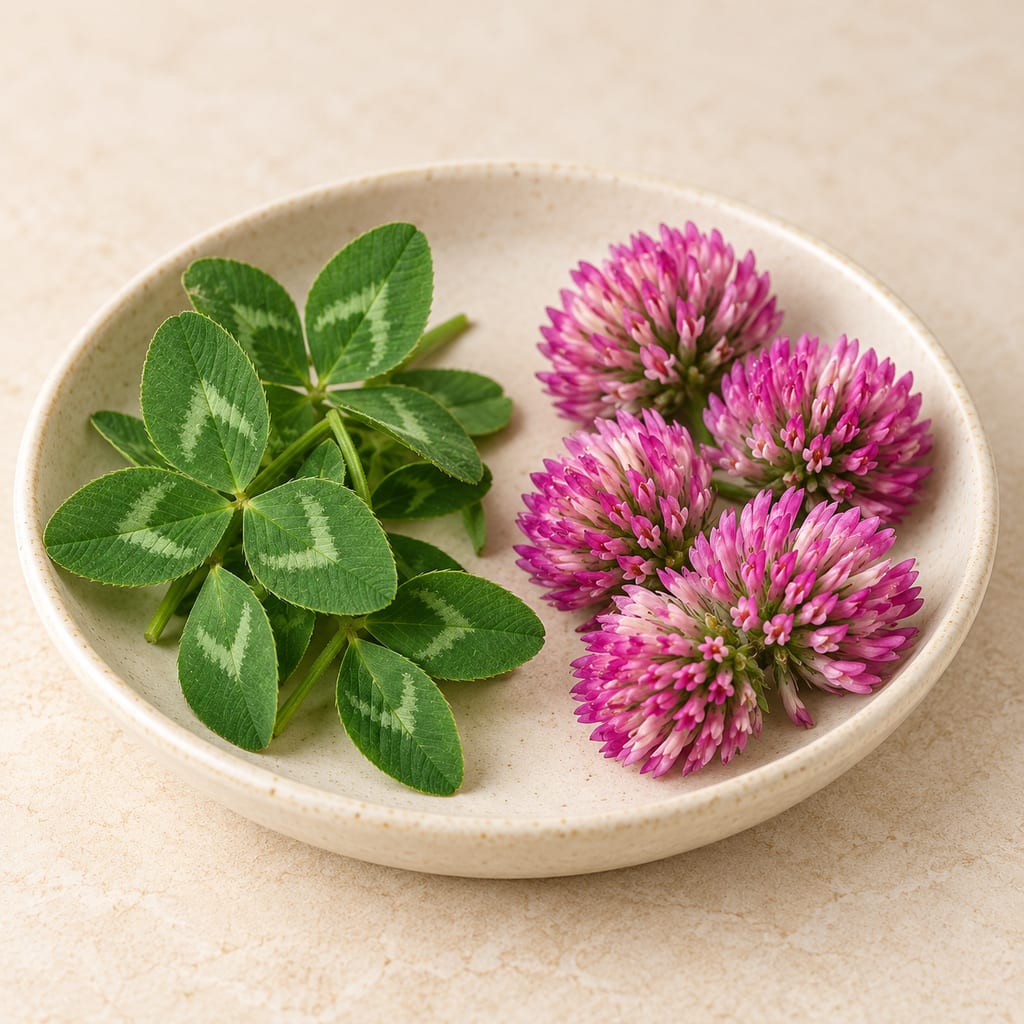
Red clover is one species among many clovers
Kew accepts Trifolium pratense L. in Fabaceae and lists three accepted subspecies. The RHS and North Carolina State Extension use red clover for this species; NCSU also lists cow grass, peavine clover and purple clover. Other clovers are distinct taxa, so familiar common names alone do not identify a plant.
Kew gives a native range from Macaronesia and north-west Africa through Europe to Mongolia and the Himalaya, and classifies the species as primarily temperate. It also records introduced areas. These broad distributions do not establish the identity or collection status of a local specimen.
Food and forage reports have different contexts
NCSU Extension describes the leaves and flowering heads as edible raw or cooked. It reports young leaves in salads or soups and spinach-like cooking; it also describes dried flower heads and seed pods as a flour substitute. The source does not give a complete recipe or quantities.
A 2022 review of Mediterranean ethnobotanical literature lists Trifolium pratense flowers in tea, salads, cakes, fritters and soups in Italy, Spain and Turkey. This is a secondary summary of country reports, not a set of complete recipes. Red clover’s pasture, hay, livestock-feed and green-manure roles are separate agricultural uses, not human food methods.
Regional growing guidance
The RHS profile lists full sun, clay, loam or sand, moist but well-drained soil and acid or neutral pH; its narrative says slightly acidic soil. It assigns RHS UK hardiness H7, defined as the severest European continental climates below −20°C. The category is not a measured survival cutoff. The profile describes meadow use and seed propagation, not a food-crop yield trial.
The RHS marks drought resistance “Yes,” while Penn State Extension rates drought tolerance low in its Pennsylvania forage comparison and reports that pH 6.5 or higher is associated with maximum forage yield there. These statements differ in source and purpose and should not be combined into a universal watering or pH prescription. Penn State’s red-clover page returned 403 on direct access; the comparison is retained from the indexed full text recorded in the dossier, not claimed as freshly verified from the publisher page.
Food cautions and limits
NCSU says red-clover flowers are not easily digestible and advises against eating the flowers during pregnancy or nursing. That is the extension page’s food-part-specific caution; it supplies no dose, mechanism or clinical endpoint. NCCIH separately describes isoflavones and cautions about red-clover supplements during pregnancy or breastfeeding. Its supplement information is not a food-portion assessment.
The available use reports do not establish a safe quantity, a storage period or a complete household preparation. No medicinal use or therapeutic benefit is recommended here.
Research gaps
No complete source-specific human-food recipe with quantities, yield, ordered steps, endpoint and storage was verified.
NCSU’s food-part-specific pregnancy/nursing caution has no dose or mechanism; broader food-specific toxicology and serving limits remain unresolved.
Penn State Extension direct retrieval returned 403; its indexed Pennsylvania forage comparisons are not household food-growing or garden recommendations.
No productive container or greenhouse trial, human-food harvest yield, or local collection/planting-permission review was established.
The Mediterranean review page now challenges direct retrieval with a captcha; its table was fully inspected in the prior dossier research pass, but not freshly reopened in this publication pass.
Sources for this section
- Trifolium pratense L. | Plants of the World Online →
- Trifolium pratense | red clover →
- Trifolium pratense (Cow Grass, Peavine Clover, Purple Clover, Red Clover) | Plant Toolbox →
- Red Clover: How and why to grow, harvest, and store a perennial red clover crop in Pennsylvania →
- Red Clover: Usefulness and Safety →
- Edible Flowers Used in Some Countries of the Mediterranean Basin: An Ethnobotanical Overview →
Research status
The underlying plant account received a partial source review. Its review scope is described in the original plant article.
Sources for this section
Places
Unknown
Relationship not established · Place not establishedThe available research does not establish a single origin for this ingredient.
Community
No community contributions have been published for this entry yet.
Share what you made
Sign in to contribute. Published comments and photos are free to read.
Sources
Royal Botanic Gardens, KewIngredient research
Trifolium pratense L. | Plants of the World OnlineCited in: Red clover is one species among many clovers; Food and forage reports have different contexts; Research gaps
Royal Horticultural SocietyIngredient research
Trifolium pratense | red cloverCited in: Red clover is one species among many clovers; Regional growing guidance; Research gaps
North Carolina State Extension Gardener Plant ToolboxIngredient research
Trifolium pratense (Cow Grass, Peavine Clover, Purple Clover, Red Clover) | Plant ToolboxCited in: Red clover is one species among many clovers; Food and forage reports have different contexts; Food cautions and limits; Research gaps
Penn State ExtensionIngredient research
Red Clover: How and why to grow, harvest, and store a perennial red clover crop in PennsylvaniaCited in: Regional growing guidance; Research gaps
National Center for Complementary and Integrative Health, National Institutes of HealthIngredient research
Red Clover: Usefulness and SafetyCited in: Food cautions and limits; Research gaps
Plants (Basel), full-text article via PubMed CentralIngredient research
Edible Flowers Used in Some Countries of the Mediterranean Basin: An Ethnobotanical OverviewCited in: Food and forage reports have different contexts; Food cautions and limits; Research gaps
FermenteaResearch provenance
Red clover: reported food uses and regional growing guidance: original plant researchCited in: Research status