
Substrates
Broad-leaved cattail as food
Broad-leaved cattail is a wetland plant with North American accounts of edible shoots, stem bases, flower parts, pollen and rhizomes, alongside substantial identity and water-quality limits.
Species and related cattails
Kew and ITIS accept Typha latifolia L. in Typhaceae. Kew lists Massula latifolia among its synonyms. Canadian VASCAN records T. latifolia as one parent of the hybrid T. × glauca; narrow-leaved cattail, T. angustifolia, is a separate species. Common names such as cattail, bulrush and reedmace can refer to different plants in different places.
The USDA guide describes the male flower spike above the female portion, separated by a short naked section. Cornell and North Carolina State note that leaf-only young cattails can resemble iris or sweet flag before flowering. These descriptions are partial source accounts, not a field identification key or confirmation of a particular plant.
Documented food parts and cultural scope
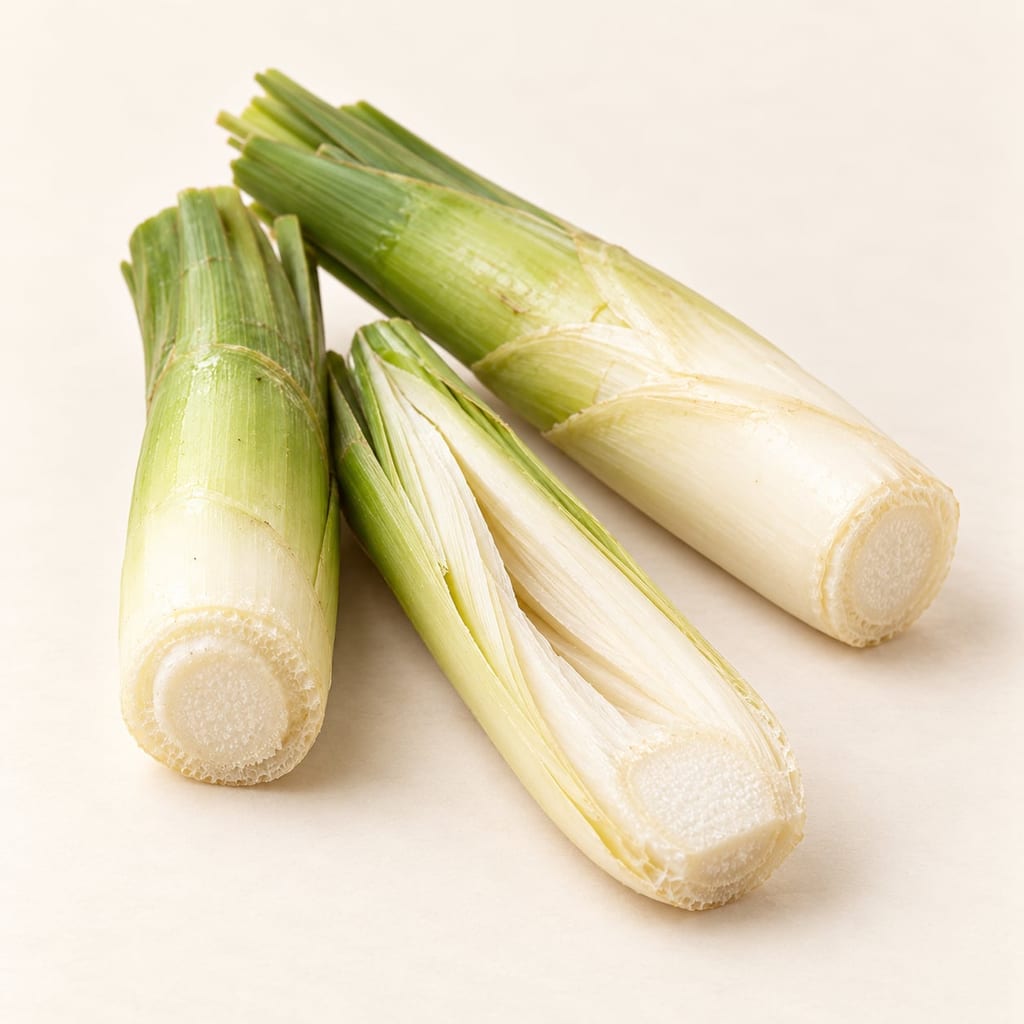
The USDA NRCS plant guide summarizes North American food reports for spring shoots, the stem base where it joins the rhizome, young flower stalks, pollen and rhizomes. It specifically attributes eating the end of a new stem to the Washoe. The guide’s Klamath and Modoc examples concern basketry and mats, not the same food claim.
Virginia Cooperative Extension’s farm-pond account describes young stems, young flower spikes, pollen and rhizomes in its Virginia context. These agency descriptions record particular food uses and stages; they do not show that every plant part, every Typha species or every wetland location is suitable to eat.
Sources for this section
Preparation accounts and their limits
The USDA guide describes raw or steamed young shoots, boiled or roasted stem bases, boiled or steamed young flower stalks, pollen used as flour, and rhizomes or lower stems prepared in several ways. Virginia Extension lists boiling young stems, roasting early-summer flower spikes, using pollen as flour or thickener, and cooking or drying and pounding rhizomes. These are source-described preparation leads, not a single complete measured recipe.
Neither source supplies a complete batch with all quantities, ordered stages, storage conditions and a validated safety endpoint. The sources do not provide a general method for identifying safe plants or choosing a safe water source.
Sources for this section
Wetland growing observations
RHS describes T. latifolia as a full-sun pond-margin plant and gives a UK H6 hardiness category; it notes that vigorous rhizomes can spread and damage pond liners. North Carolina State describes container growing as one way to limit spread in small ponds or water gardens, an ornamental containment approach rather than an edible-yield trial.
USDA NRCS Technical Note 38 describes the species in Intermountain West restoration settings at 3,000–7,000 feet, with season-long saturated soils or standing or slow-moving water up to 12 inches deep. It rates acidity and salinity relative to local vegetation. A separate NRCS plant guide describes greenhouse seed propagation at 100°F ±5°F, sowing about ¼ inch deep, and plugs ready in 100–120 days; those are wetland restoration procedures, not household food-crop settings. No productive harvest or home greenhouse thresholds are established.
Sources for this section
Water quality and open identification questions
Cornell Cooperative Extension says not to harvest wild foods near potentially contaminated water sources. A Polish study measured elements in leaves and rhizomes of T. latifolia and T. angustifolia collected from western Poland lakes for bioindication; it did not establish food limits or show that an untested site is suitable. No source here supplies a threshold for water quality or plant tissue.
Cornell and North Carolina State describe early-stage resemblance to iris or sweet flag. Utah Poison Control labels Iris species as stomach irritants, but that genus-level toxicity entry is not a cattail identification tool or a Typha-specific poisoning report. Local identification, water quality, land access and collection rules remain unresolved before any site-specific food advice.
Research gaps
No field key or qualified specimen identification distinguishes young T. latifolia from all related cattails, hybrids, iris or sweet flag.
No site-specific test or numeric contaminant threshold establishes that a pond or wetland plant is suitable for food.
The food sources give partial uses but no complete measured household batch, storage duration or validated preparation endpoint.
The NRCS habitat, restoration greenhouse and RHS/NC State garden observations do not establish a productive food crop, container yield or household heated or unheated greenhouse method.
No global or local collection-permission, conservation or legal status survey was completed.
Sources for this section
- Typha latifolia L. | Plants of the World Online →
- Typha latifolia | RHS Plant Profile →
- Broad-leaved Cattail Plant Guide →
- Edible Aquatic Plants in Farm Ponds (CNRE-127NP) →
- Wild Edibles: Safety, Conservation, and Consumables →
- Typha latifolia | NC Common Wetland Plants Guide →
- Typha latifolia | Database of Vascular Plants of Canada (VASCAN) →
- Users Guide to Description, Propagation and Establishment of Wetland Plant Species and Grasses for Riparian Areas in the Intermountain West, Technical Note 38 →
- Macro- and Trace-Elements Accumulation in Typha angustifolia L. and Typha latifolia L. Organs and their Use in Bioindication →
- Iris | Poison Control Plant Guide →
Research status
The underlying plant account received a partial source review. Its review scope is described in the original plant article.
Sources for this section
Places
Unknown
Relationship not established · Place not establishedThe available research does not establish a single origin for this ingredient.
Community
No community contributions have been published for this entry yet.
Share what you made
Sign in to contribute. Published comments and photos are free to read.
Sources
Royal Botanic Gardens, KewIngredient research
Typha latifolia L. | Plants of the World OnlineCited in: Species and related cattails; Research gaps
Royal Horticultural SocietyIngredient research
Typha latifolia | RHS Plant ProfileCited in: Species and related cattails; Wetland growing observations; Research gaps
USDA NRCS National Plant Data Center and Idaho Plant Materials CenterIngredient research
Broad-leaved Cattail Plant GuideCited in: Species and related cattails; Documented food parts and cultural scope; Preparation accounts and their limits; Wetland growing observations; Research gaps
Virginia Cooperative Extension, Virginia Tech and Virginia State UniversityIngredient research
Edible Aquatic Plants in Farm Ponds (CNRE-127NP)Cited in: Documented food parts and cultural scope; Preparation accounts and their limits; Research gaps
Cornell Cooperative ExtensionIngredient research
Wild Edibles: Safety, Conservation, and ConsumablesCited in: Water quality and open identification questions; Research gaps
North Carolina State University and North Carolina Division of Water ResourcesIngredient research
Typha latifolia | NC Common Wetland Plants GuideCited in: Species and related cattails; Wetland growing observations; Water quality and open identification questions; Research gaps
Canadensys / Canadian Biodiversity Information FacilityIngredient research
Typha latifolia | Database of Vascular Plants of Canada (VASCAN)Cited in: Species and related cattails; Research gaps
USDA Natural Resources Conservation ServiceIngredient research
Users Guide to Description, Propagation and Establishment of Wetland Plant Species and Grasses for Riparian Areas in the Intermountain West, Technical Note 38Cited in: Wetland growing observations; Research gaps
Polish Journal of Environmental StudiesIngredient research
Macro- and Trace-Elements Accumulation in Typha angustifolia L. and Typha latifolia L. Organs and their Use in BioindicationCited in: Water quality and open identification questions; Research gaps
University of Utah Health, Utah Poison Control CenterIngredient research
Iris | Poison Control Plant GuideCited in: Water quality and open identification questions; Research gaps
FermenteaResearch provenance
Broad-leaved cattail: food and wetland records: original plant researchCited in: Research status
