
Substrates
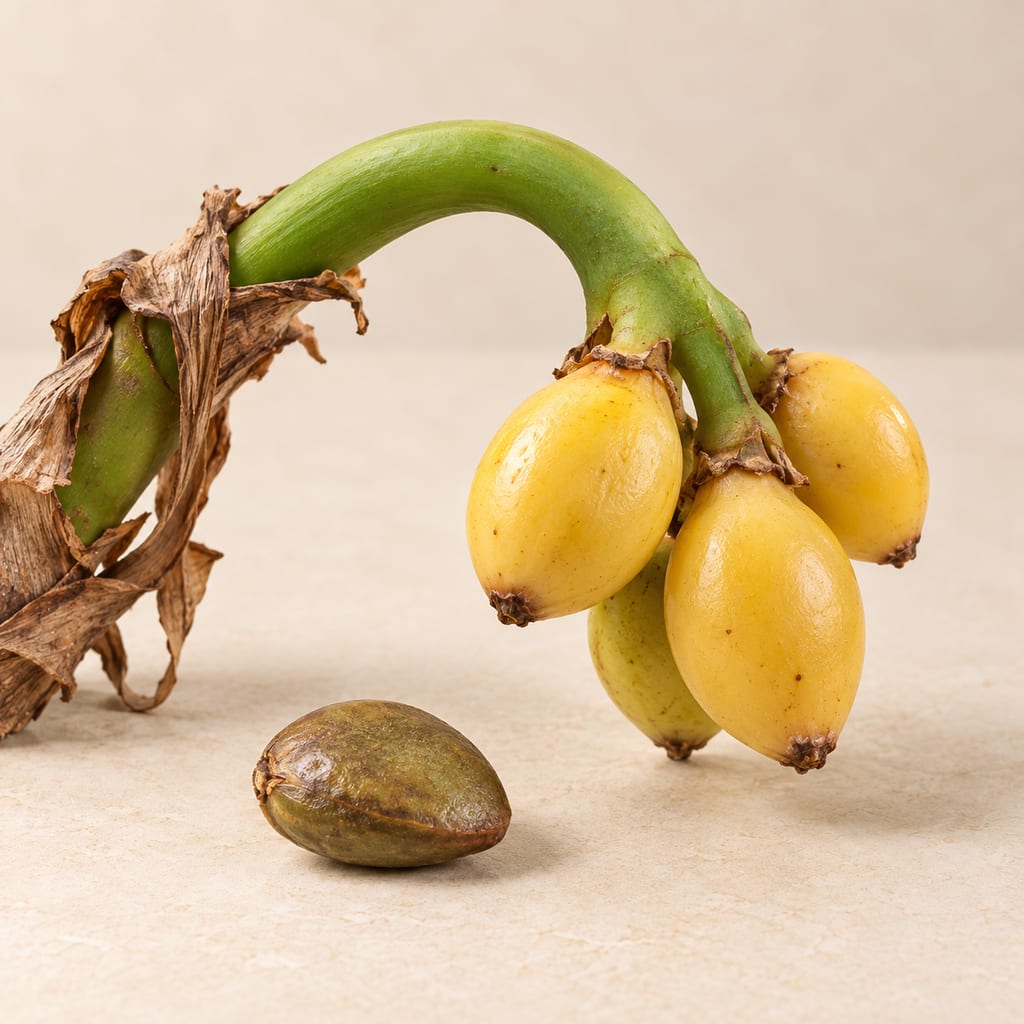
Viha seed and tuber
Madagascar sources document distinct seed and tuber food accounts for this wetland aroid; greenhouse cultivation data come from a botanical display, not food production.
Names and range
Kew accepts Typhonodorum lindleyanum Schott and lists Madagascar, Comoros and Tanzania in its native range; T. madagascariense is listed as a synonym. Manombo researchers use via for this species and distinguish it from tavolo, Tacca leontopetaloides. The Lake Alaotra article uses the spelling Viha. Those names are tied to their respective study contexts and are not identification instructions.
Sources for this section
- Typhonodorum lindleyanum Schott | Plants of the World Online →
- Finding food in the hunger season: A mixed methods approach to understanding wild plant foods in relation to food security and dietary diversity in southeastern Madagascar →
- Useful plants in the Park Bandro and its surroundings, Lake Alaotra, Madagascar →
Lake Alaotra food record
The Lake Alaotra survey concerns Sihanaka residents and knowledge holders around Andreba Gara. Table 2 lists Typhonodorum lindleyanum as Viha; Table 3 includes it as human food, and the Results prose assigns seeds as the consumed part. The table Frequency column and food-use prose give different values whose relationship is unresolved, so no overall species frequency is repeated. The abstract’s 76% leaf figure describes useful aquatic plants collectively.
Sources for this section
A separate Manombo account
The Manombo study separately reports via as a lean-season food and records focus-group accounts about tuber and fruit-seed use, alongside reports of adverse effects. These are interview-described regional accounts and remain distinct from the Lake Alaotra seed entry. They do not supply a validated household process, safe quantity or safety endpoint; this article does not reproduce a preparation sequence.
Greenhouse cultivation context
A Sibbaldia paper describes cultivation at Rotterdam Zoo’s tropical greenhouse, where plants were grown in a heated pond and greenhouse air. The authors report air at 24–28°C, water at 24–26°C, and summer shading material that reduced incoming solar radiation to 60 per cent. These are observations from an institutional display setting, not tested food-crop thresholds, a home greenhouse prescription or a shade percentage recommendation. The paper reports Tetranychus urticae and Pseudococcus longispinus among greenhouse pests and describes biological control in that setting; these observations are not household pest-management advice.
Research gaps
The relationship between the general Table 2 frequency and food-use Results frequency is unresolved; neither is repeated as overall prevalence.
The MCD article PDF was not reopened in this publication pass; its table and methods are carried from the dossier’s earlier direct inspection.
The regional food accounts do not establish a complete validated preparation or safety endpoint, nor do they reconcile seed and tuber/fruit-seed reports into one method.
Rotterdam Zoo display data do not establish outdoor, container, unheated greenhouse or food-production performance.
No specimen, harvest site water-quality assessment, local collection permission or consumer identification method was reviewed.
Sources for this section
- Typhonodorum lindleyanum Schott | Plants of the World Online →
- Finding food in the hunger season: A mixed methods approach to understanding wild plant foods in relation to food security and dietary diversity in southeastern Madagascar →
- Useful plants in the Park Bandro and its surroundings, Lake Alaotra, Madagascar →
- The cultivation of Typhonodorum lindleyanum Schott at the Royal Rotterdam Zoological and Botanical Gardens →
Research status
The underlying plant account received a partial source review. Its review scope is described in the original plant article.
Sources for this section
Places
Unknown
Relationship not established · Place not establishedThe available research does not establish a single origin for this ingredient.
Community
No community contributions have been published for this entry yet.
Share what you made
Sign in to contribute. Published comments and photos are free to read.
Sources
Royal Botanic Gardens, KewIngredient research
Typhonodorum lindleyanum Schott | Plants of the World OnlineCited in: Names and range; Research gaps
Frontiers in Sustainable Food Systems (2022)Ingredient research
Finding food in the hunger season: A mixed methods approach to understanding wild plant foods in relation to food security and dietary diversity in southeastern MadagascarCited in: Names and range; A separate Manombo account; Research gaps
Madagascar Conservation & DevelopmentIngredient research
Useful plants in the Park Bandro and its surroundings, Lake Alaotra, MadagascarCited in: Names and range; Lake Alaotra food record; Research gaps
Louwerens-Jan Nederlof and Christopher Lee Degenaar; Sibbaldia 18 (2020)Ingredient research
The cultivation of Typhonodorum lindleyanum Schott at the Royal Rotterdam Zoological and Botanical GardensCited in: Greenhouse cultivation context; Research gaps
FermenteaResearch provenance
Viha (Typhonodorum lindleyanum): original plant researchCited in: Research status