
Substrates
Ethiopian nettle greens
Ethiopian ethnobotanical studies describe regional use of Urtica simensis leaves and young shoots. A separate four-site study reports outdoor livestock-forage cultivation; those yields and methods are not human-food production guidance.
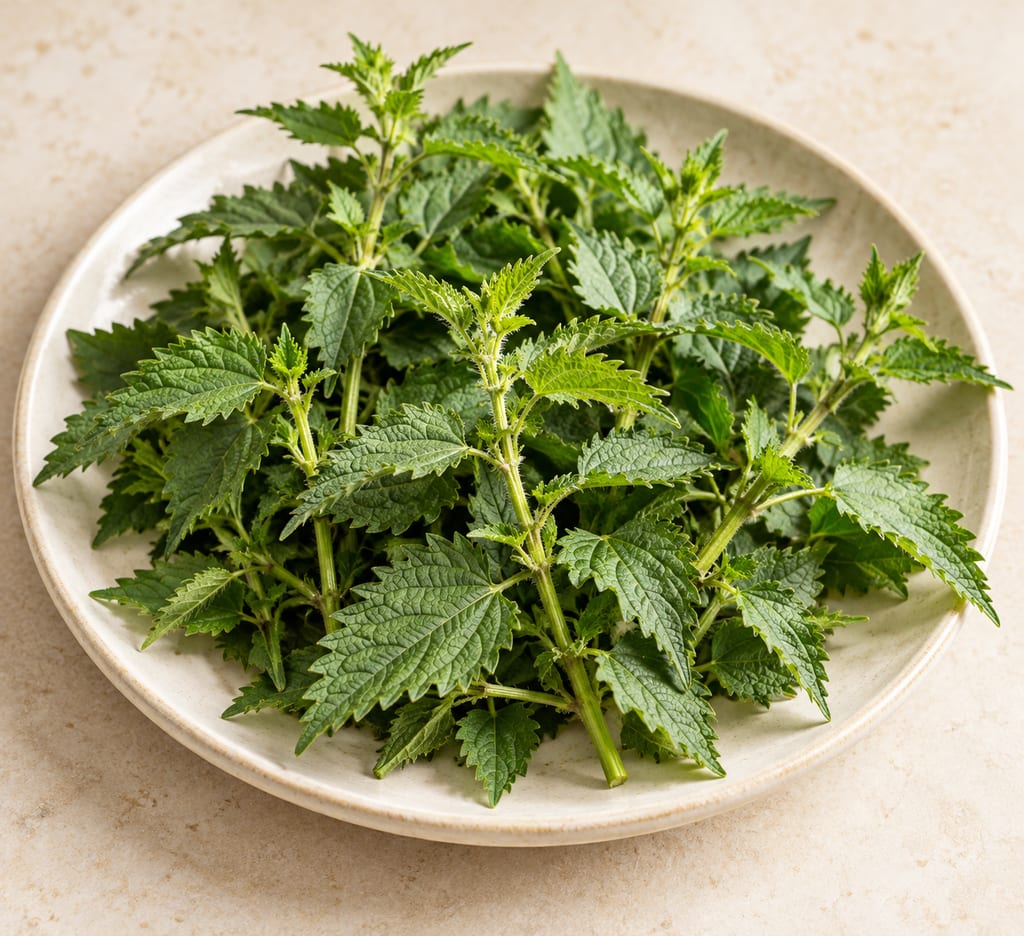
Accepted name and regional records
Kew accepts Urtica simensis Hochst. ex A.Rich. as a perennial in Urticaceae native to Ethiopia. It is a different species from Urtica dioica. A Soro District table records the source spelling “Urtica simensis Steudel,” the name Cimcima, cooked leaf with bud in a wild/riverside setting and voucher MH-194. A Yeki District row records U. simensis, the name Sama and voucher YD-37. The published rows do not assign these names to a language, and the voucher specimens were not examined.
Food use in separate local accounts
An Oromia ethnobotanical study across selected North Shewa, Bale and Arsi districts records young shoots in local sauces and reports seasonal availability in December–February and after small rains in March–May. In Yeki, the published row reports tender young leaves cooked and eaten locally during famine and plucked in summer. These accounts belong to their respective study regions; they do not define a countrywide calendar or identify other gathered plants.
Reported preparation and its limits
The Oromia article’s preparation table describes cooking young shoots, discarding cooking liquid and recooking the partly cooked leaves with specially prepared barley flour. The account gives no ingredient weights or batch size and was not validated as a safe home process. Reported cooling and next-day serving details are not storage advice. Cloth or plastic hand covering is a reported gathering practice, not a field-identification method or complete protection protocol.
What the cultivation study measured
A 2015 study cultivated U. simensis as livestock forage at Bore, Hula, Aleta-Wendo and Kofele. Researchers planted 5–9 cm rhizomes made from root cuttings, 10 cm apart, in open 2 × 1 m plots in September 2012; the trial used nine replicates in three blocks. Harvests took place at three flowering stages between February and March 2013. The paper reports dry-matter forage yields from 4.0 to 10.8 t/ha across the location-by-stage comparisons. These measurements concern animal forage, not human-food yield, a preferred food harvest stage or household garden performance.
Sites and growing gaps
The forage trial sites were listed at 1,851–2,759 m and as Nitosols. Those observations do not establish climate tolerance, soil pH or a home-growing prescription. The study does not report container or greenhouse methods. A separate discussion reference to unspecified “stinging nettle” does not establish protected cultivation for U. simensis. No frost, heat, humidity, light or irrigation threshold was established in the inspected sources.
Open questions
The local food accounts lack validated safety endpoints, ingredient quantities and household storage controls. Regional names and voucher rows remain study-specific; no identification guarantee is provided. The available research does not establish medicinal advice, a safe serving amount or a current gathering permission.
Sources for this section
- Urtica simensis Hochst. ex A.Rich. | Plants of the World Online →
- Ethnobotany of stinging nettle (Urtica simensis Hochst. ex. A. Rich.) in the Oromia region of central and southeastern highlands of Ethiopia →
- Biomass yield, chemical composition and in vitro organic matter digestibility of stinging nettle (Urtica simensis) from four locations at three stages of maturity →
- Ethnobotany of wild edible plants in Soro District of Hadiya Zone, southern Ethiopia →
- Ethnobotanical study of wild and semi-wild edible plants in Yeki district, Sheka Zone, Southwest Ethiopia →
Research gaps
Food and vernacular-name accounts are regional and do not establish specimen identity elsewhere.
The reported cooking account has no ingredient weights, batch size or validated safety endpoint; reported cooling is not a recommendation.
Forage trial yield and plot methods do not establish human-food yield or home production.
No species-confirmed container or greenhouse protocol, soil pH, hardiness rating, frost/heat response or irrigation schedule was found.
Published voucher records are not specimen examinations; names’ language assignments are unavailable in the rows.
No qualified identification, food-safety, medicinal or collection-permission approval is provided.
Sources for this section
- Urtica simensis Hochst. ex A.Rich. | Plants of the World Online →
- Ethnobotany of stinging nettle (Urtica simensis Hochst. ex. A. Rich.) in the Oromia region of central and southeastern highlands of Ethiopia →
- Biomass yield, chemical composition and in vitro organic matter digestibility of stinging nettle (Urtica simensis) from four locations at three stages of maturity →
- Ethnobotany of wild edible plants in Soro District of Hadiya Zone, southern Ethiopia →
- Ethnobotanical study of wild and semi-wild edible plants in Yeki district, Sheka Zone, Southwest Ethiopia →
Research status
The underlying plant account received a partial source review. Its review scope is described in the original plant article.
Sources for this section
Places
Unknown
Relationship not established · Place not establishedThe available research does not establish a single origin for this ingredient.
Community
No community contributions have been published for this entry yet.
Share what you made
Sign in to contribute. Published comments and photos are free to read.
Sources
Royal Botanic Gardens, KewIngredient research
Urtica simensis Hochst. ex A.Rich. | Plants of the World OnlineCited in: Accepted name and regional records; Open questions; Research gaps
Tigist Tadesse Shonte and Kebede Woldetsadik, CABI Agriculture and Bioscience 3, article 17 (2022)Ingredient research
Ethnobotany of stinging nettle (Urtica simensis Hochst. ex. A. Rich.) in the Oromia region of central and southeastern highlands of EthiopiaCited in: Food use in separate local accounts; Reported preparation and its limits; Open questions; Research gaps
D. Andualem, T. Negesse and A. Tolera, Livestock Research for Rural Development 27(8) (2015)Ingredient research
Biomass yield, chemical composition and in vitro organic matter digestibility of stinging nettle (Urtica simensis) from four locations at three stages of maturityCited in: What the cultivation study measured; Sites and growing gaps; Open questions; Research gaps
Mulatu Hankiso et al., Journal of Ethnobiology and Ethnomedicine 19, article 21 (2023)Ingredient research
Ethnobotany of wild edible plants in Soro District of Hadiya Zone, southern EthiopiaCited in: Accepted name and regional records; Open questions; Research gaps
Ashebir Awoke et al., Journal of Ethnobiology and Ethnomedicine 21, article 54 (2025)Ingredient research
Ethnobotanical study of wild and semi-wild edible plants in Yeki district, Sheka Zone, Southwest EthiopiaCited in: Accepted name and regional records; Food use in separate local accounts; Open questions; Research gaps
FermenteaResearch provenance
Urtica simensis in Ethiopian food and forage studies: original plant researchCited in: Research status