
Substrates
Bitterleaf greens
A source-linked account of bitterleaf as a West and Central African leafy vegetable, with its accepted-name synonym, reported household preparations and cultivation context kept distinct from safety guidance.
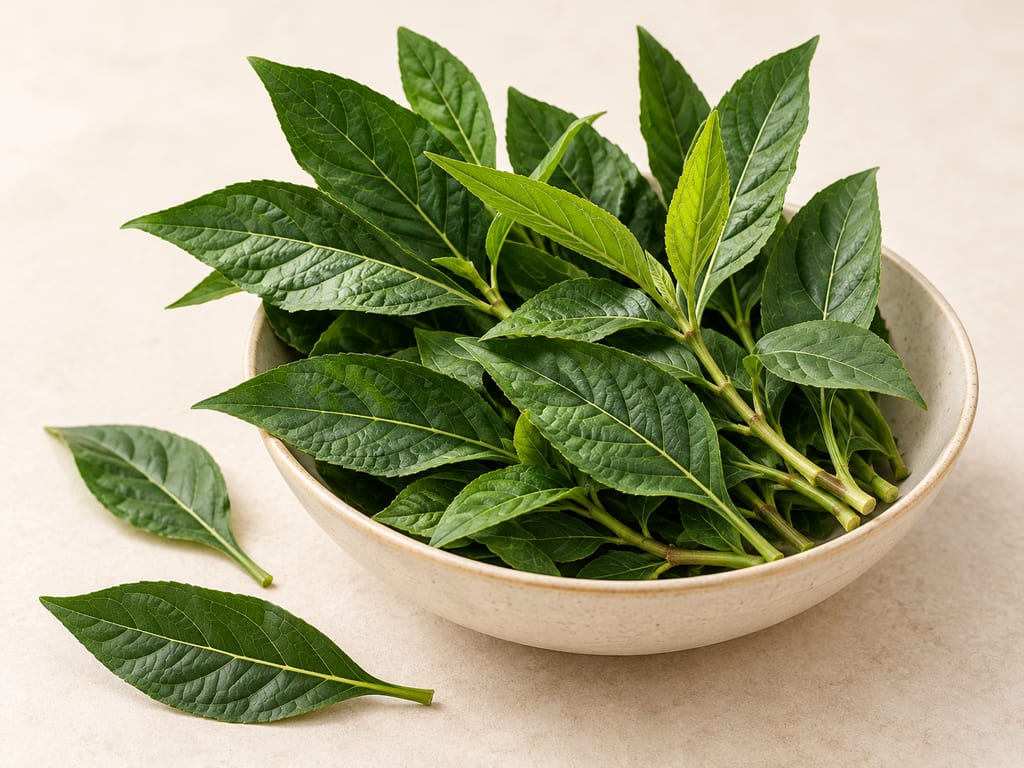
Accepted name and food-name boundary
Kew accepts Gymnanthemum amygdalinum (Delile) Sch.Bip. and lists Vernonia amygdalina Delile as a synonym. PROTA records English bitterleaf, French vernonie and ndole, and Nigerian Yoruba ewuro and Igbo onugbu. Those names belong to specific source contexts; a market label or dish name alone does not establish a specimen's identity.
Sources for this section
Food uses in regional accounts
PROTA describes leaves as a vegetable used in West and Central Africa. Its examples include boiled leaves in Nigerian soups; shredded and parboiled leaves sold in balls; Cameroonian ndole with meat or prawns and ground peanuts; and leaves cooked with cassava or yam. It also reports dried, ground leaves for soups and a Cameroon account of raw leaves mixed with palm oil and salt. These are reported food practices, not one standardized household recipe or a safety determination.
Sources for this section
Bitterness and household preparation reports
PROTA says selected cultivated plants are generally less bitter than wild leaves. Its account describes shredding or pounding leaves and rinsing between pounding steps to reduce bitterness; it also describes boiling before kneading or pounding, followed by further rinsing. The account says runoff is rinsed until it is no longer green. This is a reported preparation cue for bitterness and appearance, not a test for contaminants or a validated food-safety control. Salt, lime and palm oil are mentioned as processing variations without measured household amounts.
Sources for this section
Outdoor cultivation context
PROTA describes bitterleaf as a shrub that can be pruned and managed as a hedge or leafy crop. It reports full sun, a preference for humid conditions and humus-rich soils, while noting growth on different soil types and some drought tolerance. Propagation is possible by seed, but farmers commonly use stem cuttings selected for traits such as leaf size and bitterness. PROTA describes seed nursery beds shaded from excessive heat and sunlight, regular nursery watering during dry periods, and transplanting several weeks after emergence. It reports that cuttings grow faster than seedlings and that slanting cuttings can encourage side shoots. These are regional cultivation descriptions, not a universal production prescription.
Sources for this section
Season, harvest and crop care
PROTA reports flowering during the dry season in West and Central Africa and says short days induce flowering. It describes regular shoot harvest as delaying flower initiation and reports rainy-season harvesting of leafy shoots, with dry-season leaf picking sometimes used instead. The account says fresh shoots may regrow after pruning when adequate water is available. The NRI fact sheet describes full-sun, humid cultivation and cuttings as a propagation option in Kenya. Its climate and elevation observations are specific to its Kenyan locations, not a general tolerance range.
Sources for this section
Limits and open growing questions
The inspected sources do not establish a frost threshold, heat ceiling, numerical soil pH, container production method or greenhouse regime. PROTA names leaf-curl virus and bitterleaf weevil damage as production problems, with other pests reported in northern Nigeria; it does not make those observations universal. NRI describes seed extraction and storage in wording that is difficult to reconcile with the dry fruit morphology, so that account is not used as a home seed-handling instruction. Neither the cooking reports nor the washing descriptions establish contaminant removal, storage life or safety of a gathered plant.
Sources for this section
Research gaps
No local botanical specimen, cultivar comparison or market-product identity assessment was made.
Reported leaf washing and cooking practices do not establish a validated food-safety endpoint or storage life.
The reviewed sources do not establish frost and heat limits, numerical pH, container performance or household greenhouse conditions.
NRI seed extraction/storage wording was not adopted because the fruit description and directions appear difficult to reconcile; independent seed-propagation guidance is needed.
No current local collection rules or site-specific conservation assessment was reviewed.
Research status
The underlying plant account received a partial source review. Its review scope is described in the original plant article.
Sources for this section
Places
Unknown
Relationship not established · Place not establishedThe available research does not establish a single origin for this ingredient.
Community
No community contributions have been published for this entry yet.
Share what you made
Sign in to contribute. Published comments and photos are free to read.
Sources
Royal Botanic Gardens, Kew, Plants of the World OnlineIngredient research
Gymnanthemum amygdalinum (Delile) Sch.Bip.Cited in: Accepted name and food-name boundary; Research gaps
Plant Resources of Tropical Africa (PROTA), hosted by Pl@ntUse / Pl@ntNetIngredient research
Vernonia amygdalina (PROTA)Cited in: Accepted name and food-name boundary; Food uses in regional accounts; Bitterness and household preparation reports; Outdoor cultivation context; Season, harvest and crop care; Limits and open growing questions; Research gaps
Natural Resources Institute, University of GreenwichIngredient research
Fact sheet about Vernonia amygdalinaCited in: Outdoor cultivation context; Season, harvest and crop care; Limits and open growing questions; Research gaps
FermenteaResearch provenance
Bitterleaf (Vernonia amygdalina): original plant researchCited in: Research status