
Spices and aromatics
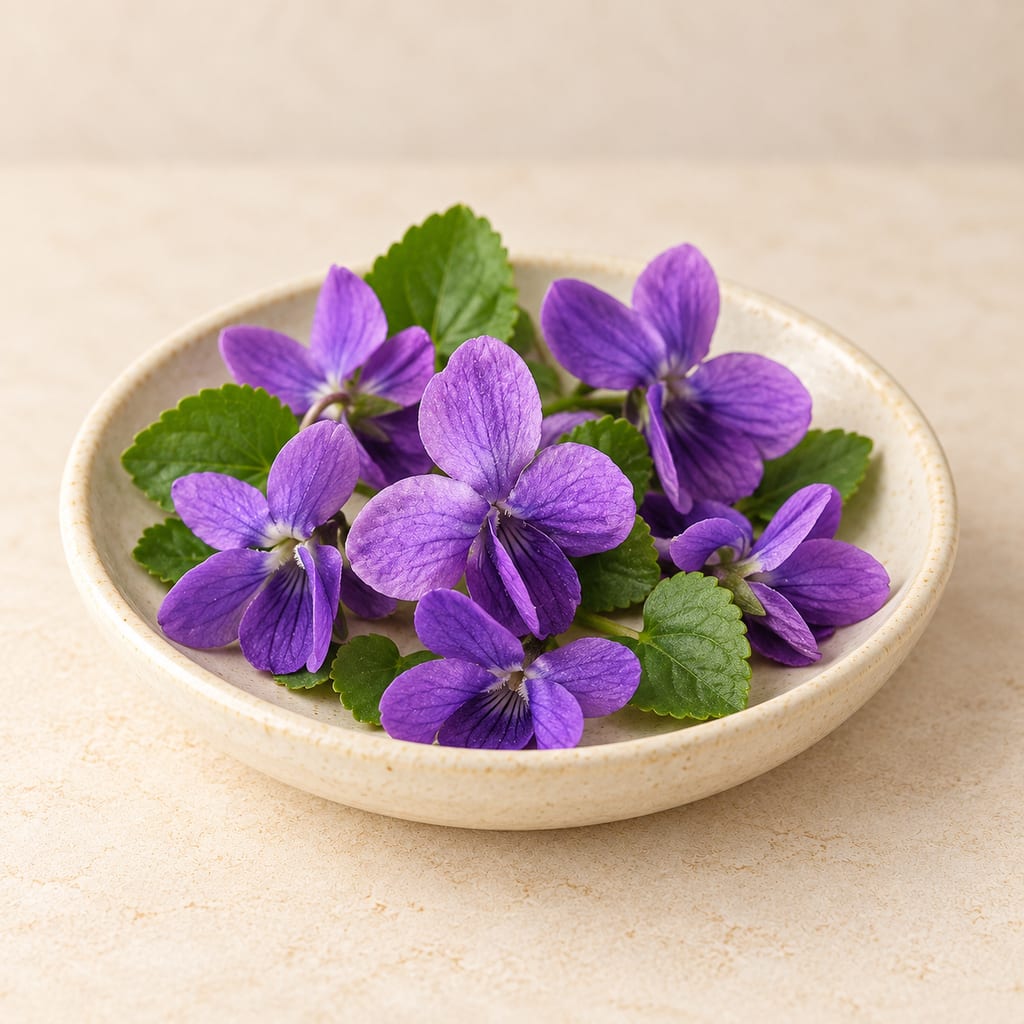
Sweet violet flowers
Viola odorata is a temperate, mat-forming perennial with UK flower-garnish uses and an interview-reported Moldovan fermented-flower drink whose method is not specified.
Name and range
Kew accepts Viola odorata L. (Violaceae), native from Europe to western and northern Iran and north-western Africa; introduced occurrences are listed separately. Kew records two accepted subspecies, V. odorata subsp. odorata and subsp. stolonifera. RHS lists sweet violet, English violet, florist’s violet, garden violet and March violet among its names; “pansy” can also mean other Viola taxa or horticultural hybrids.
RHS describes a rhizomatous mat-forming perennial with heart-shaped leaves and fragrant violet or white flowers. The Woodland Trust distinguishes common dog violet (V. riviniana) as a close-looking species. Common names and flower appearance do not establish species identity; this account is not a field key.
Flowering and garden descriptions
RHS gives late-winter and early-spring flowering for its UK garden profile; the Woodland Trust gives March-to-May flowering and woodland-edge habitat in its UK species account. These regional descriptions are not universal harvest dates.
RHS lists full sun or partial shade; chalk, clay, loam or sand; broad acid/alkaline/neutral pH categories; and moist but well-drained or well-drained soil. It assigns H6 in the UK scheme, which it defines as −20 to −15°C; this is not an experimental frost-damage threshold. RHS lists seed or division propagation, describes woodland-garden use and deadheading, and names susceptibility to slugs/snails, glasshouse red spider mite, violet gall midge, pansy leaf spot and powdery mildews. It does not give pot dimensions or a protected-production schedule.
Sources for this section
Reported food uses in Moldova and the UK
A Moldova study published on 14 July 2021 reports student conversations followed by interviews with about 120 adults aged 40–80; 16 spontaneous edible herbs mentioned at least once were selected. Its Table 2 separates general literature/database descriptions from a Moldova culinary-use column attributed to interview results. For V. odorata, the interview column reports flowers and leaves in raw salads, flowers as decoration, a slightly alcoholic aromatic drink from fermented flowers compared with cherry or socata, and sweetened flowers used to decorate and flavour desserts. This is an aggregated country-level report, not a measured national frequency or an informant’s full recipe.
The table’s separate literature-use column describes young leaves and flower buds as raw or cooked, leaves in salads and soups, and other uses including pudding flavouring and tea. These literature-derived descriptions should not be reassigned to the Moldova interview column. RHS separately suggests sprinkling sweet-violet flowers over puddings; the Woodland Trust describes candied flowers used to decorate cakes and flowers in salads or as garnish.
What the food account does not specify
The Moldova paper does not supply an informant-level formula for the fermented-flower drink: it gives no additional ingredients, starter, quantities, yield, ordered stages, time, temperature, monitoring, endpoint, storage or safety assessment. The report is useful as a regional food-history lead, not a household recipe. No process is reconstructed from unrelated violet syrups or from uses assigned to the wider genus.
RHS’s flower guidance is general. It advises checking identity, using young fresh flowers, avoiding sites frequented by livestock or dog walkers, washing them, and recognizing possible reactions or chemical treatment of non-food flowers. It does not assess the safety of a particular V. odorata specimen or beverage.
Local conservation and cultivation limits
The Woodland Trust describes sweet violet as widespread across the UK but increasingly uncommon and says culinary foraging may add pressure; it recommends planting violets for kitchen use. This is a qualitative UK conservation message, not a population survey or legal collection rule.
The inspected horticultural evidence is a UK garden profile, not a measured food crop study. No species-specific container dimensions, home harvest/regrowth schedule, greenhouse temperature or humidity regime, heat limit, irrigation threshold or storage period was established.
Sources for this section
Research gaps
The Moldova beverage account is interview-reported and gives no complete method, measured batch, endpoint, storage or safety information.
No respondent-level frequency or locality-specific account, or earliest dated food attestation, was verified.
No productive household container or heated/unheated greenhouse protocol, universal climate threshold, harvest yield or regrowth schedule was found.
No independent botanical identification key, species-specific food-safety assessment or legal wild-collection survey is provided.
Research status
The underlying plant account received a partial source review. Its review scope is described in the original plant article.
Sources for this section
Places
Unknown
Relationship not established · Place not establishedThe available research does not establish a single origin for this ingredient.
Community
No community contributions have been published for this entry yet.
Share what you made
Sign in to contribute. Published comments and photos are free to read.
Sources
Royal Botanic Gardens, KewIngredient research
Viola odorata L. | Plants of the World OnlineCited in: Name and range; Research gaps
Royal Horticultural SocietyIngredient research
Viola odorata (Vt) | RHS Plant ProfileCited in: Name and range; Flowering and garden descriptions; Local conservation and cultivation limits; Research gaps
Rodica Siminiuc and Dinu Țurcanu, Food and Nutrition Sciences 12 (2021), 703–718Ingredient research
Study of Edible Spontaneous Herbs in the Republic of Moldova for Ensuring a Sustainable Food SystemCited in: Reported food uses in Moldova and the UK; What the food account does not specify; Research gaps
Royal Horticultural SocietyIngredient research
Edible flowersCited in: Reported food uses in Moldova and the UK; What the food account does not specify; Research gaps
Woodland TrustIngredient research
Sweet violet (Viola odorata) | British PlantsCited in: Name and range; Flowering and garden descriptions; Reported food uses in Moldova and the UK; Local conservation and cultivation limits; Research gaps
FermenteaResearch provenance
Sweet violet: Moldovan food notes and garden evidence: original plant researchCited in: Research status