
Substrates
Water bamboo stems
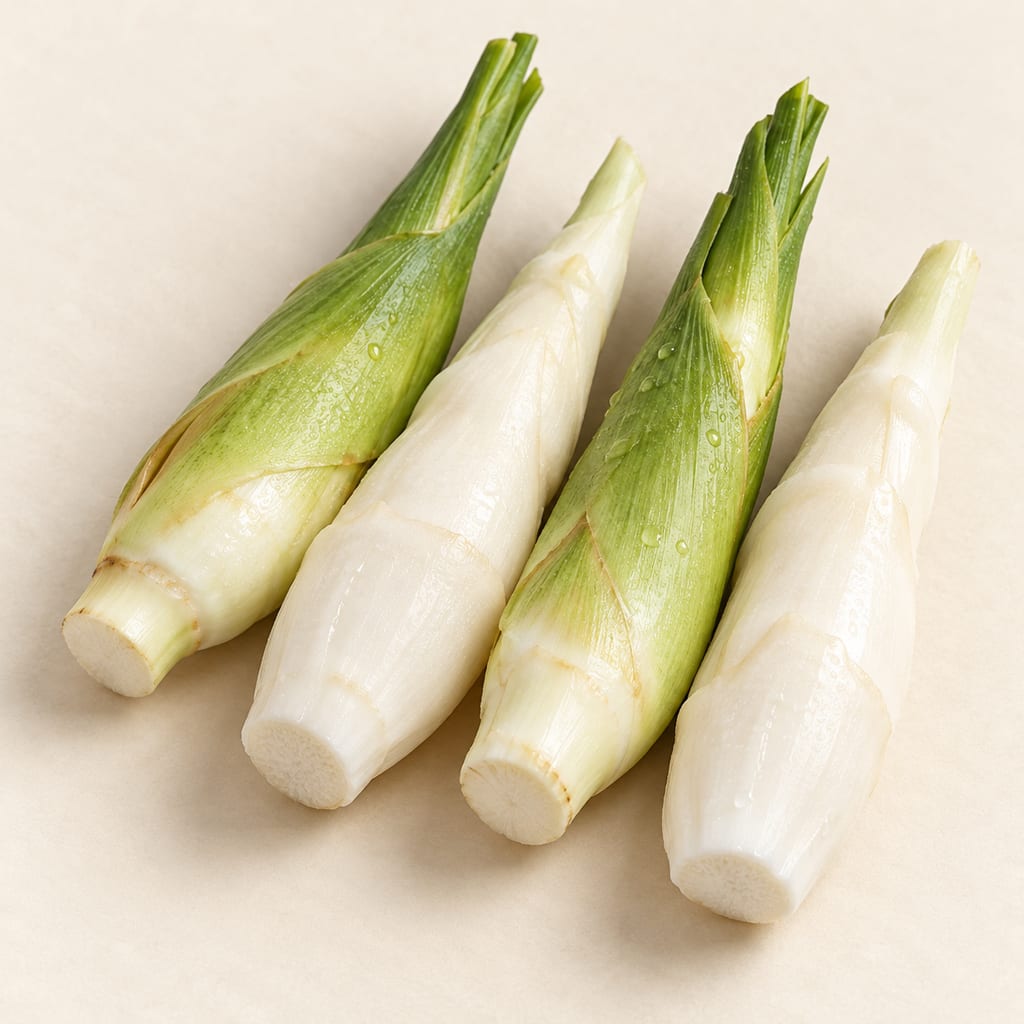
In Taiwan and Hong Kong food sources, jiaobai is the swollen stem of Zizania latifolia associated with Ustilago esculenta. It is distinct from the grain called North American wild rice, and the plant-fungus association is not food fermentation.
Accepted name and lookalikes
Kew accepts Zizania latifolia (Griseb.) Hance ex F.Muell., a perennial grass native from Assam to southeastern Siberia and temperate East Asia. Its synonym list includes Hydropyrum latifolium and Zizania dahurica. The words “wild rice” can mislead: the North American grain crops are other Zizania species. In food accounts, “water bamboo shoot” or jiaobai refers to a swollen stem of Z. latifolia, not a grain and not proof of the identity of an unknown plant.
The edible shoot and its fungal partner
Hong Kong Wetland Park describes the edible water bamboo shoot as the white, crisp, juicy swelling of a young stem after Ustilago esculenta acts within it; its page says plants without the fungus do not form that edible swelling. Taiwan's agricultural food-information page presents jiaobai as a seasonal vegetable and lists cooked examples including stir-frying, blanching, soup, grilling and cold preparations. This plant–fungus growth association is not a fermented food process. These are accounts of cultivated market shoots, not instructions to inoculate, collect or eat an unidentified wetland plant.
Sources for this section
Taiwanese food and crop context
A Taiwan Ministry E-news item describes a salted-egg quick stir-fry as a one-pot dish taking about ten minutes and lists ingredients for about two servings. Its page does not give the video's ordered steps, so it is an incomplete source-described food example, not a reproducible recipe or process validation. A separate Ministry historical article describes earlier grain use recorded in ancient Chinese texts before the later crop selected for swollen stems. This is the authors' historical summary, not an independent reading of the cited ancient texts.
Sources for this section
Cultivation evidence is regional and commercial
Taiwan Ministry crop guidance describes shallow-water field production, vegetative planting stock and locally named cultivars with different calendars. A Taiwan Agricultural Research Institute account reports first harvest at about 100 days after winter-solstice transplanting in its normal-season system and describes day-length extension beyond 14 hours per day for a named early-season setting. These are source-specific commercial schedules and treatments, not universal day-length requirements, a home tub or container design, or a heated or unheated greenhouse regime. The reviewed sources give no general frost-survival, heat-injury, humidity, water-quality or household-harvest thresholds.
Sources for this section
New Zealand status and its limits
New Zealand's Smart Weed Alert Tool currently classifies Z. latifolia as a weed and lists it in national categories that include Environmental Weeds, the National Pest Plant Accord, Notifiable Organisms and Unwanted Organisms, as well as regional pest-management plans. These are the tool's listed classifications, not a legal interpretation for other countries. The linked Biosecurity (Notifiable Organisms) Order page could not be opened in this review, so its current statutory wording was not independently checked. An EPPO pest-risk analysis was only partially reviewed and is not used here to claim a separate legal rule.
Food, harvest and growing gaps
Taiwan's sources describe quality changes as the shoots mature, including black spore masses and a coarser texture; a consumer page also gives short-term refrigerated storage advice for covered shoots. Those are source-specific descriptions, not a food-safety test or a validated shelf-life. No safe endpoint for wild-harvested material, fermentation process, household propagation method, or legal status outside the cited New Zealand records was established.
Sources for this section
Research gaps
No specimen-level identification method, collection permission or safety assessment is provided; a common name or swelling alone is not identification.
Taiwan calendar, field-lighting and vegetative propagation examples are crop- and site-specific, not home growing, container or greenhouse protocols.
The government salted-egg page omits ordered video steps; no complete source-verified household recipe or processing endpoint is available here.
Taiwan consumer storage advice and maturity descriptions are not validated safety or shelf-life findings.
The New Zealand weed tool's categories were inspected, but the linked Biosecurity Order could not be reopened. Current legal effect and legal status elsewhere remain unchecked; EPPO report review is partial.
Sources for this section
- Zizania latifolia (Griseb.) Hance ex F.Muell. | Plants of the World Online →
- Manchurian Wild Rice | Aquatic Plants →
- 茭白筍 | Taiwan Agricultural Product Map →
- 茭白筍產期調節與周年生產技術 →
- 一分鐘簡單料理教室 EP8-金沙茭白筍 →
- Zizania latifolia | Smart Weed Alert Tool →
- Biosecurity (Notifiable Organisms) Order 2016 →
- Pest risk analysis: Zizania latifolia →
- 茭白筍黑心是否可食用? →
- 茭白之演化、利用與育種方向 →
Research status
The underlying plant account received a partial source review. Its review scope is described in the original plant article.
Sources for this section
Places
Unknown
Relationship not established · Place not establishedThe available research does not establish a single origin for this ingredient.
Community
No community contributions have been published for this entry yet.
Share what you made
Sign in to contribute. Published comments and photos are free to read.
Sources
Royal Botanic Gardens, KewIngredient research
Zizania latifolia (Griseb.) Hance ex F.Muell. | Plants of the World OnlineCited in: Accepted name and lookalikes; Research gaps
Hong Kong Wetland Park, Leisure and Cultural Services DepartmentIngredient research
Manchurian Wild Rice | Aquatic PlantsCited in: Accepted name and lookalikes; The edible shoot and its fungal partner; Research gaps
Taiwan Ministry of Agriculture Food and Agriculture Education PlatformIngredient research
茭白筍 | Taiwan Agricultural Product MapCited in: The edible shoot and its fungal partner; Food, harvest and growing gaps; Research gaps
Taiwan Ministry of Agriculture, Taiwan Agricultural Research InstituteIngredient research
茭白筍產期調節與周年生產技術Cited in: Cultivation evidence is regional and commercial; Research gaps
Taiwan Ministry of Agriculture E-newsIngredient research
一分鐘簡單料理教室 EP8-金沙茭白筍Cited in: Taiwanese food and crop context; Food, harvest and growing gaps; Research gaps
New Zealand Biosecurity Surveillance NetworkIngredient research
Zizania latifolia | Smart Weed Alert ToolCited in: New Zealand status and its limits; Research gaps
New Zealand LegislationIngredient research
Biosecurity (Notifiable Organisms) Order 2016Cited in: New Zealand status and its limits; Research gaps
European and Mediterranean Plant Protection OrganizationIngredient research
Pest risk analysis: Zizania latifoliaCited in: New Zealand status and its limits; Research gaps
Taiwan Ministry of AgricultureIngredient research
茭白筍黑心是否可食用?Cited in: Food, harvest and growing gaps; Research gaps
Taiwan Council of Agriculture, Forestry Research Institute authors Hung Sheng-feng and Chen Shun-ying, hosted by Taiwan Ministry of AgricultureIngredient research
茭白之演化、利用與育種方向Cited in: Taiwanese food and crop context; Research gaps
FermenteaResearch provenance
Zizania latifolia: the fungus-swollen water bamboo shoot: original plant researchCited in: Research status