
Spices and aromatics
Kawakawa leaf
Kawakawa is a New Zealand pepper-family plant with source-specific Māori food knowledge, dated regulatory views for dried leaves and cultivation advice that varies by taxonomic and regional scope.
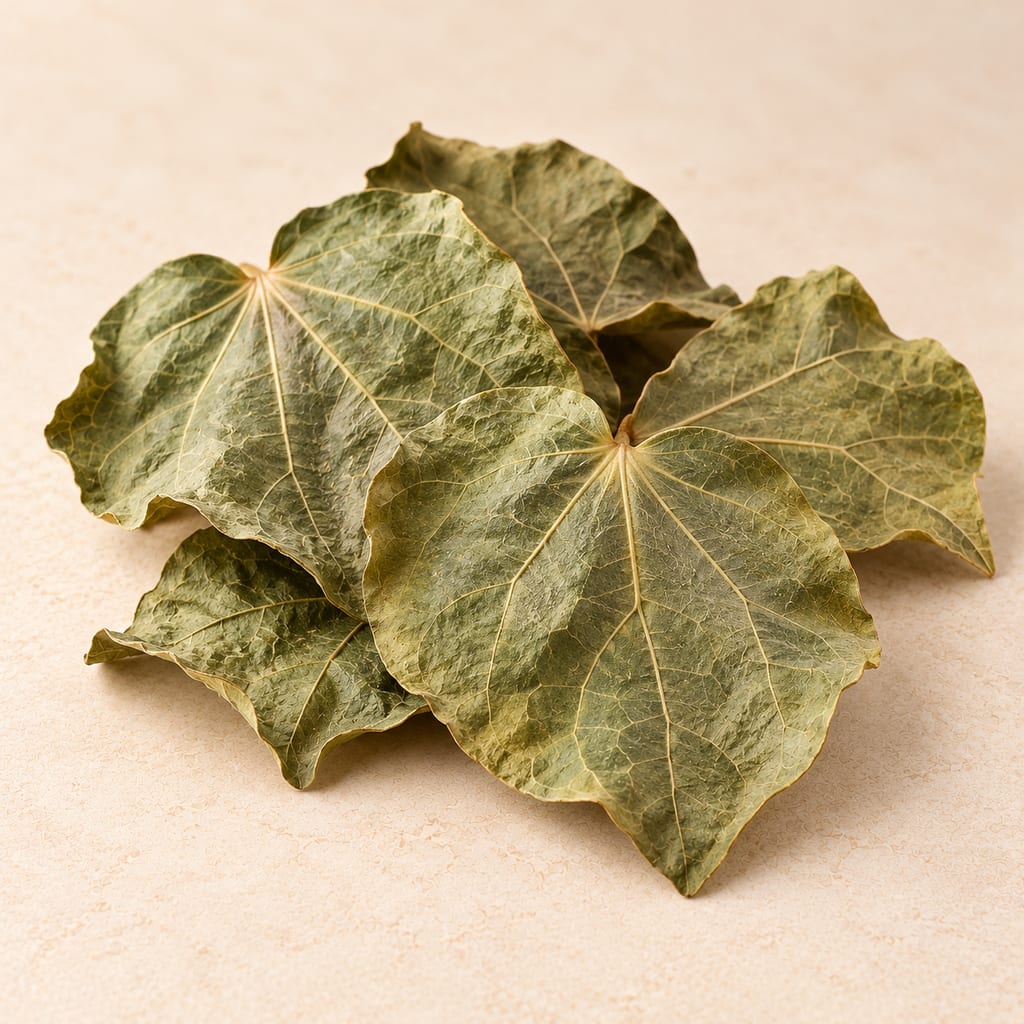
Name and range
Flora of New Zealand accepts Piper excelsum and lists Macropiper excelsum as a synonym. It recognizes four New Zealand subordinate taxa, including subsp. psittacorum. Kew's Plants of the World Online accepts P. excelsum with three subspecies and separately accepts P. psittacorum; Kew lists P. excelsum subsp. psittacorum among that species' synonyms and notes an alternative 1994 classification. These are authority-specific treatments. A common name on a food or garden page does not identify a subspecies. Kew gives P. excelsum a native range including New Zealand and the Society Islands, while Flora of New Zealand records it as indigenous but non-endemic in New Zealand.
Kawakawa is distinct from kava, Piper methysticum. Their shared genus does not make their names or uses interchangeable.
Season and regional growing notes
Flora of New Zealand reports flowering and fruiting throughout the year at species level. The narrower NZPCN growing account is for subsp. excelsum: it describes coastal-to-lowland forest habitat, flowers mainly from August to November, and reports fruit through the year. It recommends dappled light and moist but free-draining soil and says the subspecies will not tolerate frost. Its propagation advice names fresh seed and semi-hardwood cuttings. A 2021 Garden Life article produced by Dunedin Botanic Garden and carried by ODT groups Piper excelsum and P. melchior as kawakawa and says they can be grown as pot plants in Dunedin if protected from frost. This is qualitative local advice for two taxa together, not a measured pot trial or a species-exclusive performance result.
Auckland Botanic Gardens gives local advice for Piper excelsum: partial shade, moist free-draining soil and careful watering of young plants in dry periods. DOC describes seed collection and propagation for kawakawa, including fruit ripening around December or January in its account. These regional and taxonomic scopes do not establish a universal frost threshold, greenhouse setting or container schedule.
Food reports and cultural context
Food sources describe dried leaf as an infusion or minor seasoning and preserve historical leaf and fruit reports. Ngā Rauropi Whakaoranga records historical accounts under the synonym Macropiper excelsum, including reports attributed to particular writers and a Whakatōhea-associated use of the name tākawa. These records do not represent every Māori community. The Ngāti Whanaunga Incorporated Society report describes knowledge in its own cultural-impact and rohe context; it is not generalized here.
FSANZ's June 2025 record of views includes dated, use-specific opinions concerning dried P. excelsum leaf in herbal infusion and as a minor seasoning component. Those entries are not individual product approvals and do not cover fresh leaf, fruit, other parts or every preparation. Te Ara describes modern uses of kawakawa by common name without a Latin name in the relevant passage. KidsHealth publishes a kawakawa tea recipe using fresh leaves, but its page does not provide a scientific identification or subspecies; its local tikanga note remains specific to that source.
Preparation and evidence limits
The inspected sources report leaf infusion, seasoning and historical ripe-fruit use, but they do not establish one recipe or preparation rule across parts and sources. The KidsHealth recipe is a common-name-only fresh-leaf tea account; the FSANZ views concern dried leaf in their stated categories. The difference in ingredient form and scope matters. Neither source establishes a safety endpoint for the other's preparation.
The research sources include historical medicinal accounts, but this article makes no therapeutic recommendation. They do not establish a food-safety threshold, storage life or reliable field-identification method for gathered material. The KidsHealth page's leaf-hole heuristic is not used as an identity or safety test.
What remains unresolved
A voucher or other taxonomic evidence is absent from common-name-only culinary records, so their ingredients cannot be assigned to a Piper excelsum subspecies. The New Zealand Flora and Kew treatments differ on P. psittacorum; the article preserves both authority statements instead of choosing a taxonomic consensus. Local growing advice is not a global climate prescription. No complete validated household recipe, food-safety endpoint, storage limit or local collection permission was established.
Sources for this section
- Flora of New Zealand: Piper excelsum taxon entry →
- Piper excelsum G.Forst. →
- Piper psittacorum Endl. →
- Piper excelsum subsp. excelsum fact sheet →
- Macropiper excelsum. Kawakawa. →
- Record of views formed in response to inquiries, updated June 2025 →
- Piper excelsum →
- Collect seeds and propagate native trees and shrubs: Piper excelsum/kawakawa →
- Kawakawa Tea →
- Māori foods – kai Māori →
Research gaps
Flora of New Zealand and Kew differ on whether psittacorum is a Piper excelsum subspecies or an accepted species; common-name food sources have no subspecies voucher.
FSANZ's entries are dated views for stated dried-leaf categories, not product approvals or evaluation of fresh leaf, fruit or other preparations.
Māori food accounts retain their named authors, iwi/rohe and historical contexts; they are not universalized.
No complete source-reviewed household method with a shared endpoint, storage guidance or safety determination was established.
NZPCN's frost and propagation statements concern subsp. excelsum; other horticultural advice is regional and does not establish universal container or greenhouse controls.
Sources for this section
- Flora of New Zealand: Piper excelsum taxon entry →
- Piper excelsum G.Forst. →
- Piper psittacorum Endl. →
- Piper excelsum subsp. excelsum fact sheet →
- Macropiper excelsum. Kawakawa. →
- Ngāti Whanaunga Cultural Impact Assessment (Auckland Surf Park, 18 July 2023; redacted) →
- Record of views formed in response to inquiries, updated June 2025 →
- Piper excelsum →
- Collect seeds and propagate native trees and shrubs: Piper excelsum/kawakawa →
- Kawakawa Tea →
- Māori foods – kai Māori →
- NZ natives suitable for indoor plantings (15 April 2021) →
Research status
The underlying plant account received a partial source review. Its review scope is described in the original plant article.
Sources for this section
Places
Unknown
Relationship not established · Place not establishedThe available research does not establish a single origin for this ingredient.
Community
No community contributions have been published for this entry yet.
Share what you made
Sign in to contribute. Published comments and photos are free to read.
Sources
Manaaki Whenua – Landcare Research / Flora CommitteeIngredient research
Flora of New Zealand: Piper excelsum taxon entryCited in: Name and range; Season and regional growing notes; What remains unresolved; Research gaps
Plants of the World Online, Royal Botanic Gardens, KewIngredient research
Piper excelsum G.Forst.Cited in: Name and range; What remains unresolved; Research gaps
Plants of the World Online, Royal Botanic Gardens, KewIngredient research
Piper psittacorum Endl.Cited in: Name and range; What remains unresolved; Research gaps
New Zealand Plant Conservation NetworkIngredient research
Piper excelsum subsp. excelsum fact sheetCited in: Name and range; Season and regional growing notes; What remains unresolved; Research gaps
Ngā Rauropi Whakaoranga / Manaaki WhenuaIngredient research
Macropiper excelsum. Kawakawa.Cited in: Food reports and cultural context; Preparation and evidence limits; What remains unresolved; Research gaps
Ngāti Whanaunga Incorporated SocietyIngredient research
Ngāti Whanaunga Cultural Impact Assessment (Auckland Surf Park, 18 July 2023; redacted)Cited in: Food reports and cultural context; Research gaps
Food Standards Australia New ZealandIngredient research
Record of views formed in response to inquiries, updated June 2025Cited in: Food reports and cultural context; Preparation and evidence limits; What remains unresolved; Research gaps
Auckland Botanic GardensIngredient research
Piper excelsumCited in: Season and regional growing notes; What remains unresolved; Research gaps
Department of Conservation Te Papa AtawhaiIngredient research
Collect seeds and propagate native trees and shrubs: Piper excelsum/kawakawaCited in: Season and regional growing notes; What remains unresolved; Research gaps
KidsHealth New Zealand; recipe credited to Charlie RahiriIngredient research
Kawakawa TeaCited in: Food reports and cultural context; Preparation and evidence limits; What remains unresolved; Research gaps
Te Ara – The Encyclopedia of New Zealand; Charles Royal and Jenny Kaka-ScottIngredient research
Māori foods – kai MāoriCited in: Food reports and cultural context; Preparation and evidence limits; What remains unresolved; Research gaps
Otago Daily Times; Garden Life produced by Dunedin Botanic GardenIngredient research
NZ natives suitable for indoor plantings (15 April 2021)Cited in: Season and regional growing notes; Research gaps
FermenteaResearch provenance
Kawakawa (Piper excelsum): original plant researchCited in: Research status