
Mushrooms
Lactarius rubrobrunneus
Lactarius rubrobrunneus is a taxonomically described Southeast Asian milk cap; food use is not established by a culinary source in this record.
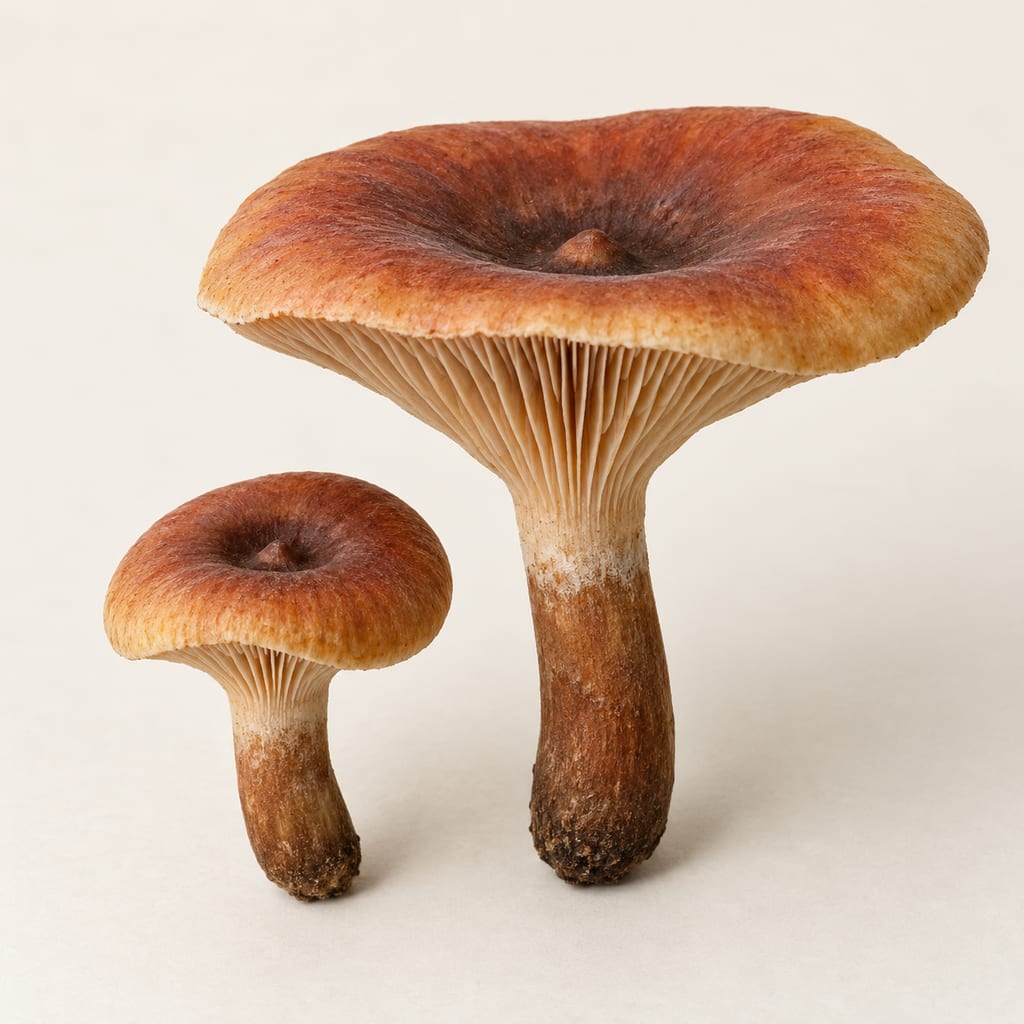
What it is
Lactarius is the milk cap genus. Its members are mycorrhizal, meaning they form a partnership with the roots of trees, and most of them release a milky latex when the flesh or gills are cut or broken. The latex colour and taste are among the features used to tell species apart.
Wisitrassameewong and colleagues described Lactarius rubrobrunneus as a new species in a 2015 taxonomic study of Southeast Asian milkcaps. Their description records a depressed, papillate reddish-brown cap with a darker centre, crowded cream to greyish-orange gills and a brown stem; Figure 11c shows the AV12-044 collection and credits the photograph to A. Verbeken.
Food use
No ethnomycological, market or culinary source reviewed names Lactarius rubrobrunneus as a food, and no preparation method is recorded. The catalogue's food-use label for this species is unconfirmed.
Milk caps as a group are a mixed food category. Several species are eaten in different places, and the mushroom is often parboiled or soaked before cooking to reduce its sharpness, but whether those practices apply to this species is not established.
Safety and look-alikes
Edibility in Lactarius is species-specific, so a genus-level statement does not establish that this species is safe. Some milk caps are not good to eat, and the sources list at least one, Lactarius turpis, as unsuitable. The peppery milk cap, Lactifluus piperatus, is a related species that is semi-edible.
A 2015 taxonomic treatment compares this species with Lactarius fuscomaculatus, distinguishing the latter by dark brown cap spots and differences in microscopic cap-surface structure. Such taxonomic comparisons are not a field identification guide; this page gives no edibility verdict.
Notes
The 2015 taxonomic paper describes the species' fruitbody morphology and montane Thai habitat. The food-use label carried in the catalogue remains unconfirmed by a culinary or market source listed here.
Places
No source in this record establishes a place.
Community
No community contributions have been published for this entry yet.
Share what you made
Sign in to contribute. Published comments and photos are free to read.
Sources
MykowebIdentity · Safety
Milky Caps, Mykoweb cookbookMilk caps (genus Lactarius) include several edible species, but edibility is species-specific and some milk caps are not good to eat.
Cited in: What it is; Food use; Safety and look-alikes
PubMed Central, as suppliedFood use
Food-use record supplied in the fungi catalogue (entry F-4baa2496184e)Catalogue entry for Lactarius rubrobrunneus with a supplied food-use label pending specialist review.
Cited in: Food use; Safety and look-alikes; Notes
Phytotaxa / Magnolia PressTaxonomy · Identity · Morphology
Lactarius subgenus Russularia (Russulaceae) in South-East Asia: 3. new diversity in Thailand and VietnamDescribes L. rubrobrunneus as a new species from Thailand, with holotype collection AV12-044 (2012).
Describes a 15–80 mm convex to depressed or infundibuliform papillate pileus, dry and slightly rugulose, dark brown at center and reddish-orange to reddish-brown or yellow-brown toward the margin.
Describes crowded, forked, decurrent cream to greyish-orange gills.
Figure 11c depicts L. rubrobrunneus collection AV12-044 and credits the photograph to A. Verbeken.
Does not support edibility or a food-use claim.
Cited in: What it is; Safety and look-alikes; Notes