
Mushrooms
Lake's bolete
Lake's bolete, Suillus lakei, is a North American mycorrhizal bolete of Douglas-fir that has been introduced to South America, where it is gathered from plantations as a wild food.
Overview
Lake's bolete, Suillus lakei, is a bolete of the Suillaceae family. It forms ectomycorrhizal partnerships with Douglas-fir, and its distribution follows the range of that tree. The fungus grows in the ground under young conifers and in open ground such as road banks and campgrounds, where the soil is poor and exposed.
In the catalogue used for this page, it is listed as an introduced, plantation-associated food fungus in Patagonia, supplied from the wild. Its food use there rests on that catalogue entry and is not confirmed by a separate source.
Sources for this section
Taxonomy and names
William Alphonso Murrill described the species as Boletinus lakei from a collection made near Corvallis, Oregon, in 1907. The name honours the mycologist E.R. Lake. Smith and Thiers moved it to Suillus in 1964. Earlier names in use include Boletus lakei and Ixocomus lakei, and a variety, pseudopictus, was described in 1964.
Common names include Lake's bolete, matte jack and western painted suillus. The catalogue records the scientific name as a research label rather than a reconciled accepted name, so records should be checked against the name Suillus lakei.
Sources for this section
Description
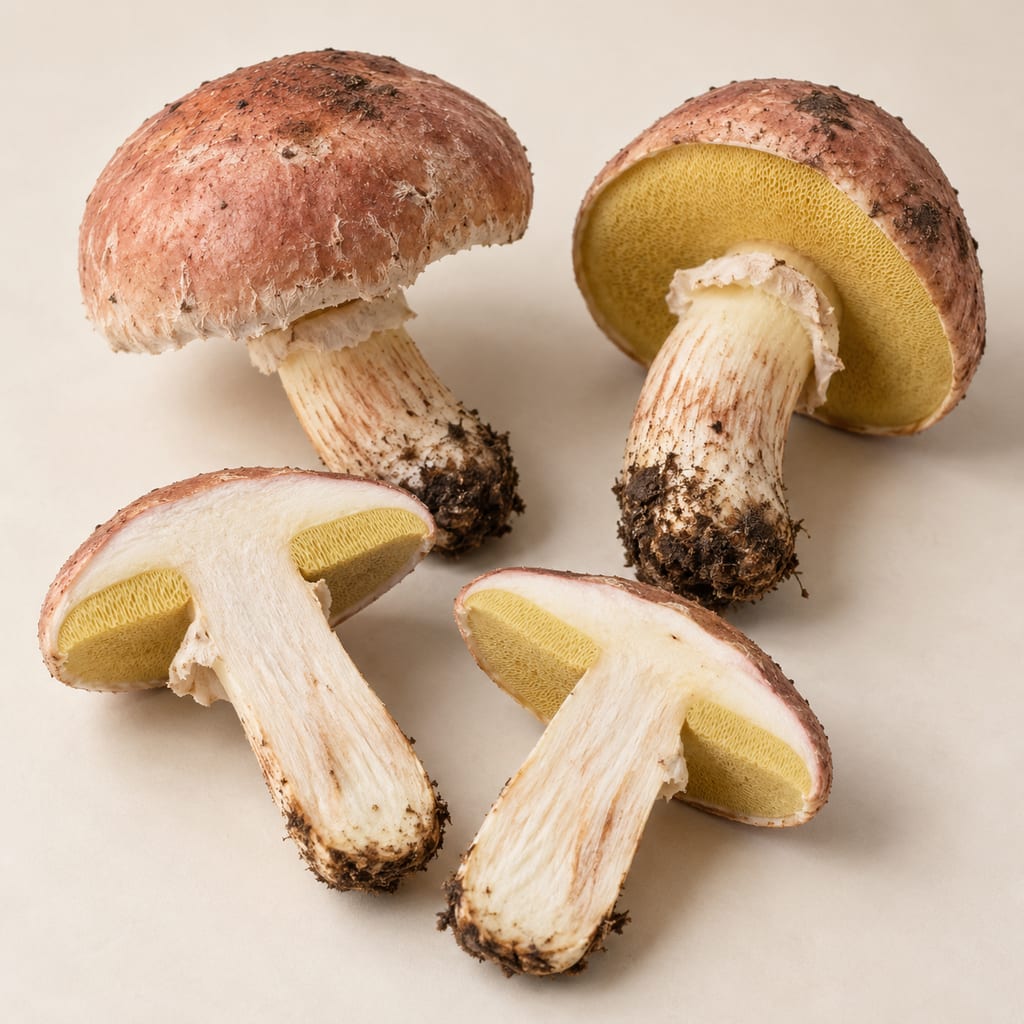
The cap reaches about 15 cm across, is convex and flattens with age, and is yellowish to reddish-brown with pressed-down hairs or small tufted scales. It can become sticky after heavy rain. The pores are angular, yellow to ochre, and bruise brownish or reddish-brown. A whitish partial veil covers them when the fungus is young. The stem is yellow, sometimes streaked with red, solid, and carries a delicate woolly ring that often disappears. The flesh is yellow and either stays unchanged or turns pinkish-red when bruised. The spore print is cinnamon to brown.
Sources for this section
Look-alikes and identification
The species is separated from other Suillus species by host tree, cap colour, veil type and blue staining when the stem is injured. The sources name S. spraguei, S. cavipes, S. ochraceoroseus, S. ponderosus, S. decipiens and S. caerulescens as related species to check against.
A description on a page is not an identification. Anyone gathering this fungus should compare it with a voucher or a regional expert and keep to the species' host tree and habitat.
Sources for this section
Distribution
Lake's bolete is native to the Rocky Mountains and western North America and extends south into Mexico. It has been introduced to parts of Europe, to South America (Argentina and Chile), and to the South Island of New Zealand, usually with planted Douglas-fir. The IUCN Red List assesses it as Least Concern.
Sources for this section
Edibility and quality
The species is described as edible. The IUCN Red List says it is edible but rarely collected for food. Wikipedia says opinions vary considerably on its quality, with descriptions ranging from choice to mediocre and from good to poor in taste and texture.
The sources reviewed give no toxicity data, no cooking method and no safe quantity. The catalogue flags food preparation and tolerance for species-level review, and that review is still open.
Sources for this section
Safety
No toxicity or safety claim was found in the sources reviewed. Laboratory work cited on Wikipedia reports antimicrobial activity and the presence of alkaloids and tannins, and it does not show whether the fungus is safe to eat.
Appearance, smell and taste do not establish that a mushroom is safe to eat. Identify wild fungi with a qualified expert and follow official food safety advice before eating any wild mushroom.
Sources for this section
Open questions
The sources do not give a dated record of food use, a Patagonia-specific distribution source, regional names used by harvesters, or any preparation that makes the species safe. These gaps are unknown, not negative findings.
Sources for this section
Places
Patagonia
Documented use · Region evidenceThe catalogue records food use in Patagonia with the species introduced there. Wikipedia lists introduced records in Argentina and Chile with Douglas-fir; no Patagonia-specific source was found.
Western North America
Relationship not established · Region evidenceNative range is the Rocky Mountains and western North America, extending into Mexico. The sources reviewed do not document a traditional food use there.
Community
No community contributions have been published for this entry yet.
Share what you made
Sign in to contribute. Published comments and photos are free to read.
Sources
WikipediaTaxonomy · Description · Habitat · Distribution · Edibility
Suillus lakeiNamed Boletinus lakei by Murrill from a 1907 Corvallis, Oregon collection; transferred to Suillus by Smith and Thiers in 1964
Mycorrhizal with Douglas-fir; grows on poor, exposed soil such as road banks and campgrounds
Introduced to parts of Europe, South America (Argentina and Chile) and New Zealand
Edible; opinions vary considerably as to its quality
Look-alikes include S. spraguei, S. cavipes, S. ochraceoroseus, S. ponderosus, S. decipiens, S. caerulescens
Cited in: Overview; Taxonomy and names; Description; Look-alikes and identification; Distribution; Edibility and quality; Safety; Open questions
IUCN Red ListConservation · Edibility
Suillus lakei, IUCN Red List assessmentLeast Concern (LC), assessed 2018
States the species is edible but rarely collected for food
Cited in: Distribution; Edibility and quality