
Mushrooms
Meadow waxcap
The meadow waxcap, Cuphophyllus pratensis, is a salmon-to-orange gilled mushroom of old grassland in Europe. Its fruit bodies are edible and gathered for sale in some countries, but its habitat is declining.
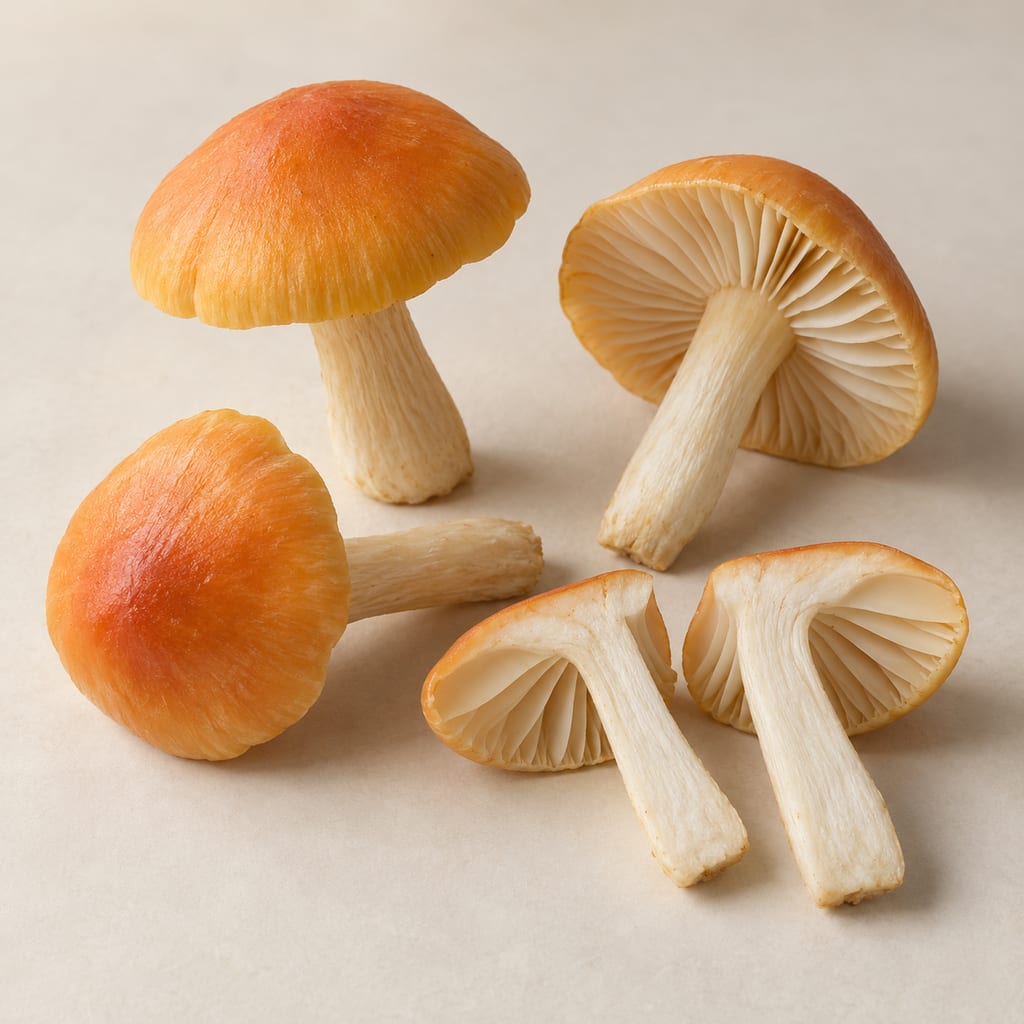
What it is
The meadow waxcap is a gilled mushroom with a cap up to 6 centimetres across, convex at first and later flat, umbonate or slightly depressed. The surface is smooth and dry, pale salmon to orange-buff. The gills are waxy, pale and decurrent, running down the stem, and the stem is smooth, creamy and up to 7 centimetres long.
Its flesh is whitish with a mild smell and taste, which is sometimes described as unpleasant. The spore print is white. The Latin epithet pratensis means growing in meadows.
Sources for this section
Names and taxonomy
Jacob Christian Schaffer first described the species in 1774 as Agaricus pratensis. It was moved to Hygrocybe in 1914, and DNA-based research later placed it in Cuphophyllus. Older books and guides often use Hygrocybe pratensis, and Camarophyllus pratensis also appears in the literature.
The recommended English name is meadow waxcap. Similar species include Cuphophyllus berkeleyi, a white-fruited form sometimes treated as a variety, and Hygrophorus nemoreus.
Sources for this section
Where it grows
In Europe the meadow waxcap grows in old, unimproved short grassland, such as pastures and lawns. It is typical of waxcap grasslands, a habitat that is declining. Elsewhere it is recorded in woodland, and its distribution is mainly temperate.
Recent research suggests the species is neither mycorrhizal nor saprotrophic and may be associated with mosses. That point is unsettled and should not be read as a settled ecology.
Sources for this section
Edibility and taste
The fruit bodies are edible, and in some countries they are gathered seasonally for sale at local markets. Guides rate its taste differently. One describes it as the best eating in its group, with a nutty, mushroomy flavour in prime condition. A Swedish guide rates it a good edible with a mild taste, best mixed with more flavourful mushrooms.
The fruit bodies are described as holding their texture when cooked. Their high water content means the mushroom can be cooked in its own juices, without oil or fat, according to one foraging guide.
Identification and safety
Some waxcaps are highly toxic lookalikes, so a waxcap is not identified by its colour alone. The Foraging Course Company advises being fully certain of the identification and of the edibility before eating any wild mushroom.
The catalogue notes that old genus names are common in the literature, which can make older food records hard to match to the current name.
Conservation
Although it is one of the commoner members of its genus, the meadow waxcap appears on official or provisional red lists of threatened fungi in several European countries, including the Czech Republic, Bavaria in Germany and Poland. Waxcap grasslands decline when fertiliser use and land change remove the old, unimproved grassland the species needs.
The catalogue notes that many waxcap habitats merit conservation.
Sources for this section
Places
Europe
Traditional use · Region evidenceIn Europe it grows in old, unimproved short-sward grassland such as pastures and lawns. Some European countries gather the fruit bodies seasonally for local markets.
Temperate regions outside Europe
Documented use · Region evidenceThe encyclopedia reports a widespread, mainly temperate distribution, with woodland records outside Europe. No locality is pinned down.
Community
No community contributions have been published for this entry yet.
Share what you made
Sign in to contribute. Published comments and photos are free to read.
Sources
WikipediaIdentity · Taxonomy · Habitat · Edibility · Conservation
Cuphophyllus pratensisCap up to 6 cm, pale salmon to orange-buff, smooth and dry; waxy decurrent gills; stipe up to 7 cm; flesh whitish with a mild, sometimes unpleasant smell and taste; spores about 5.5 to 6.5 by 4.0 to 5.0 micrometres; in Europe grows in old, unimproved grassland; described in 1774 by Schaffer as Agaricus pratensis; moved to Hygrocybe in 1914 and later placed in Cuphophyllus by DNA research; fruit bodies edible and seasonally gathered for sale in some countries; listed on red lists in several European countries.
Cited in: What it is; Names and taxonomy; Where it grows; Conservation
SvampguidenTaste · Edibility
Grassland waxcaps (Svampguiden)Rated a good edible with a mild taste, best mixed with more flavourful mushrooms (from search summary; full page not read).
Cited in: Where it grows; Edibility and taste
Galloway Wild FoodsTaste · Identification · Safety
Waxcap Fungi: Identification, Distribution, Edibility, ConservationDescribed as the best eating in its group, with a nutty, mushroomy flavour in prime condition; some waxcap lookalikes are highly toxic; waxcap habitats are under pressure from fertiliser use and land change (from search summary; full page not read).
Cited in: Edibility and taste; Identification and safety
The Foraging Course CompanyCooking · Safety
Meadow Waxcap, Cuphophyllus pratensis (foraging guide)Holds its texture on cooking; high water content, so it can be cooked without oil or fat; advises full certainty of identification and edibility before eating any wild mushroom (from search summary; full page not read).
Cited in: Edibility and taste; Identification and safety
Nordic repositoryFood · Market
Supplied catalogue source (norden diva-portal FULLTEXT01.pdf)Supplied catalogue source for a cooked grassland mushroom with food and market evidence; the catalogue notes that old genus names are common and that many waxcap habitats merit conservation.
Cited in: Identification and safety; Conservation