
Mushrooms
Mongolian mushroom
The Mongolian mushroom, Leucocalocybe mongolica, is a wild steppe fungus of the Mongolian Plateau, prized as food in Northeast Asia and listed as threatened by drought and over-collection.
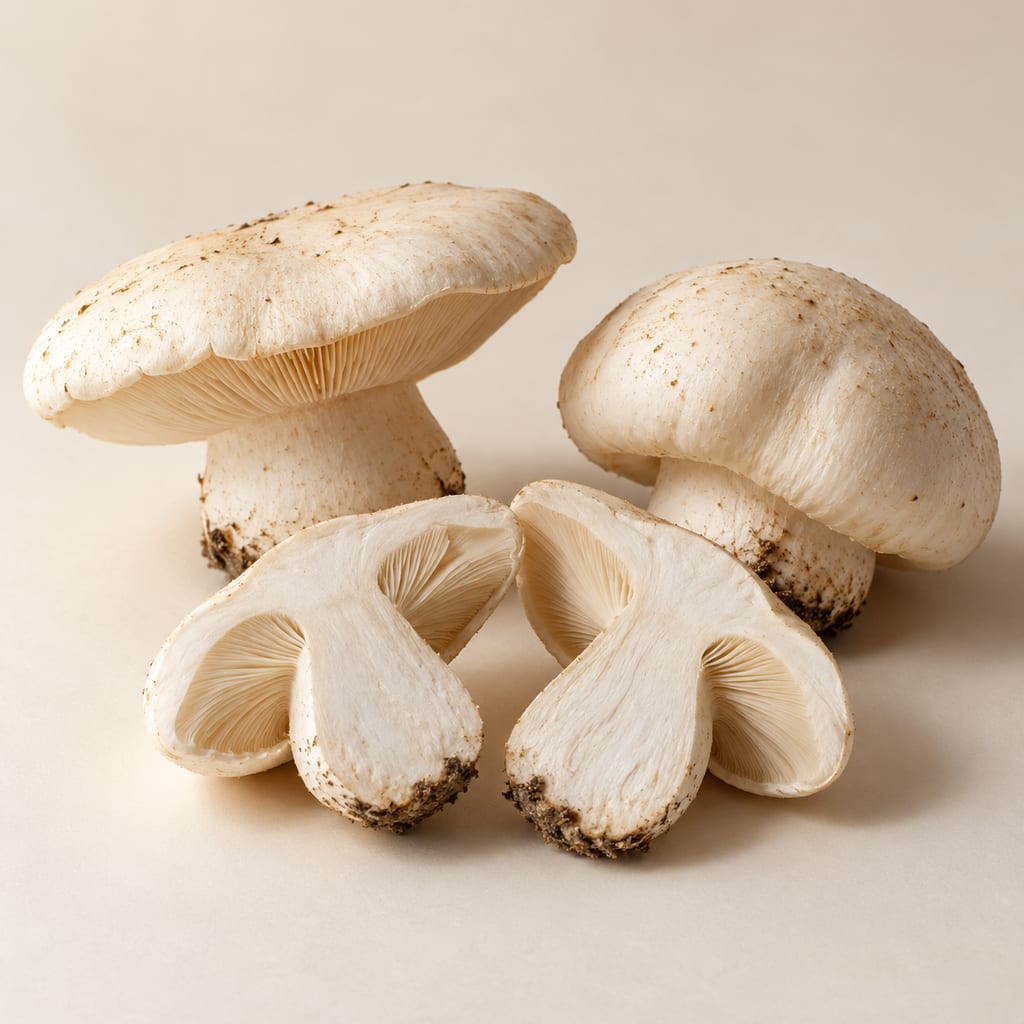
What it is
Leucocalocybe mongolica is a grassland fungus of the Mongolian Plateau steppe. It was formerly placed in Tricholoma as Tricholoma mongolicum, and its genus has been revised since. Its name in the supplied catalogue remains a research label rather than a settled identification.
The species forms fairy rings. Its fruiting bodies appear on the outer edge of the ring, which is a useful habitat clue for the people who gather it.
Food use
A Scientific Reports study describes the species as a prestigious rare wild edible mushroom in Northeast Asia. Other sources report that it is eaten in Chinese and Mongolian daily dishes. Evenks in the region boil it with mutton for health reasons, which is a medicinal use rather than a culinary one.
Conservation and harvest
The species appears on China's Red List of macrofungi. Researchers link its decline to increasing drought on the Mongolian Plateau and to over-collection for food and medicine. A genome study connects its limited wild occurrence to possible losses of carbohydrate-active enzyme genes, which is a research hypothesis rather than an established cause.
No data on harvest volumes, seasonal timing or cultivation success was found. Mongolian harvest rules were not found either, so this page cannot say whether any apply.
Safety and identification
The catalogue carries the species with food-market and specialist evidence and notes that its genus and cultivation status are still being revised. That is not a safety assessment. Wild steppe mushrooms should be identified by a specialist before they are eaten, and nothing on this page is an identification guide.
Sources for this section
Places
Mongolian Plateau
Traditional use · Region evidenceEndemic to the Mongolian Plateau, which spans Mongolia and Inner Mongolia in China.
Community
No community contributions have been published for this entry yet.
Share what you made
Sign in to contribute. Published comments and photos are free to read.
Sources
Scientific Reports / PubMed CentralConservation · Food use · Taxonomy
Analyses of transcriptomes and the first complete genome of Leucocalocybe mongolica (Scientific Reports)Prized food in Northeast Asia; conservation and gene-loss findings.
Cited in: What it is; Food use; Conservation and harvest
Taylor & FrancisFood use · Conservation
Supplied research on Leucocalocybe mongolica (Tandfonline, supplied source)Supplied source; not opened in this session because the page returned 403.
Cited in: What it is; Conservation and harvest; Safety and identification