
MSG (monosodium glutamate)
Monosodium glutamate is a crystalline savoury seasoning whose glutamate contributes umami to foods.
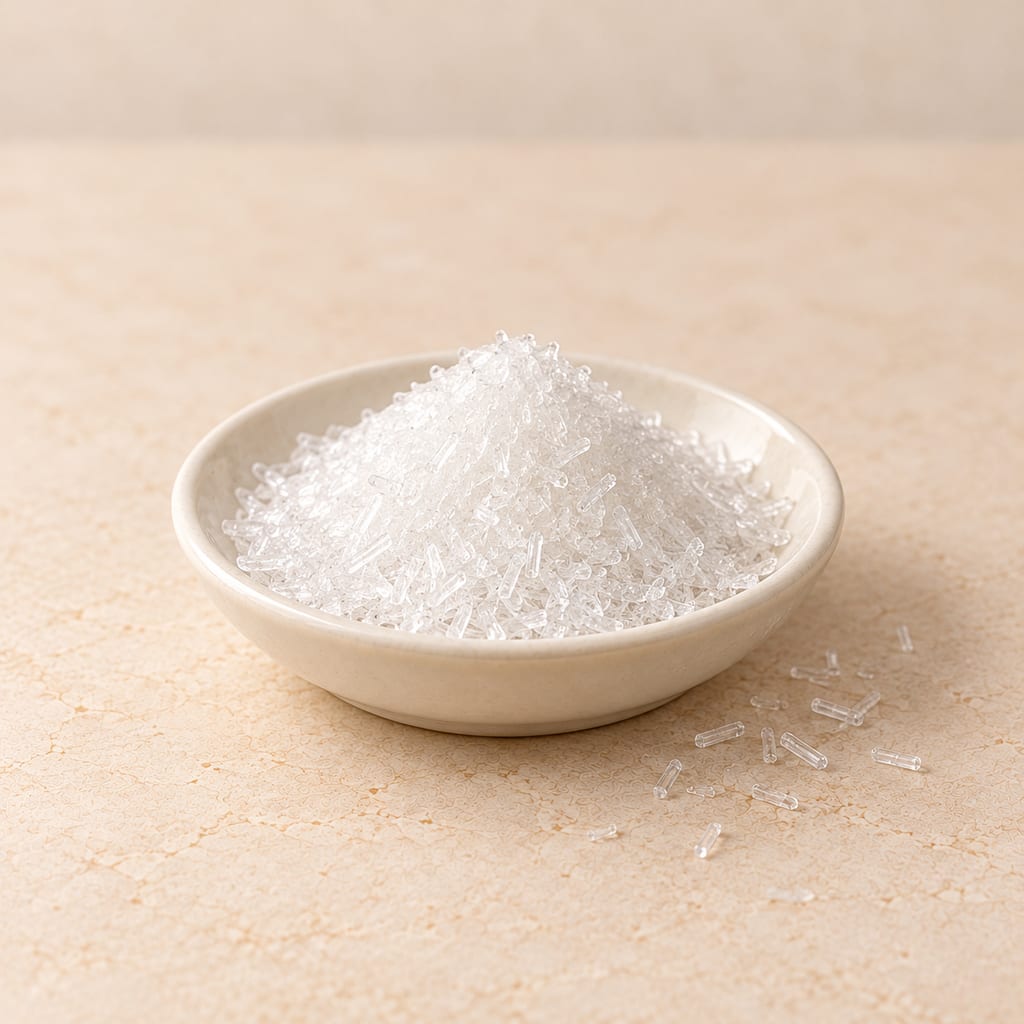
A crystalline form of glutamate
Monosodium glutamate, usually shortened to MSG, is the sodium salt of glutamic acid. Food-grade MSG is sold as white crystals or powder. It is a seasoning in its own right, not a fermented sauce or a starter culture. Dissolved in food, it supplies free glutamate, one of the compounds that gives the taste called umami.
Glutamate is also part of proteins. When proteins break down, some glutamate is released in free form; that free glutamate tastes different from glutamate still bound within an intact protein. The glutamate in MSG is chemically the same as free glutamate from foods. The material therefore contributes one particular taste, while a fermented condiment such as soy sauce brings its own mixture of salt, acidity, aromas and other compounds.
MSG contains sodium. It can be used alongside salt, but it is not sodium-free and does not make the sodium in a dish disappear. The amount and balance are matters of the dish and its label or recipe; the ingredient's identity does not prescribe a universal dose.
Kombu broth and the naming of umami
Kombu broth, or dashi, had a place in Japanese cooking before MSG became a packaged seasoning. In 1908, chemist Kikunae Ikeda studied the savoury character of kombu broth and identified glutamate as a contributor to it. He distinguished this taste from the familiar sweet, sour, salty and bitter tastes and called it umami. Glutamic acid itself was known to chemists earlier; Ikeda's contribution was identifying the taste role of glutamate in kombu and developing a way to make a crystalline seasoning from it.
Ikeda's original work began with extraction from seaweed broth. The acid form was isolated, then neutralised with sodium hydroxide to obtain monosodium glutamate crystals. The commercial seasoning that followed made a taste component associated with a brewed stock available as a measured, dry pantry ingredient. Commercial production began in Japan in 1909.
This history should not be confused with the way most MSG is made today. Industrial fermentation became a production route in the twentieth century. Current production described by the US Food and Drug Administration uses fermentation of carbohydrate materials such as starch, sugar cane, sugar beet or molasses. The Ajinomoto Group's company history describes an early period using hydrolysed wheat gluten, a later move to soybeans, and a transition to bacterial fermentation in the 1960s. Those details describe that manufacturer's history; exact feedstocks and processes can differ among producers.
Why glutamate tastes savoury
Umami is not simply a synonym for strong flavour. It is a taste response to glutamate and certain other compounds. In taste research, glutamate is often used as the umami stimulus. Ikeda's work linked the taste of kombu broth with glutamate; later work identified 5′-inosinate in dried bonito and 5′-guanylate in shiitake as other umami substances.
Glutamate can intensify the savoury impression when it appears with these nucleotides. The effect is described as synergy: a mixture can produce a stronger umami response than glutamate alone. This helps explain why a seasoning can work differently in different foods. MSG added to a broth containing bonito or shiitake meets other taste-active compounds; in a plain starch-based food, the same seasoning has a different context.
Fermentation connects to glutamate through protein breakdown in some foods. Proteases split proteins into smaller peptides and amino acids, and this can release free glutamate. That process contributes to the savoury character of some fermented sauces and pastes. Adding crystalline MSG to a food is a separate operation: it adds free glutamate but does not reproduce the enzymes, salt, acids, aroma compounds or texture that developed during fermentation.
Using and recognising MSG
The crystals can be distributed through a dish during seasoning. Because MSG contributes umami rather than the full flavour of a broth or sauce, it cannot stand in for every role played by a fermented ingredient. A fermented sauce may season with salt and acid, carry volatile aromas, colour a dish and add body as well as savouriness. MSG supplies none of those other qualities by itself.
On United States packaged foods, added MSG is declared in the ingredient list by the name monosodium glutamate. Free glutamate can also occur naturally in tomatoes and cheeses, or in ingredients such as yeast extracts and protein hydrolysates. The label rules distinguish adding MSG as an ingredient from the natural glutamate present in another named ingredient. Glutamate is unrelated to gluten; the name similarity does not mean MSG contains gluten.
The supplied condiment record lists MSG in a Japanese-style yolk mayonnaise, including a 0.5 g amount and label examples. That is evidence of one use in a formulated condiment, not a general instruction for mayonnaise or a universal seasoning quantity. Product names, recipes and labelling vary, so read the particular ingredient list when a dietary ingredient matters.
Sources for this section
Regulatory assessments and reported reactions
Food authorities describe their assessments within their own regulatory systems. The US FDA considers added MSG generally recognised as safe and reports that studies have not consistently triggered reactions in people who identify themselves as sensitive. Reports of symptoms exist, but reports alone do not establish that MSG caused them.
The European Food Safety Authority's 2017 re-evaluation addressed glutamic acid and six glutamate additives as a group. EFSA set a group acceptable daily intake of 30 mg per kilogram of body weight per day and estimated that exposure from additives could exceed that level for some population groups, particularly people with higher consumption of foods containing the additives. The agency recommended that permitted maximum levels be reviewed. This assessment and the FDA's GRAS determination answer different regulatory questions using different frameworks; neither statement is a personal diagnosis or a guarantee about an individual's response.
These assessments concern dietary exposure and food-additive regulation, not fermentation control. MSG is a finished seasoning, and its presence does not make another ingredient safe, preserve a food, or show that a fermentation has completed.
Keeping and choosing the crystals
MSG is a dry crystalline product. Select a product sold for food use and follow its own package directions. Keeping the container closed and dry helps protect a crystalline seasoning from moisture and contamination; no universal shelf life should be inferred where the product label does not provide one. Fine crystal size can affect how quickly a dry ingredient disperses, but the source material does not establish a conversion between crystal grades or a standard dose.
Its fermentation role is indirect: MSG may be added to a fermented dish as seasoning, while industrial fermentation is one route for manufacturing the glutamate used to make MSG. These are separate meanings of fermentation. The seasoning itself is not alive, does not contain a working culture, and does not begin a ferment when added to food.
Sources for this section
Places
No source in this record establishes a place.
Community
No community contributions have been published for this entry yet.
Share what you made
Sign in to contribute. Published comments and photos are free to read.
Sources
US Food and Drug AdministrationIdentity · Production · History · Labelling · Regulatory context
Questions and Answers on Monosodium glutamate (MSG)MSG is the sodium salt of glutamic acid.
Commercial production began after Kikunae Ikeda's 1908 extraction and patent; current commercial production described by FDA uses fermentation of starch, sugar beets, sugar cane or molasses.
Added MSG must be named as monosodium glutamate on US ingredient panels; naturally occurring free glutamate may occur in other ingredients.
FDA considers added MSG generally recognized as safe; reports of symptoms have not established causality.
Cited in: A crystalline form of glutamate; Kombu broth and the naming of umami; Using and recognising MSG; Regulatory assessments and reported reactions; Keeping and choosing the crystals
European Food Safety AuthorityRegulatory context
EFSA reviews safety of glutamates added to foodEFSA's 2017 re-evaluation derived a group acceptable daily intake of 30 mg/kg body weight per day for six glutamate additives.
EFSA estimated that additive exposure could exceed this level for some population groups and recommended review of maximum permitted levels.
Cited in: Regulatory assessments and reported reactions
BioMed Research InternationalHistory · Taste science · Fermentation context
Umami the Fifth Basic Taste: History of Studies on Receptor Mechanisms and Role as a Food FlavorIkeda identified glutamate in kombu in 1908; glutamic acid was neutralized with sodium hydroxide to obtain MSG crystals.
The umami taste is associated with the glutamate anion; glutamate combines synergistically with 5'-inosinate and 5'-guanylate in taste perception.
Proteolysis during fermentation releases free glutamate from proteins; glutamate bound within proteins does not itself taste umami.
Cited in: A crystalline form of glutamate; Kombu broth and the naming of umami; Why glutamate tastes savoury
Ajinomoto GroupManufacturing history
What is MSG and How is it Made?Ajinomoto describes its current MSG production as fermentation of plant materials including sugar cane, sugar beet, cassava or corn.
The company recounts early hydrolysis of wheat gluten, later soy-based production, and a shift to bacterial fermentation in the 1960s.
Cited in: Kombu broth and the naming of umami; Keeping and choosing the crystals