
Mushrooms
Neofavolus subpurpurascens
Neofavolus subpurpurascens is a Neotropical honeycomb polypore on wood, recorded in Brazil. Documented occurrence does not establish a food-safety assessment.
Overview
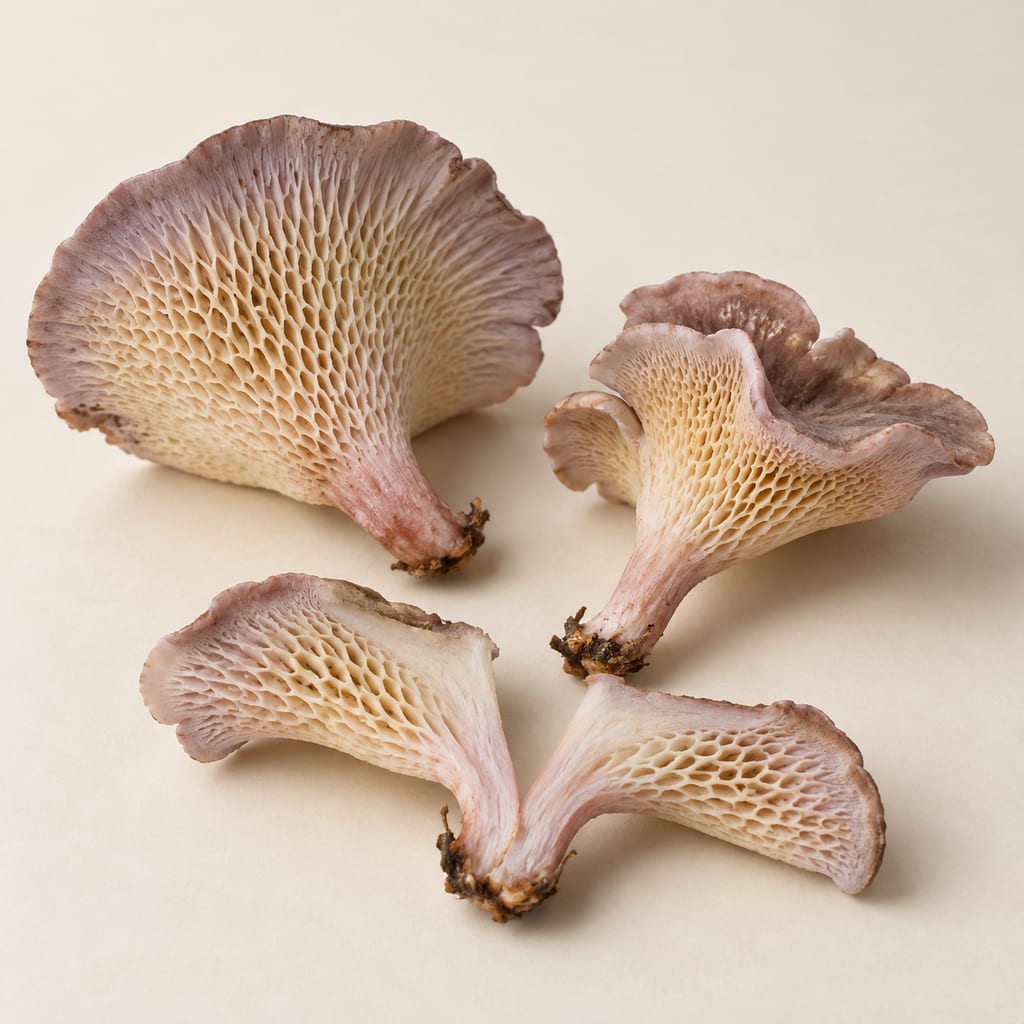
Neofavolus subpurpurascens is a polypore on wood, known in English as the honeycomb polypore. It has a deep purplish surface on the cap and radially elongated pores. A 2019 Phytotaxa paper by Palacio, Silveira and Robledo moved the species from Polyporus to Neofavolus and reported Neotropical specimens from Argentina, Bolivia and Brazil.
Sources for this section
Brazilian records
A 2020 Hoehnea paper reports the species from restored areas in the State of São Paulo. That is a fungal-community record, not a food report.
The catalogue lists the species as a recent Brazilian ethnomycological food record, with the habitat given as wood in Atlantic rainforest. The article the catalogue cites could not be opened in this session, so the number of records, the local preparation and the context of use are not described here.
Food use and safety
The catalogue's own caution is that documented occurrence and consumption do not establish a standardized food-safety assessment. Its food-use claim rests on the supplied study and nothing else in this record.
A related genus, Favolus, is recorded as a wild edible mushroom for several traditional communities. That statement concerns Favolus and does not transfer to Neofavolus subpurpurascens.
Sources for this section
Places
No source in this record establishes a place.
Community
No community contributions have been published for this entry yet.
Share what you made
Sign in to contribute. Published comments and photos are free to read.
Sources
CONICET Digital (repository record)Taxonomy · Distribution
Neofavolus subpurpurascens comb. nov., with new records from the NeotropicsTransfer from Polyporus to Neofavolus, 2019
Neotropical specimens from Argentina, Bolivia and Brazil
Cited in: Overview
DOAJ (Hoehnea)Distribution
Hoehnea (2020), record from São PauloNew record for the State of São Paulo in restored areas
Cited in: Brazilian records
Springer (supplied catalogue source, not opened in this session)Food use record
Supplied catalogue study on Brazilian edible fungi (Neofavolus record)Recent Brazilian ethnomycological food record
Caution on standardized safety assessment
Cited in: Brazilian records; Food use and safety