
Mushrooms
Orange birch bolete
Orange birch bolete, Leccinum versipelle, is a bolete that grows with birch in Northern Europe. Sources treat it as edible only after thorough cooking, because raw or undercooked specimens can cause nausea and vomiting.
Overview
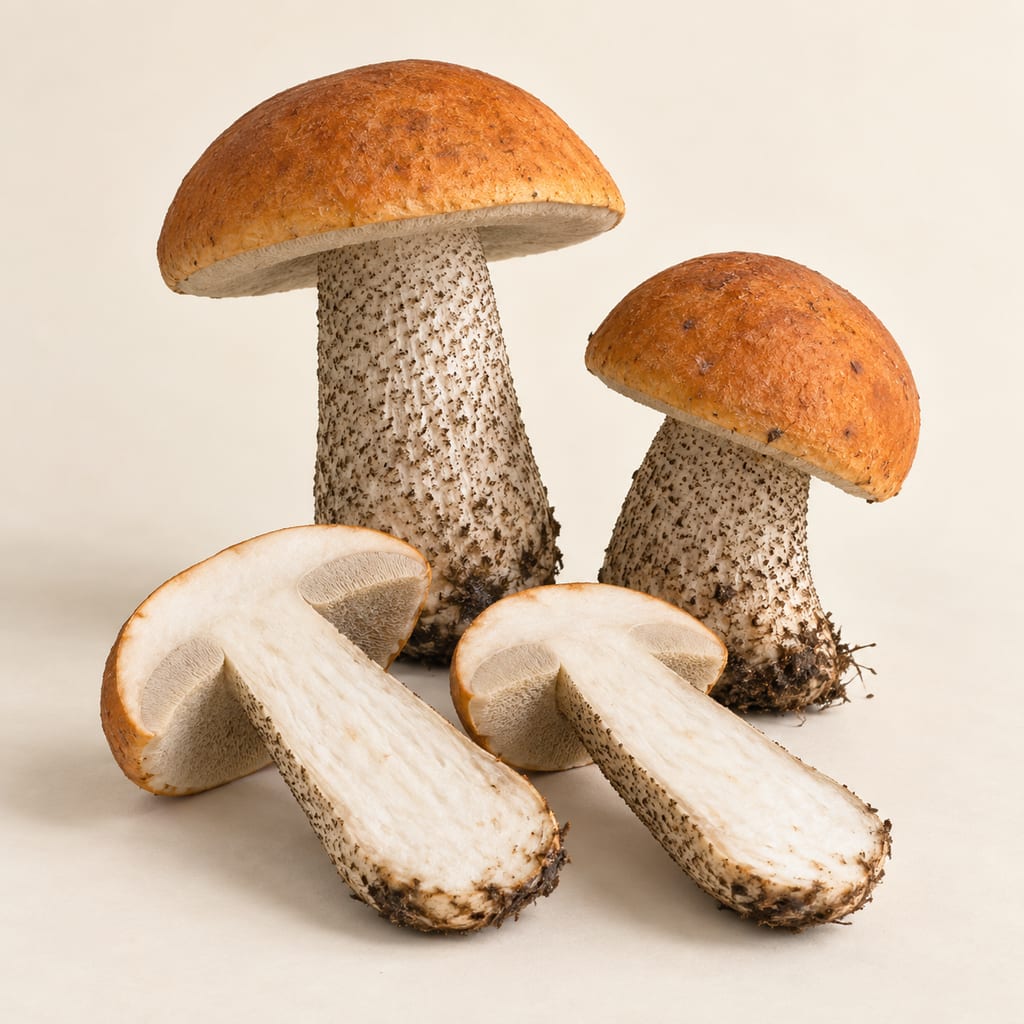
Orange birch bolete, Leccinum versipelle, is a bolete of the family Boletaceae. It grows on the ground, alone or in groups, in an ectomycorrhizal partnership with birch trees. Its cap is orange to brick red and felty, and its stipe is covered in dark scabers.
The species is harvested for food in several northern and eastern European countries. Its flesh turns black in cooking, a change that does not affect the taste, according to one foraging guide.
Sources for this section
Names and taxonomy
Synonyms include Boletus versipellis Fr. and Hok (1835) and Leccinum atrostipitatum A.H. Sm., Thiers and Watling (1966). Other names are Boletus testaceoscaber and dark-stalked bolete.
The genus Leccinum is recognised by the small, rigid scabers on the stalk.
Sources for this section
Habitat and ecology
The species forms ectomycorrhizal partnerships with birch, Betula, and grows in forests and heathland on sandy, slightly acidic, loamy soils. Wikipedia gives the season as mainly August to November.
The catalogue records the species as birch-associated and wild-supplied in Northern Europe.
Sources for this section
Food use and cooking
The species is treated as edible when cooked. Galloway Wild Foods suggests young, firm specimens for most mushroom dishes and large, spongy specimens for drying. Gone71 notes that large specimens soften with age and are usually not suitable to eat.
Wikipedia gives the heat treatment as frying or boiling for 15 to 20 minutes. Gone71 cites at least 15 minutes. Both guides advise against eating it raw.
Safety
The catalogue marks this species as a conditional record: inadequate cooking has been associated with illness. Wikipedia describes the species as mildly toxic, causing nausea and vomiting, unless it receives proper heat treatment. No specific toxin is named in these sources.
Some sources report upset stomach in people who eat it without thorough cooking. The sources do not give a toxicity figure for properly cooked specimens.
This page is not an identification guide. Do not eat a wild bolete on the basis of this page, and do not eat any wild mushroom raw. Confirm identity with an expert before eating any wild fungus.
Lookalikes
Galloway Wild Foods and Gone71 warn about related orange boletes. The orange oak bolete, Leccinum aurantiacum, is described as edible, and the orange aspen bolete is also described as edible, though some reports of problems exist for the aspen species. Sources do not give a full comparison of features for telling them apart.
Sources for this section
Open questions
The sources do not give a clinical study of the illness or a toxin profile, and most food guidance comes from foraging websites rather than peer-reviewed work. The catalogue's review label stays open pending individual record review.
Sources for this section
Places
Northern Europe
Traditional use · Region evidenceThe catalogue records wild use in Northern Europe. Wikipedia names harvesting in Finland, Latvia, Lithuania, Estonia, Belarus, southeast Alaska and Russia.
Community
No community contributions have been published for this entry yet.
Share what you made
Sign in to contribute. Published comments and photos are free to read.
Sources
WikipediaLead · Taxonomy · Food · Safety
Leccinum versipelleSynonyms Boletus versipellis Fr. and Hok (1835) and Leccinum atrostipitatum; also called Boletus testaceoscaber and dark-stalked bolete
Ectomycorrhizal with birch (Betula) on sandy, slightly acidic soils; August to November
Edible when cooked; turns black when cooked
Mildly toxic (nausea and vomiting) unless given proper heat treatment: frying or boiling for 15-20 minutes
Cited in: Overview; Names and taxonomy; Habitat and ecology; Food use and cooking; Safety; Open questions
Galloway Wild FoodsFood · Safety · Lookalikes
Orange Birch Bolete and Brown Birch Bolete: identification, edibility, distributionAll Leccinum species should be cooked before use
Some reports of upset stomach when not thoroughly cooked
Young firm specimens suit most dishes; large spongy specimens are best dried; orange oak and orange aspen boletes are also edible, with some reports of problems for the aspen species
Cited in: Food use and cooking; Safety; Lookalikes
Gone71Food · Safety
Orange Birch Bolete (Leccinum versipelle)Considered slightly toxic raw; cook for 15 minutes or more
Flesh turns black in cooking without changing taste; large specimens become soft with age
Cited in: Overview; Food use and cooking
Nordic Council of Ministers (via DiVA)Food · Safety
Nordic edible mushroom assessment (source S049 in the catalogue)Catalogue record: cooked or dried bolete, Northern Europe, wild supply, birch-associated mycorrhizal fungus; catalogue condition: inadequate cooking associated with illness; the PDF could not be read as text in this research pass
Cited in: Habitat and ecology; Safety