
Mushrooms
Parasol
The parasol, Macrolepiota procera, is a large wild mushroom of European grassland and woodland edges. Foraging sources treat it as a well-regarded edible; its main risk is confusion with poisonous Chlorophyllum species.
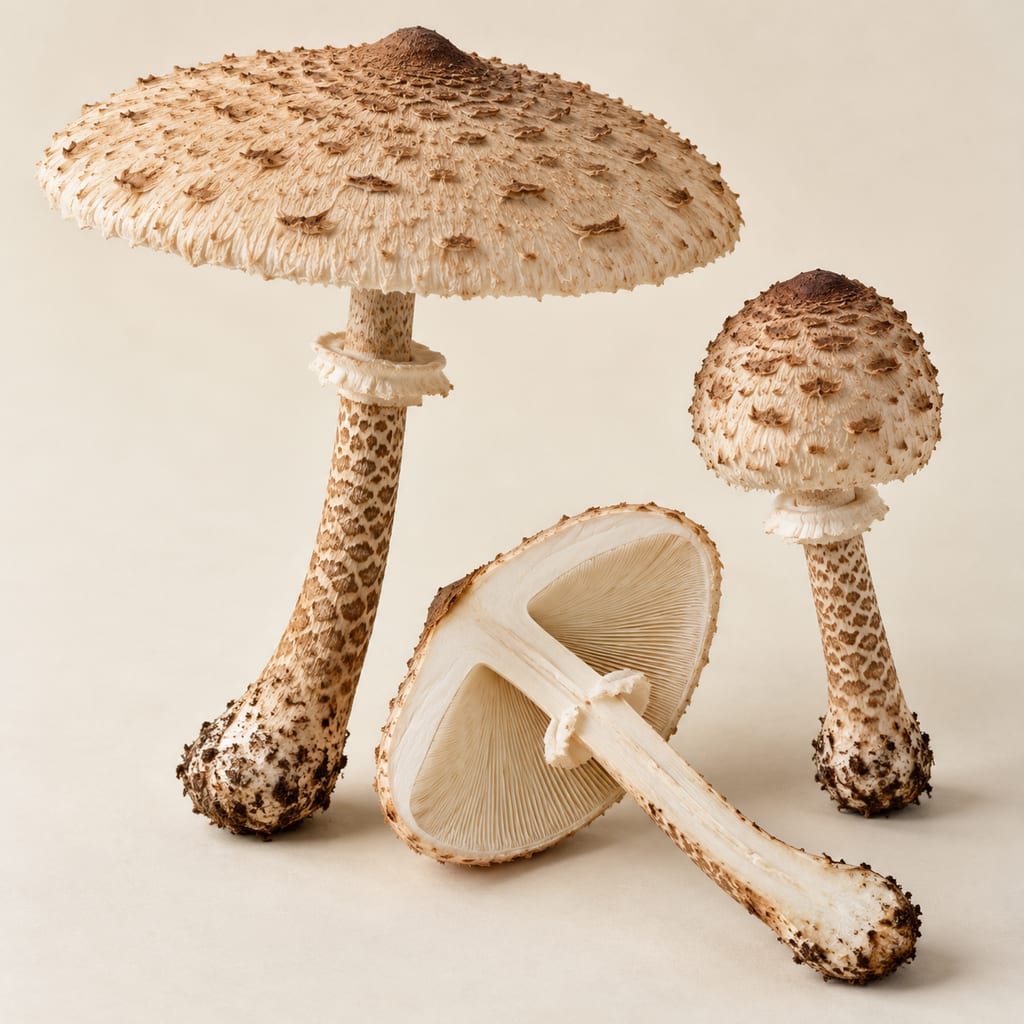
What it is
Macrolepiota procera is a large agaric with an umbrella-shaped cap, which grows as an oval button and opens to a flat cap with a central bump. A snakeskin pattern on the stem is one of the features foragers use to separate it from look-alikes. The older name Lepiota procera is a synonym still seen in field guides and older records.
It grows on soil and leaf litter, in open woods, along footpaths and under conifers or hardwoods. The catalogue describes it as a soil and litter decomposer gathered from the wild.
Sources for this section
Food use
The parasol is widely described as a well-regarded edible. The catalogue records that its large caps are used cooked. Foraging sources advise that it is best attempted by experienced foragers, not beginners.
Preparation details beyond cooking were not established in the sources read for this page, and no quantity or method is given here.
Sources for this section
Look-alikes and safety
The main risk is confusion with Chlorophyllum molybdites, the green-spored parasol, which one source calls one of the top causes of mushroom intoxication worldwide, and which is more common than the edible parasol in the Americas. Its spores are green in a spore print, a simple test to separate it. Some Chlorophyllum species, such as C. rhacodes, are edible, so the genus cannot be treated as uniformly toxic. In Portugal a further toxic species, Macrolepiota venenata, is reported as a common cause of mushroom poisoning.
Foraging sources say the whole, intact mushroom should be examined, not only the cap, and that the parasol is best attempted by experienced foragers. This page does not establish that any particular collection is safe to eat, and no cooking method makes an unidentified mushroom safe.
Sources for this section
Places
Europe
Traditional use · Region evidenceCatalogue records large caps used cooked in Europe. Regional records elsewhere are noted in the catalogue but are not used here as evidence of food use.
Community
No community contributions have been published for this entry yet.
Share what you made
Sign in to contribute. Published comments and photos are free to read.
Sources
WikipediaIdentity · Food · Safety
Macrolepiota proceraWell-regarded edible; Lepiota procera synonym; Chlorophyllum look-alikes; Macrolepiota venenata in Portugal
Cited in: What it is; Food use; Look-alikes and safety
Missouri Department of ConservationIdentity
ParasolField identification of the parasol
Cited in: What it is; Look-alikes and safety
Michigan State University Extension (CANR)Food
Macrolepiota proceraEdible use context
Cited in: Food use
Mushroom AppreciationSafety · Identification
Parasol mushroomsForagers advise expert confirmation; examine the whole mushroom
Cited in: Look-alikes and safety