
Cultures
Penicillium nalgiovense
Penicillium nalgiovense is a mould sold as a selected starter culture for ripened foods, most often dry sausage, and tested in laboratory and cheese starter studies.
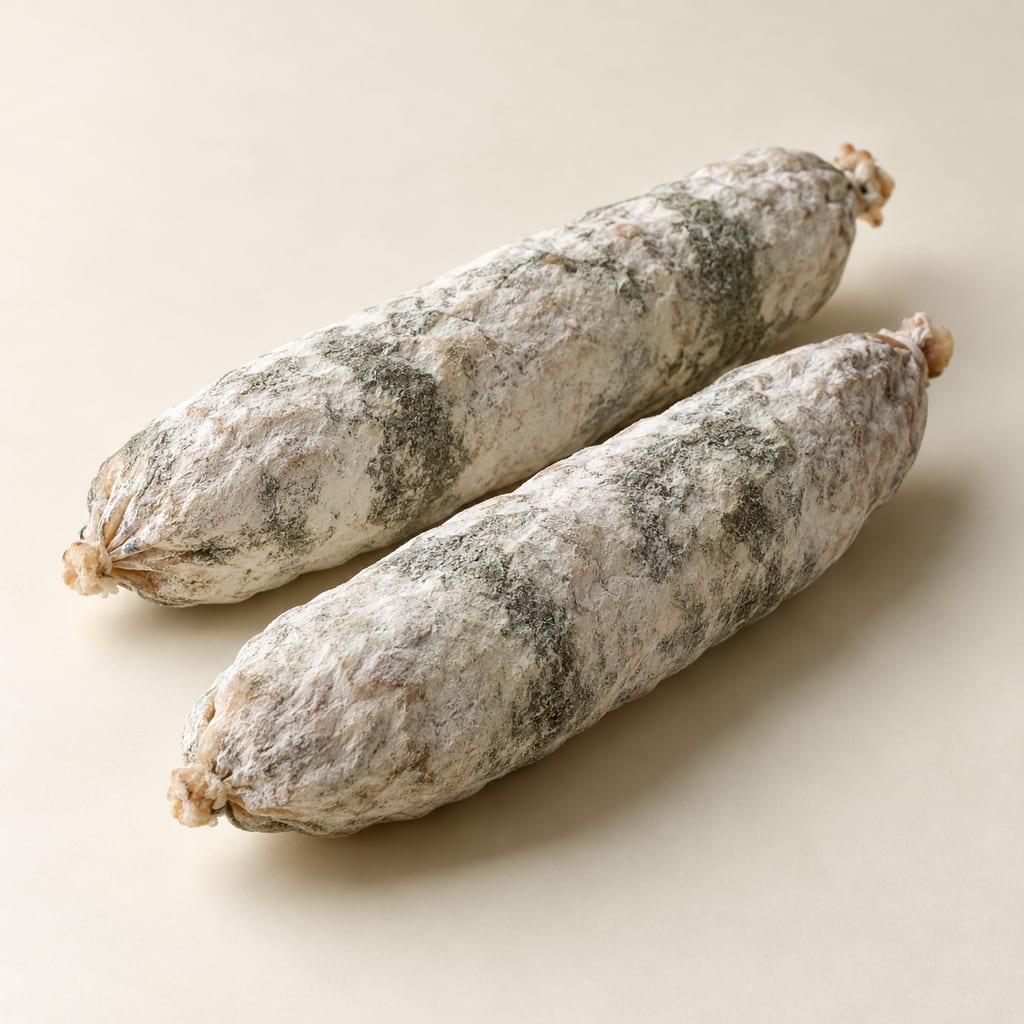
What it is
Penicillium nalgiovense is a filamentous fungus of the Penicillium genus. In food technology it appears as a selected starter culture: a mould kept or bought as a culture and applied to a ripened food so that it grows on the surface during maturing.
The name identifies a species, not a production strain. The catalogue that lists it describes the food-production use as selected starter cultures for ripened foods, evaluated in cheese starter experiments. It explicitly does not give permission to eat or propagate environmental moulds of this species, and a species name does not establish that a given culture is suitable for a given food process.
Commercial starters are reported as mainly composed of P. nalgiovense biotype 6 by a sausage-ingredient supplier. That is a supplier statement and not an independent identification.
Its role in ripened foods
Mould starters are used in ripened foods to take over the surface before undesirable organisms do. The supplier literature for a commercial P. nalgiovense product describes the aim as building typical flavour, giving the surface a desirable appearance and preventing superficial spoilage organisms. Producers who do not use a fungal starter, the same supplier notes, tend to end up with a more varied mould community on the product.
Surface growth changes the product as it develops. A starter that covers the surface quickly limits the space and nutrients left for other moulds, yeasts and bacteria. Whether it does so in a particular product depends on the food, the conditions and the culture, which the sources do not settle in general.
What the research shows
A 1998 study from the Technical University of Denmark tested four starter moulds, P. nalgiovense, P. camemberti, P. roqueforti and Geotrichum candidum, against seven contaminant fungi of cheese. On laboratory media, P. nalgiovense and the other Penicillium starters inhibited contaminant growth, and P. nalgiovense produced the largest reduction in contaminant secondary metabolite production. The authors report these results on laboratory media only.
On Camembert cheese the picture changed. The starters did not significantly change contaminant metabolite production, and P. nalgiovense did not show the effect seen on laboratory media. G. candidum, not P. nalgiovense, was the starter that significantly inhibited contaminants on Camembert. The authors conclude that G. candidum plays an important role in competing with undesirable organisms in mould-fermented cheeses.
The study names isolates of each species and gives no strain designations, so its results cannot be applied to a named commercial culture.
Dry sausage and ham
The most clearly documented commercial use of P. nalgiovense is on dry-fermented sausage. A supplier product page for a freeze-dried P. nalgiovense culture describes it as producing a white surface layer and suppressing indigenous moulds, yeasts and bacteria. That is marketing language from the supplier, and the sources found do not give independent data on the surface result. The sources found did not describe ham-specific use in detail, so this page does not claim one.
Choosing and handling
The sources do not give a shelf life, storage temperature or safe limit for P. nalgiovense cultures, and this page does not supply them. A reader who buys or keeps a culture should follow the producer's storage instructions and the process the culture was selected for.
Two points from the sources are worth keeping. First, selected strains are used in a specified process and are not a species-wide permission. Second, the difference between a starter culture and a mould that grows in an unstarted product matters: an unstarted product carries a more varied mould community, and the sources do not present that community as safe or unsafe in general.
Notes
Commercial P. nalgiovense cultures have no established strain-level identity, and their performance in whole-sausage and ham processes is not established. The 1998 laboratory results are not shown to apply to cheese or sausage. Its context is European food technology and international starter use, without a single place.
Places
Unknown
Relationship not established · Place not establishedThe catalogue gives European food technology and international starters without a single place, and the sources do not tie the culture to a single origin.
Community
No community contributions have been published for this entry yet.
Share what you made
Sign in to contribute. Published comments and photos are free to read.
Sources
International Journal of Food MicrobiologyMethod · History
Protection by fungal starters against growth and secondary metabolite production of fungal spoilers of cheeseStarters P. nalgiovense, P. camemberti, P. roqueforti, G. candidum tested against seven contaminant fungi
P. nalgiovense inhibited contaminant growth on laboratory media and gave largest reduction in contaminant secondary metabolite production there
On Camembert the starters produced no significant change in contaminant metabolite production; G. candidum significantly inhibited contaminants
Sausage Maker (supplier)Use · Identity
Bactoferm Mold-600 product pageCommercial mould starters are mainly P. nalgiovense biotype 6 (supplier statement)
Freeze-dried P. nalgiovense culture described as producing a white surface layer and suppressing indigenous moulds, yeasts and bacteria (supplier marketing)
Used on dry-fermented sausage