
Spices and aromatics
Pennywort
A guide to Centella food reports from Thai, Sri Lankan and Taishan sources, with Thai and Sri Lankan cultivation guidance and common-name, plant-part and local-status uncertainties preserved.
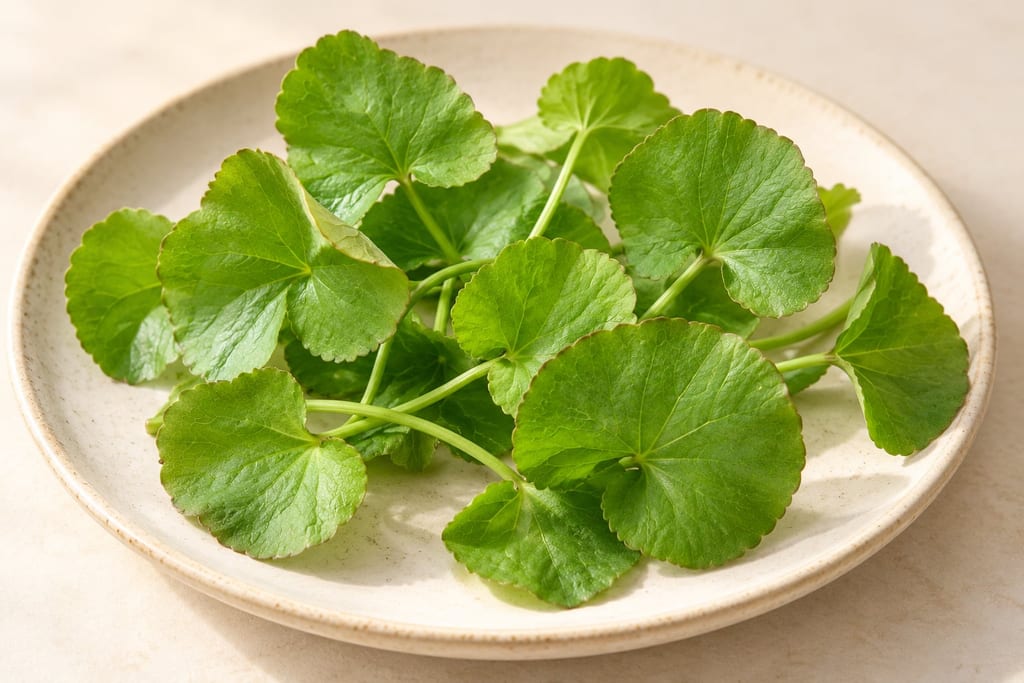
Scope of this account
The common ingredient name can refer to more than one plant. The research below concerns the particular taxon and uses named in its sources; it does not identify every ingredient sold under this name.
Sources for this section
Names and identity
Kew accepts Centella asiatica (L.) Urb. and lists Hydrocotyle asiatica as a synonym. It is a perennial in Apiaceae. PROSEA records names including Thai bua bok and Vietnamese rau má; the Taishan supplement lists 崩大碗 and 老肝菜 for its county row. “Pennywort” is also used broadly, so a common name alone does not identify this species or distinguish it from other plants called water pennywort.
Food reports and preparation examples
PROSEA describes Centella leaves eaten raw or cooked as a vegetable in parts of Southeast Asia and Sri Lanka, and reports a leaf-juice drink diluted with water and sweetened in Thailand, Vietnam, Cambodia and Laos. Those reports do not include proportions, storage duration or food-safety validation. The Taishan article calls the plant a whole-plant vegetable and a tea substitute, while Table S3 records stems and boiled-water and stir-fry categories. Its legend marks non-native species with an asterisk; the Centella row has no asterisk. The row is coded “Yes” in the “Medical plant” column; that source classification is not evidence of clinical efficacy. Its CFSI 1140.75, Order 4 and voucher specimen ZSY-018 appear under those exact column headings. The article describes CFSI as a Cultural Food Significance Index, a measure of cultural food use rather than a safety or efficacy rating. The authors state that voucher specimens were deposited in the Herbarium of South China Agricultural University (CANT), so ZSY-018 is the voucher code, not a respondent identifier. The article narrative and table differ on plant part; the local occurrence status is not resolved here.
A Thai household dish in the source
Thailand’s Department of Agricultural Extension guide includes a Centella-leaf salad called yum bai bua bok. The printed account pairs the leaves with cooked pork and shrimp and other seasonings. It gives household quantities and a preparation sequence, but does not specify measured safe cooking endpoints for the animal ingredients or a storage life for the finished salad. This article records the food example without turning it into a procedure. The guide also includes traditional remedy statements; no health claim is repeated here.
Sources for this section
Outdoor growing and propagation
PROSEA describes the plant in sunny or lightly shaded, damp sites and prefers fertile sandy loam with organic matter; its ecological account ranges from sea level to 2,500 m, which is not a frost or climate-tolerance limit. The Thai guide describes good growth in clay or clay-loam, in moist ground that is not flooded, and in partial shade or open sun. These are separate regional source descriptions, not a universal soil prescription. The guide describes propagation from runners or seed and starting rooted runners in a tray for about one to two weeks before moving them to a bed or container. PROSEA likewise describes one-node stem pieces or runners and notes seed is possible.
Sources for this section
Containers, water and harvest timing
The Thai guide gives a specific recommendation for broad-mouth and hanging containers: depth no greater than 10 cm, because it describes the root system as shallow, about 1.5–2 cm. This is the guide’s cultivation advice, not a tested container design; it does not specify material, drainage geometry or a substrate mix. It calls for regular moisture and warns that standing water can lead to basal rot. The same guide reports a first harvest about 60–90 days after planting, cutting stems about 2–3 cm above the ground, and a possible next harvest within two to three months; it says well-maintained plantings may yield for two to three years. PROSEA reports first harvest at two to three months under favourable conditions and subsequent leaf harvest about every two months; creeping forms are often harvested whole. These are source-specific timings, not guarantees.
Sources for this section
Growing and food limits
The reviewed sources do not establish a universal frost, heat, humidity or pH range, a household greenhouse regime, or a validated harvest/storage life. PROSEA notes rapid wilting of fresh vegetable bundles; the Thai guide says fresh leaves should be refrigerated but does not give a duration. The sources describe both raw and cooked food uses, but they do not assess contamination, residues, wild lookalikes or safe raw consumption. The Taishan row has no non-native asterisk. Kew’s broad native range does not establish the status of a particular collection locality. Do not use common names or this article as a field identification guide.
Later Sri Lankan regional amendment
Sri Lanka’s Department of Agriculture HORDI identifies Gotukola as Centella asiatica and describes bush and vine forms. Its page names large-leaved “Giant Gotukola,” medium-leaved “Meerigama selection,” and small-leaved “WelGotukola”; it calls the medium-leaved form the most commercially grown. These are source-specific crop labels, not independently verified cultivars. HORDI says the Low Country wet zone is more suitable and irrigation allows production elsewhere in the country. It recommends well-drained lowlands at pH 6–7, partially mature healthy rooted runners, field beds chosen for drainage, and maintaining moisture while avoiding waterlogging. The page reports a first harvest within 100 days and field harvest continuation for about two to three years. This is Sri Lankan field-extension advice; it does not establish container performance, greenhouse conditions, frost/heat limits or a household harvest guarantee.
A 2025 qualitative paper based on observation and discussions with selected elderly people in Galle district describes Gotukola porridge using extracted plant material, coconut milk, shallots and garlic, served with jaggery. This is a regional food description, not a measured recipe, clinical trial, validated process or safety finding. The paper’s broader traditional medicinal framing is not adopted as a benefit claim.
Sources for this section
Research gaps
No specimen-level identification, cultivar comparison or local wild-harvest assessment is recorded.
Taishan article narrative says whole plant while Table S3 lists stems; Table S3 does not mark the Centella row as non-native; the record does not establish local occurrence status.
The Thai salad source gives a preparation account but no measured food-safe endpoint for pork or shrimp or finished-dish storage life.
No universal numeric soil pH or site-/cultivar-specific pH range; HORDI gives pH 6–7 for Sri Lankan field production, but this does not assess other regions, household substrates or cultivars. General climate tolerances, quantified greenhouse regimes and locally validated container trials also remain unestablished.
The Thai guide reports a wide-mouth container with depth not exceeding 10 cm, but does not specify its diameter, material, substrate formulation or drainage construction; no engineered pot design is implied.
The new Sri Lankan HORDI guidance is field-scale and does not provide household container or greenhouse trials, quantified climate limits, or a local planting calendar.
The Galle porridge paper is a qualitative account from selected elderly participants and gives no measured formula, process endpoint, storage period or food-safety evaluation.
Sources for this section
- Centella asiatica (L.) Urb. →
- Centella asiatica (PROSEA) →
- คู่มือสมุนไพรประจำบ้าน (Household Herb Guide), Centella chapter →
- An ethnobotanical study on wild edible plants in Taishan County, Guangdong, China →
- Data Sheet 1: supplementary Tables S1–S3 →
- HORDI Crop – Gotukola →
- An exploration of the porridge tradition in Southern Sri Lankan culture →
Research status
The underlying plant account received a partial source review. Its review scope is described in the original plant article.
Sources for this section
Places
Unknown
Relationship not established · Place not establishedThe available research does not establish a single origin for this ingredient.
Community
No community contributions have been published for this entry yet.
Share what you made
Sign in to contribute. Published comments and photos are free to read.
Sources
Royal Botanic Gardens, Kew, Plants of the World OnlineIngredient research
Centella asiatica (L.) Urb.Cited in: Scope of this account; Names and identity; Growing and food limits; Research gaps
Plant Resources of South-East Asia (PROSEA), hosted by PlantUse / Pl@ntNetIngredient research
Centella asiatica (PROSEA)Cited in: Names and identity; Food reports and preparation examples; Outdoor growing and propagation; Containers, water and harvest timing; Growing and food limits; Research gaps
Thailand Department of Agricultural ExtensionIngredient research
คู่มือสมุนไพรประจำบ้าน (Household Herb Guide), Centella chapterCited in: A Thai household dish in the source; Outdoor growing and propagation; Containers, water and harvest timing; Growing and food limits; Research gaps
Zhang et al., Frontiers in Sustainable Food SystemsIngredient research
An ethnobotanical study on wild edible plants in Taishan County, Guangdong, ChinaCited in: Food reports and preparation examples; Growing and food limits; Research gaps
Zhang et al., Frontiers in Sustainable Food Systems / FigshareIngredient research
Data Sheet 1: supplementary Tables S1–S3Cited in: Names and identity; Food reports and preparation examples; Growing and food limits; Research gaps
Sri Lanka Department of Agriculture, Horticultural Crops Research and Development InstituteIngredient research
HORDI Crop – GotukolaCited in: Later Sri Lankan regional amendment; Research gaps
Piyoda Darmasiri Wijesekara, Journal of Ethnic Foods 12, article 27 (2025)Ingredient research
An exploration of the porridge tradition in Southern Sri Lankan cultureCited in: Later Sri Lankan regional amendment; Research gaps