
Mushrooms
Pine bolete
Boletus pinophilus is a European porcini-type bolete, often linked to conifers, gathered wild and used fresh or dried. Older records and commercial mixtures may not separate it from other porcini.
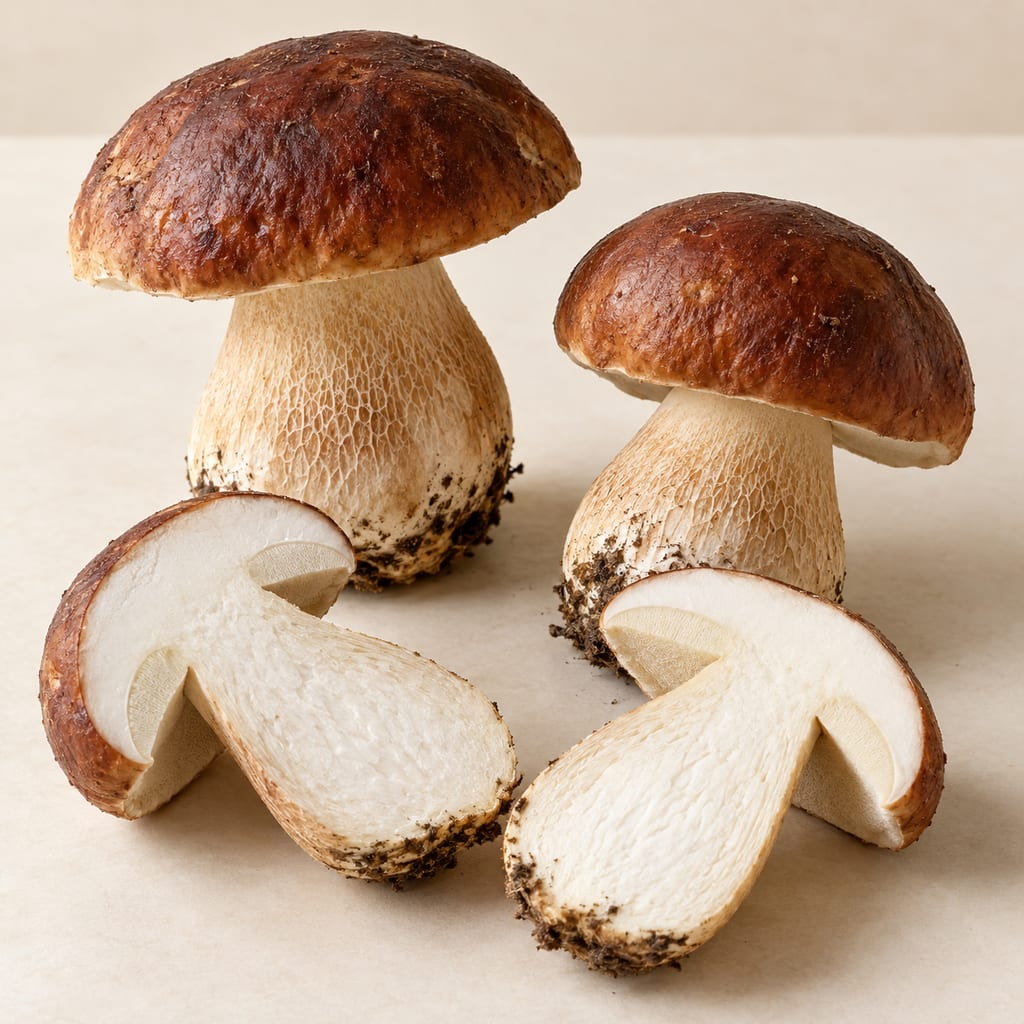
Overview
The pine bolete, Boletus pinophilus, is a wild porcini-type mushroom of Europe. The supplied catalogue describes it as a mushroom used for cooking and drying, with a supply recorded as wild.
The name needs care. Older sources sometimes used Boletus pinicola for the same material, so a record under that name should be checked against its own taxonomic context.
Ecology
The catalogue describes the fungus as a mycorrhizal species often associated with conifers. It forms a partnership with the roots of trees and is not a wood-rotting fungus. Its fruiting depends on the woodland around it, and the catalogue records no season or yield figures.
Sources for this section
Food use
The catalogue classes the species as a porcini-type mushroom used for cooking and for drying. Its evidence is food, market or specialist edible-fungi evidence. The record gives no household preparation method, and this page adds none.
Porcini-type mushrooms are often sold as mixtures. The catalogue warns that older records and commercial mixtures may not separate pine bolete from other porcini, so a food-use record for one name may cover several species.
Safety and identification
A food-use record does not establish identification, edibility or a safe preparation. Porcini-type boletes are not safe to collect or eat on a description or a single photograph, and the catalogue does not give an identification verdict for this species. Anyone gathering wild boletes should have them checked by an experienced identifier first.
Sources for this section
Sources and gaps
The Nordic source and the Spanish regulatory entry listed for this species were not read in full for this page; their content is kept as catalogued. The next research question is which European regional records under this name are supported by a species-level identification.
The European porcini compared
Boletus pinophilus is one of four porcini that DNA work in Europe separates clearly, with B. edulis, B. aereus and B. reticulatus. The forms inside the penny bun group, including a birch form, B. betulicola, and a pine-heath species, B. pinetorum, which Finnish authors keep apart, are not separated by DNA. Fechtner's bolete, once listed with the porcini, was moved to Butyriboletus after molecular data placed it far from the penny bun.
In short, from the sources. B. pinophilus has a dry, matt cap, maroon to chocolate or reddish brown, with a thicker, gelatinous skin than its relatives, a bulbous stem with a coarse orange-red network, white flesh, and pores that are white at first and then yellow and olive-brown. The Finnish study notes that its pores turn pale bluish green and then rusty brown when bruised, so a colour change on bruising does not by itself sort a porcini from a look-alike. It grows mainly under pine, especially Scots pine, and also under fir and spruce, and sometimes under broadleaf trees. B. pinetorum is also a pine species, with a greyish-brown cap and a wrinkled edge. B. edulis has a viscid cap and a fine white net, mostly under spruce. B. aereus has a darker, velvety bronze-brown cap under oak and beech. B. reticulatus has a paler, often cracked cap under oak and other broadleaf trees.
The bitter bolete, Tylopilus felleus, is the classic confusion. Its pores are white when young and turn pink with age, and its stem carries a coarse dark brown net on a lighter ground. Its flesh is intensely bitter, cooking makes this worse, and sensitivity to the bitterness varies between people, so tasting is not a safe test. Red- and orange-pored boletes are a different hazard. Satan's bolete, Rubroboletus satanas, has yellow to orange pores that turn red and blue at a touch, a stem running from yellow to carmine at the base, and is described as moderately poisonous, especially raw. The bitter beech bolete, Caloboletus calopus, has a pink-red lower stem, pores that bruise blue and flesh that stays bitter after cooking.
This record is not a field guide. Identification has to be certain, from the whole mushroom and several features together, and checked by an experienced local identifier before anything is eaten. Smell, taste or colour change alone never establish safety.
Places
Europe
Documented use · Region evidenceThe supplied catalogue records the species as a porcini-type food mushroom in Europe. It names no locality.
Community
No community contributions have been published for this entry yet.
Share what you made
Sign in to contribute. Published comments and photos are free to read.
Sources
Nordic report (Diva portal)Identity · Ecology · Food use · Safety
Nordic source cited by the supplied fungi catalogue for Boletus pinophilusPorcini-type mushroom for cooking and drying; often conifer-associated mycorrhizal; older records and commercial mixtures may not separate porcini species (as recorded in the supplied catalogue)
Cited in: Overview; Ecology; Food use; Safety and identification; Sources and gaps
Boletin Oficial del EstadoRegulation
Spanish official bulletin entry cited by the supplied fungi catalogueListed as a cited regulatory source in the supplied catalogue; content not read for this page
Cited in: Overview; Food use; Sources and gaps
WikipediaIdentification
Boletus pinophilusCap skin, stem network, pores, hosts and season of B. pinophilus; how it differs from B. edulis, B. reticulatus and B. aereus
Cited in: The European porcini compared
Karstenia 49, Finnish Mycological SocietyTaxonomy · Identification
A new boletoid fungus, Boletus pinetorum, in the Boletus section Boletus from FennoscandiaFinnish description of B. pinophilus: reddish-brown cap, pores that turn pale bluish green to rusty brown when bruised, Scots pine, inflated encrusted cap-skin cells; four European lineages; descriptions of the other species
Cited in: The European porcini compared
WikipediaIdentification
Boletus aereusCap, stem, hosts and season of B. aereus
Cited in: The European porcini compared
WikipediaIdentification
Boletus reticulatusCap, stem, hosts and season of B. reticulatus
Cited in: The European porcini compared
WikipediaTaxonomy
Butyriboletus fechtneri (Boletus fechtneri)Fechtner's bolete moved from Boletus to Butyriboletus after molecular data placed it in the Regius clade, distant from the B. edulis core clade
Cited in: The European porcini compared
WikipediaIdentification · Safety
Tylopilus felleusPores white then pink; coarse dark net on lighter stem; intensely bitter flesh, worse on cooking; sensitivity to the bitterness varies between people
Cited in: The European porcini compared
WikipediaIdentification · Safety
Rubroboletus satanasSatan's bolete: pore, stem and flesh colours, bluing, moderate poisoning with gastrointestinal symptoms
Cited in: The European porcini compared
WikipediaIdentification · Safety
Caloboletus calopusBitter bolete: pink-red lower stem, pores that bruise blue, intensely bitter flesh not removed by cooking; red stem distinguishes it from B. edulis
Cited in: The European porcini compared