
Spices and aromatics
Pink peppercorn
Pink peppercorn is a shared name for dried fruits of several plants, not true Piper nigrum pepper. MURI documents one fermented use but does not identify its species; allergy evidence is limited and species-specific.
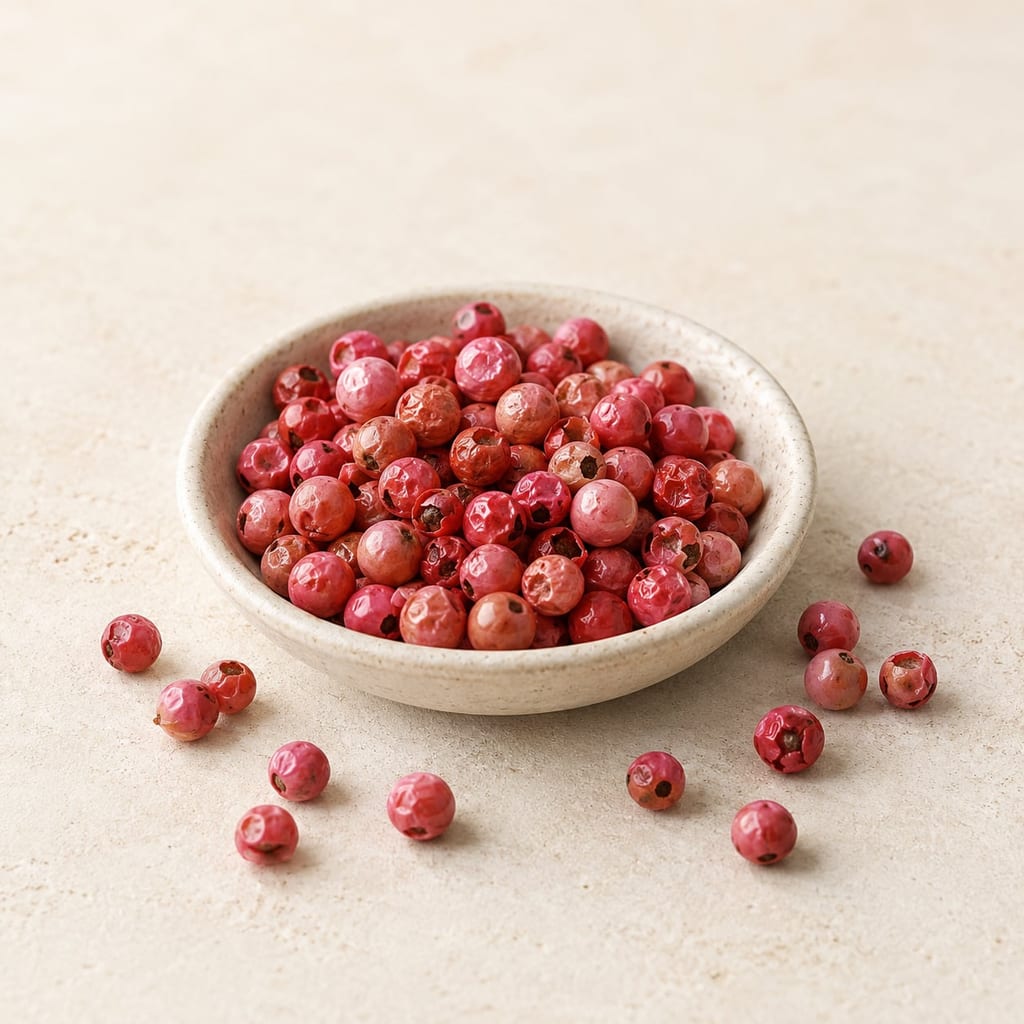
A culinary name, not a single species
Pink peppercorn is not a red form of black pepper. The U.S. Food and Drug Administration's 2026 macroanalytical manual lists three plant sources for the pink-peppercorn name: corktree (Euonymus phellomanus), Peruvian peppertree (Schinus molle) and Brazilian peppertree (Schinus terebinthifolius). This is a shared spice name, not a species identification, and it should not be confused with red Piper nigrum peppercorns. FDACS specifically says S. terebinthifolius fruits can be dried and consumed as pink peppercorn; that species-specific account does not identify every product sold under the name.
A contemporary example is MURI's Yamilé, whose product page describes a pink-peppercorn fermentation and lists pink peppercorn among its ingredients. The page does not name the plant species, origin of the peppercorn, or detailed ingredient treatment. This entry therefore describes the culinary category and that documented product use; it does not identify the botanical material in Yamilé.
Use in a fermented blend
MURI describes Yamilé as a sparkling blend built from raspberry, gooseberry, smoked rhubarb, honey and botanicals, with a pink-peppercorn fermentation. The published ingredient list includes pink peppercorn and yeast. This supports a modern commercial beverage use of the ingredient name. It is not a complete recipe, a home process, or evidence that different botanical sources will behave alike.
No ingredient-specific dose, process conditions, monitoring method or storage guidance for pink peppercorn is established. These cannot be inferred from a flavour description or from the word “fermentation.”
MURI's tasting description applies to the finished blend: it calls the drink dry and refreshing and attributes a lingering finish to pink peppercorn with the other botanicals. It does not describe the isolated spice or establish a flavour profile shared by all plants sold under this name.
Sources for this section
Allergy evidence and its limits
Some pink peppercorns come from Schinus species in the Anacardiaceae family, which also includes cashew and pistachio. A 2012 case report describes anaphylaxis after pink-peppercorn seasoning in a person with known cashew and pistachio allergies. FDACS separately notes allergic and respiratory reactions to Brazilian peppertree volatiles in sensitive people. These sources concern particular species or a single clinical report; they do not establish a universal reaction rate for all products called pink peppercorn.
A 2019 study tested Schinus terebinthifolius in a small group of 21 children with cashew and/or pistachio allergy. Sixteen had positive skin-prick tests, but participants were not given an oral challenge, so the finding is sensitization rather than proof that they would react after eating it. It also cannot be extended to other plants marketed as pink peppercorn. People with relevant allergies should rely on their clinician's advice and the exact product's allergen information; this record is not an allergy assessment.
What remains unresolved
The product connected to this record does not identify its pink-peppercorn species. The reviewed sources do not establish the ingredient's botanical identity, growing origin, harvest or treatment in that product. They also do not provide species-specific consumption limits or validate a general household fermentation, storage period, or safety endpoint for pink peppercorn.
Because the name covers multiple plants and the allergy research is limited and species-specific, no general safety assurance follows from culinary use in one commercial product. This page is descriptive; it offers no preparation directions and should not be used to identify or gather a wild peppertree.
Sources for this section
- Macroanalytical Procedures Manual: Supplemental Method for Black, White, Green and Red Peppercorns (Version 2, March 2026) →
- Yamilé →
- Brazilian Peppertree Biological Control →
- A Rare Case of Food-induced Anaphylaxis to Pink Peppercorns →
- Cross-reactivity of pink peppercorn in cashew and pistachio allergic individuals →
Places
Unknown
Relationship not established · Place not establishedThe product source documents a contemporary Yamilé use but does not establish where its pink peppercorn was grown or where that ingredient fermentation occurred.
Community
No community contributions have been published for this entry yet.
Share what you made
Sign in to contribute. Published comments and photos are free to read.
Sources
U.S. Food and Drug AdministrationIdentity
Macroanalytical Procedures Manual: Supplemental Method for Black, White, Green and Red Peppercorns (Version 2, March 2026)FDA distinguishes pink peppercorns from red Piper nigrum peppercorns and lists Euonymus phellomanus, Schinus molle and Schinus terebinthifolius as plant sources; the common name does not identify one species.
Cited in: A culinary name, not a single species; What remains unresolved
MURIDocumented use
YamiléThe current product description names a pink-peppercorn fermentation and its ingredient list includes pink peppercorn; it gives no botanical species or transferable preparation details.
Cited in: A culinary name, not a single species; Use in a fermented blend; What remains unresolved
Florida Department of Agriculture and Consumer ServicesIdentity · Safety
Brazilian Peppertree Biological ControlFDACS states that fruits of Schinus terebinthifolius can be dried and consumed as pink peppercorn, and that sensitive people can have allergic or respiratory reactions to volatiles from the plant; this is species-specific information, not a safety characterization of every product sold as pink peppercorn.
Cited in: Allergy evidence and its limits; What remains unresolved
Kim and Minikes, World Allergy Organization Journal, 2012Safety
A Rare Case of Food-induced Anaphylaxis to Pink PeppercornsThe report describes one anaphylaxis case after pink-peppercorn seasoning in a person with cashew and pistachio allergy; it is a case report and cannot estimate prevalence or establish risk for every botanical source sold under this name.
Cited in: Allergy evidence and its limits; What remains unresolved
Too et al., Asia Pacific Allergy, 2019Safety
Cross-reactivity of pink peppercorn in cashew and pistachio allergic individualsIn a small cohort of 21 cashew- and/or pistachio-allergic children, 16 had positive skin-prick tests to Schinus terebinthifolius; no oral food challenges were performed, so the result shows sensitization, not confirmed clinical cross-reactivity.
Cited in: Allergy evidence and its limits; What remains unresolved