
Coagulants
Rennet powder
A dry milk-clotting enzyme preparation for setting cheese curd. Its animal or microbial source, strength, carrier and dietary status depend on the actual product.
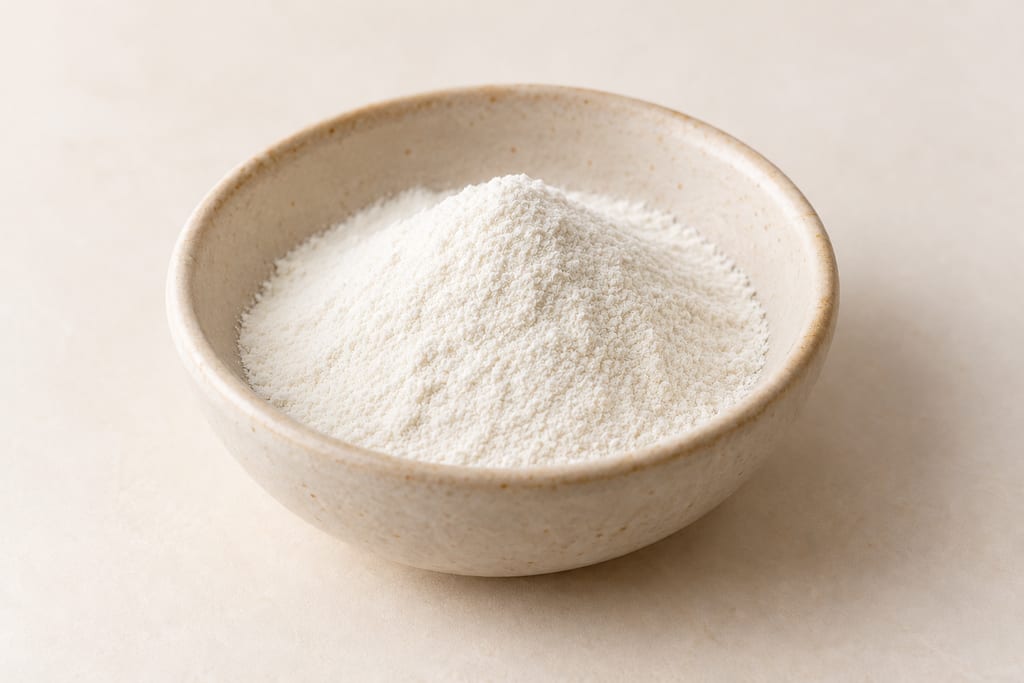
An enzyme preparation supplied dry
Rennet powder is a dry preparation of milk-clotting enzymes used to set cheese curd. Powder describes the supplied form. It does not establish whether the active enzyme came from an animal, a microbial fermentation or another source, and it does not specify a commercial strength.
The name rennet has both a narrower technical use for ruminant-stomach enzymes and a broader everyday use that includes other cheesemaking coagulants. A useful product description therefore needs more than that name: enzyme source, formulation, activity and intended application help identify what a maker is buying.
The documented use here is Queso Andino. FAO describes imported rennet in powder or tablet form, or natural rennet, but gives no brand or enzyme activity for the powder. This page retains that broad identity. It does not assign a calf-derived or vegetarian formulation to a preparation that the source has not identified.
Before standardized powder, rennet was prepared from tissue
A 1793 manuscript attributed to Dr. James Dinwiddie records rennet made from calf stomach preserved with salt and drying, then extracted into water. It also mentions other materials that could clot milk. The document shows practical coagulant knowledge written down long before a modern powder's labeled activity specification.
The preserved tissue and the infusion served different purposes: one kept an enzyme-bearing material, while the other brought an extract into contact with milk. This helps explain why the history of rennet is broader than the history of one commercial form. Dried stomach is not the same product as a formulated powder.
The manuscript is historical evidence, not current handling advice or a validated method for preparing an enzyme ingredient at home. It does not date the invention of rennet or trace the powder in Queso Andino to that recipe. Modern food-enzyme manufacture needs its own controlled source materials and processing.
Sources for this section
Animal source and physical form are separate choices
Animal rennet contains chymosin and pepsin activities whose proportions vary. EFSA's discussion of animal-rennet dossiers identifies age and feeding of source animals as influences on that balance. A statement about the animal species alone therefore does not provide the entire enzyme specification.
The preparation can be supplied as a liquid or dried into powder or granules. Manufacturing may involve concentration, separation of enzyme components, formulation and standardization before drying. The order and combination of operations can differ among producers, which is why a real product needs a description of its own manufacture.
Enzyme-activity ratios also should not be read casually as percentages of every material in a powder. Activity, protein content, carrier content and the mass of the whole preparation answer different questions. A dry form is convenient to measure and supply, but it does not mean pure chymosin or identify the source of the catalogue powder.
Sources for this section
Microbial fermentation can produce a clotting enzyme
A microbial coagulant may be manufactured by growing an appropriate organism and recovering its enzyme. JECFA's specification for rennet from Rhizomucor species describes controlled fermentation using Rhizomucor miehei or Rhizomucor pusillus. Its active principle is an aspartic proteinase that hydrolyzes proteins such as casein into smaller peptides.
That specification describes white-to-tan powdered preparations used for milk clotting. It establishes that a powder can have a microbial enzyme source, not that every rennet powder contains either organism or shares one composition. The production organism and the enzyme preparation must be distinguished.
Food-enzyme specifications call for characterized, stable production strains and consistent manufacturing conditions. An enzyme produced through fermentation is not automatically a living starter added to make lactic acid in the cheese vat. The culture used to manufacture an enzyme and the dairy bacteria used to acidify milk perform different jobs.
Food-enzyme production includes quality controls
An enzyme’s ability to clot milk is only one part of its suitability for food. Source material, production conditions and the materials carried into the finished preparation also matter. JECFA’s general specifications address these separately from the enzyme’s catalytic activity.
For microbial preparations, the production strain must be characterized and maintained consistently; manufacturing must prevent unwanted organisms and toxic materials from entering the preparation. This is why an arbitrary mold extract or a powder with an enzyme-like effect is not equivalent to a documented food-grade coagulant. The source and manufacturing controls are part of the ingredient’s identity.
Sources for this section
How rennet starts a casein gel
Rennet enzymes act on kappa-casein at the surface of milk's casein micelles. Removing part of that surface layer changes how the micelles interact. After this enzyme action, they can aggregate into chains and a network in milk's calcium-containing environment.
The network traps water, fat and other material as the milk becomes a gel. The initial cutting action by the enzyme and the later aggregation of micelles are connected phases, but the latter is not simply the powder thickening milk by absorbing water. Its effect comes from catalytic action on the protein structure.
This differs from adding acid or relying on a starter's lactic-acid production to bring about acid coagulation. Rennet curds and acid curds have different structural and drainage properties. Many cheeses combine acidification with renneting, so successful coagulation depends on the interaction of enzyme, milk and process rather than on the rennet's physical form alone.
Sources for this section
Clotting strength describes a measured activity
A gram of powder measures material, not a universal amount of enzyme action. Enzyme specifications describe activity in relation to a defined reaction, often per unit mass of preparation. Comparing products requires knowing the activity and the conditions under which it was determined.
Ramet's FAO guide explains historical rennet strength ratios through a specified amount of preparation, milk volume, temperature and clotting time. Those conditions are part of the definition. A ratio printed in an old method is not merely another way of writing the weight of any current powder.
Different assays and product descriptions therefore need careful interpretation. The strength of one powder, a liquid's concentration and the amount prescribed in a recipe cannot be made equivalent by matching spoonfuls. Use the current product's specification with an appropriate method; the unspecified powder here has no documented activity from which a general interchange can be calculated.
Two current powders show why formulations matter
PUNATURE's microbial-rennet technical sheet lists a Rhizomucor miehei preparation with sodium chloride and sodium benzoate, and declares a minimum activity of 18,000 IMCU/g. Its appearance and storage statements belong to that manufactured product, alongside its own quality specifications.
Serowar's MicroPure Dry is another named example. The seller describes fermentation and purification from Rhizomucor miehei and a crystalline powder with an activity of 5,000 IMCU/g. It gives product-specific dosing and storage advice rather than a rule for every microbial powder.
These examples show that even powders sharing an enzyme-source description can have different activity declarations and formulations. Neither is evidence for the exact powder used in FAO's Queso Andino. Their figures should not be used to reverse-engineer that missing identity, and the presence of a carrier or preservative in one should not be assigned to another. Keep the active enzyme, the whole formulation and the supplier's directions together.
Milk itself influences the curd obtained
Rennet works on a changing biological material. Casein, fat, minerals and their relationships influence the gel that forms. A firm curd must withstand cutting, then release whey through syneresis without excessive loss of fine curd particles and fat into the liquid.
Rako and colleagues studied sheep milk from Croatian flocks over lactation. Their laboratory tests found differences in gel firmness and whey release associated with the changing milk. The relationships were tied to those samples and conditions, rather than a universal equation for all dairy species.
For a maker comparing batches, this means that a change in clotting behavior cannot be attributed to the powder alone. The milk and the process also need consideration. It does not justify arbitrarily increasing a dose, borrowing the experimental conditions as a recipe or assigning a precise performance to a powder whose activity is unknown.
Queso Andino supplies one documented use
FAO's Queso Andino method combines acid-producing and aroma-producing starters with a milk-clotting preparation. The roles remain separate: bacteria develop the fermentation, while rennet sets the milk. The curd is later cut, drained and washed as part of making the cheese.
The account gives an average addition of 2.5 g of rennet powder per 100 L of milk. That is a quantity in this particular source method, not a generic recommendation. Without the powder's activity and formulation, it cannot be used to calculate a dose for every modern product sold under the same name.
The cheese's history and production in the Peruvian and Ecuadorian mountains are associations of Queso Andino. They do not identify the imported powder's manufacturer, enzyme source or country of production. The existing recipe is the supported use relationship; its missing enzyme specification should remain visible rather than being filled with a contemporary seller's unrelated product.
Microbial coagulant and fermentation-produced chymosin differ
Not every enzyme manufactured with microorganisms is the same kind of coagulant. A microorganism may produce its own milk-clotting protease, while fermentation-produced chymosin uses a production organism to make chymosin. The production route and the resulting enzyme identity are distinct parts of the description.
FDA's partial food-enzyme inventory separates microbial milk-clotting enzymes from animal rennet and lists chymosin preparations from specified microbial hosts. The inventory illustrates the need for source-specific descriptions; it is not a specification or certification for an unidentified packet.
For purchasing decisions, terms such as microbial and vegetarian need support from the actual supplier and complete formulation. They do not follow from the word powder. A broad regulatory category also cannot provide a batch's activity, carrier or allergen status. The right evidence is the current product documentation, with any dietary certification relevant to that particular preparation.
Selecting and handling the purchased preparation
Select a food-grade preparation intended for the cheese method being followed. Check its identity, activity declaration, ingredients, storage directions and date marking. Powder, tablet and liquid forms should be handled according to their own instructions rather than converted by appearance or package size.
The named producer examples give different storage and use directions. Those statements should stay with their products. They do not establish a shelf life for an unspecified powder or support storing it indefinitely because it looks dry. Neither can the absence of visible change demonstrate that a stored preparation retains its labeled activity.
Clean equipment and careful handling remain part of cheesemaking. New Mexico State University's guidance connects the coagulant with milk quality, food-contact hygiene and curd processing. Setting a gel is one stage in that process; it does not complete the work of making and storing cheese appropriately.
Coagulation does not establish food safety
Rennet's intended action is milk clotting, not sterilization. CDC warns that raw milk and its products can transmit pathogens and that good farm practice cannot guarantee their absence. A powder that sets raw milk into an attractive curd has not thereby shown that those hazards are controlled.
Choose pasteurized dairy and a supported cheesemaking method. Keep the controls for milk, equipment, acidification, later processing and storage connected to the actual cheese. A method's historical use or a commercial enzyme's existence is not evidence that every home adaptation has been validated.
The generic powder's allergen and carrier status remain unspecified. Do not describe it as milk-free or assign a vegetarian status without the actual preparation's documentation. Smell, taste, curd firmness and a home pH reading cannot establish safety. No universal safe dose, coagulation temperature, maturation period or finished-cheese shelf life follows from this ingredient name.
Sources for this section
Places
Unknown
historical-association · Place not establishedNo geographic origin or manufacturing location is established for this unspecified ingredient. Recipe geography does not identify its supply.
Community
No community contributions have been published for this entry yet.
Share what you made
Sign in to contribute. Published comments and photos are free to read.
Sources
FAOIdentity · History · Fermentation function · Handling
The technology of traditional milk products in developing countries — FAO, 1990, §3.18 Queso AndinoQueso Andino uses imported powder/tablet or natural rennet. Its average powder addition is 2.5 g/100 L without activity strength; this is one source method, not a general dose.
Cited in: An enzyme preparation supplied dry; Queso Andino supplies one documented use
Early Modern Maritime Recipes; Dalhousie University Archives, James Dinwiddie Fonds MS-2-726Identity · History · Fermentation function · Handling
Rennet for Cheese — Dr. James Dinwiddie, 1793Historical manuscript describes salted/dried calf stomach and an infusion, with other coagulant alternatives; not the origin or specification of commercial powder.
Cited in: Before standardized powder, rennet was prepared from tissue
EFSAIdentity · History · Fermentation function · Handling
Rennet: data gaps and proposals — EFSA food enzyme team, September 18, 2020Slides2–4 distinguish physical forms, manufacturing concentration/standardization/drying and chymosin-to-pepsin activity ratios; source age/feeding influence ratios.
Cited in: Animal source and physical form are separate choices
FAO/WHO JECFAIdentity · History · Fermentation function · Handling
Rennet from Rhizomucor species — specification prepared at the 55th JECFA, 2000Controlled fermentation of R.miehei or R.pusillus; microbial aspartic proteinase; casein hydrolysis; white-to-tan powders. Named preparation, not all powders.
Cited in: Microbial fermentation can produce a clotting enzyme
United States PharmacopeiaIdentity · History · Fermentation function · Handling
Enzyme Preparations — Food Chemicals Codex, 2015Accessible monograph description: enzyme preparations may include multiple active components and food-grade diluents/preservatives; activity is measured by catalyzed reaction.
Cited in: An enzyme preparation supplied dry; Clotting strength describes a measured activity
FAO/WHO JECFAIdentity · History · Fermentation function · Handling
General Specifications and Considerations for Enzyme PreparationsFood-enzyme source materials, stable production strains, carriers and good manufacturing practice; source organism distinct from prepared enzyme.
Cited in: Microbial fermentation can produce a clotting enzyme; Food-enzyme production includes quality controls; Microbial coagulant and fermentation-produced chymosin differ
PUNATURE Food Ingredients Co., Ltd.Identity · History · Fermentation function · Handling
Microbial Rennet Powder 18000 IMCU/G — Technical Data SheetManufacturer example: R.miehei preparation with sodium chloride/sodium benzoate and declared activity≥18000IMCU/g. Product-specific, not the Queso Andino powder.
Cited in: Two current powders show why formulations matter; Selecting and handling the purchased preparation
SerowarIdentity · History · Fermentation function · Handling
Microbial rennet in powder — MicroPure DrySeller describes fermentation/purification from R.miehei, crystalline powder, activity 5000 IMCU/g and product-specific handling; not generic dosing or composition.
Cited in: Two current powders show why formulations matter; Selecting and handling the purchased preparation
FAO, Animal Production and Health Paper 113Identity · History · Fermentation function · Handling
The technology of making cheese from camel milk — J. P. Ramet, 2001, Characterizing and using milk-clotting preparationsClotting strength defined through amount of preparation, milk and precise assay conditions; historical ratios differ from a generic dose. Camel-milk study context.
Cited in: Clotting strength describes a measured activity
Food Technology and BiotechnologyIdentity · History · Fermentation function · Handling
Effect of Sheep’s Milk Composition on Strength and Syneresis of Rennet-Induced Milk Gel During Lactation — Ante Rako et al., 2019Sheep-milk laboratory experiment: composition and lactation affected gel strength and drainage; not an instruction for this powder.
Cited in: Milk itself influences the curd obtained
FDAIdentity · History · Fermentation function · Handling
Enzyme Preparations Used in Food (Partial List)Lists animal rennet and fermentation-produced chymosin separately from microbial milk-clotting enzyme categories; a partial US inventory, not a packet specification.
Cited in: Microbial coagulant and fermentation-produced chymosin differ
Microbiology SpectrumIdentity · History · Fermentation function · Handling
The Basics of Cheesemaking — Paul S. Kindstedt, 2013Acidification alters casein mineral state and curd; distinction between acid and enzyme coagulation.
Cited in: How rennet starts a casein gel
New Mexico State University ExtensionIdentity · History · Fermentation function · Handling
Making Homemade Cheese — Guide E-216, revised by Nancy C. FloresProtect cultures from contamination; food-contact hygiene, milk treatment and cheese handling address separate hazards.
Cited in: Selecting and handling the purchased preparation; Coagulation does not establish food safety
CDCIdentity · History · Fermentation function · Handling
Raw Milk — January 31, 2025Raw milk may carry pathogens; farm hygiene cannot guarantee safety; choose pasteurized dairy.
Cited in: Coagulation does not establish food safety