
Substrates
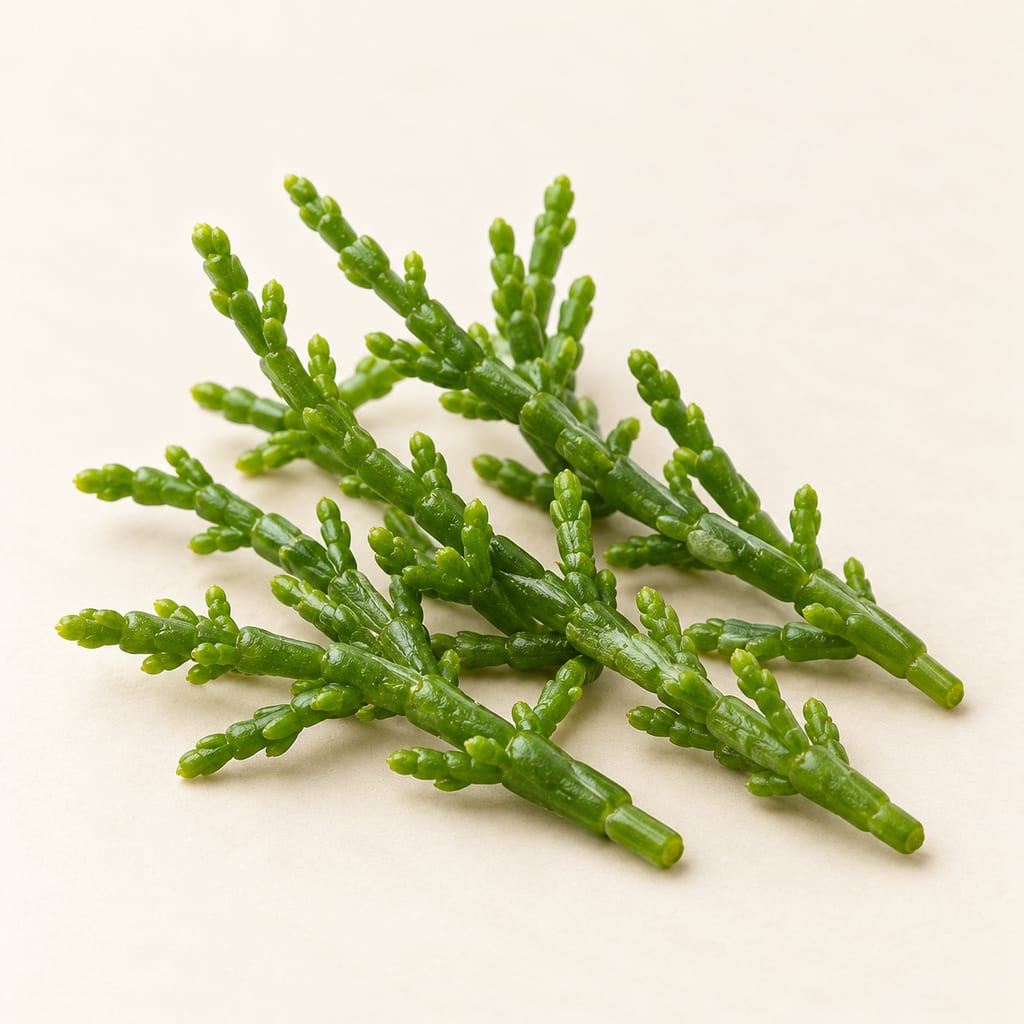
Samphire
Kew accepts Salicornia europaea, while older glasswort names can cover broader groups. French sources report food uses; one study tested S. europaea var. aprica under controlled salt treatments.
Scope of this account
The common ingredient name can refer to more than one plant. The research below concerns the particular taxon and uses named in its sources; it does not identify every ingredient sold under this name.
Sources for this section
The species behind the common names
Kew accepts Salicornia europaea L. as an annual native to northern and western Europe. Its taxon page lists Salicornia herbacea and other historical names among the synonyms. Glasswort research documents that these names have often been used broadly across several closely related taxa. The RHS page is explicitly for Salicornia europaea aggregate, and Euro+Med also records an aggregate with child taxa. Common names such as glasswort, samphire and salicorne therefore do not establish that a particular plant or food report is the exact Kew species.
Regional food reports
A French regional park account labels its subject Salicornia sp. and describes young-shoot harvest and use as a vegetable or in vinegar. CEVA describes French salicorne products, regional harvesting and processing research. These sources document local food contexts at genus or product scope; they do not establish the identity of every harvested batch as Salicornia europaea, and they do not provide a complete species-matched household recipe.
Sources for this section
A study-specific greenhouse growing experiment
An EU CAP Network project abstract reports protected greenhouse production of Salicornia europaea in Saxony-Anhalt using residual salt from potash mining and a closed growing system. It does not give full operating setpoints. A 2024 Frontiers study tested Salicornia europaea var. aprica in hydroponics. The researchers compared 0, 7.5, 15, 22.5 and 30 g/L NaCl treatments across repeated harvests; the highest fresh mass in that experiment occurred at 15 g/L about four months after germination. Its methods also report nutrient solution at pH 6–6.2 and extended daylength to 16 hours. These are conditions and results for that variety and research setup, not general home-growing settings or a universal optimum.
Habitat and what remains unresolved
JNCC describes the UK H1310 habitat as Salicornia and other annual plants colonising mud and sand. That habitat account is not a species-specific threat assessment and does not determine whether collection is allowed at a particular site. A 1977 Aquatic Botany paper concerns seed germination, a separate life stage; its publisher page returned HTTP 403, and the abstract information is not converted into home sowing advice.
Research gaps
No complete species-confirmed regional recipe with quantities, yield, ordered stages, endpoint and storage was inspected; French food pages identify Salicornia sp. or salicorne product rather than every batch as S. europaea.
The 2024 Frontiers results concern S. europaea var. aprica in a controlled hydroponic setup. They do not establish a universal salt optimum, food-safety endpoint or household cultivation recipe.
The EU project abstract does not report full greenhouse setpoints. Productive outdoor, container and household greenhouse methods, hardiness limits, pests and harvest intervals remain unresolved.
JNCC describes a UK habitat assemblage, not species-level conservation status or permission to collect. Country- and site-specific collection rules were not assessed.
The 1977 Aquatic Botany seed-germination article metadata is confirmed through Crossref/publisher indexing, but the publisher article page returned HTTP 403; full methods were not inspected.
Sources for this section
- Salicornia europaea L. →
- Salicornia L. (Salicornioideae, Chenopodiaceae) in Britain: a taxonomic and evolutionary study →
- A taxonomic nightmare comes true: phylogeny and biogeography of glassworts →
- Salicornia europaea agg. →
- Salicornia europaea agg. details →
- Salicorne →
- Salicorne →
- An innovation project on salt plants in Saxony-Anhalt has set itself the goal... →
- Molecular analysis of the reactions in Salicornia europaea to varying NaCl concentrations at various stages of development to better exploit its potential as a new crop plant →
- H1310 Salicornia and other annuals colonising mud and sand →
- Salinity, temperature, and growth regulator effects on seed germination of Salicornia europaea L. →
Research status
The underlying plant account received a partial source review. Its review scope is described in the original plant article.
Places
Unknown
Relationship not established · Place not establishedThe available research does not establish a single origin for this ingredient.
Community
No community contributions have been published for this entry yet.
Share what you made
Sign in to contribute. Published comments and photos are free to read.
Sources
Royal Botanic Gardens, Kew, Plants of the World OnlineIngredient research
Salicornia europaea L.Cited in: Scope of this account; The species behind the common names; Research gaps
Journal of Ecology / British Ecological SocietyIngredient research
Salicornia L. (Salicornioideae, Chenopodiaceae) in Britain: a taxonomic and evolutionary studyCited in: The species behind the common names; Research gaps
TaxonIngredient research
A taxonomic nightmare comes true: phylogeny and biogeography of glasswortsCited in: The species behind the common names; Research gaps
Euro+Med PlantBaseIngredient research
Salicornia europaea agg.Cited in: The species behind the common names; Research gaps
Royal Horticultural SocietyIngredient research
Salicornia europaea agg. detailsCited in: The species behind the common names; Research gaps
Parc naturel régional du Marais poitevinIngredient research
SalicorneCited in: Regional food reports; Research gaps
European Commission CAP NetworkIngredient research
An innovation project on salt plants in Saxony-Anhalt has set itself the goal...Cited in: A study-specific greenhouse growing experiment; Research gaps
Frontiers in Plant ScienceIngredient research
Molecular analysis of the reactions in Salicornia europaea to varying NaCl concentrations at various stages of development to better exploit its potential as a new crop plantCited in: A study-specific greenhouse growing experiment; Research gaps
Joint Nature Conservation CommitteeIngredient research
H1310 Salicornia and other annuals colonising mud and sandCited in: Habitat and what remains unresolved; Research gaps
Aquatic Botany (Elsevier)Ingredient research
Salinity, temperature, and growth regulator effects on seed germination of Salicornia europaea L.Cited in: Habitat and what remains unresolved; Research gaps
FermenteaResearch provenance
Salicornia europaea: taxonomic scope, food reports and cultivation research: original plant researchCited in: Research status