
Mushrooms
Scaly wood mushroom
Agaricus langei, the scaly wood mushroom, is a brown-scaled woodland agaric. Its name is not settled across sources, and it is recorded as a cooked wild mushroom in Europe.
Overview
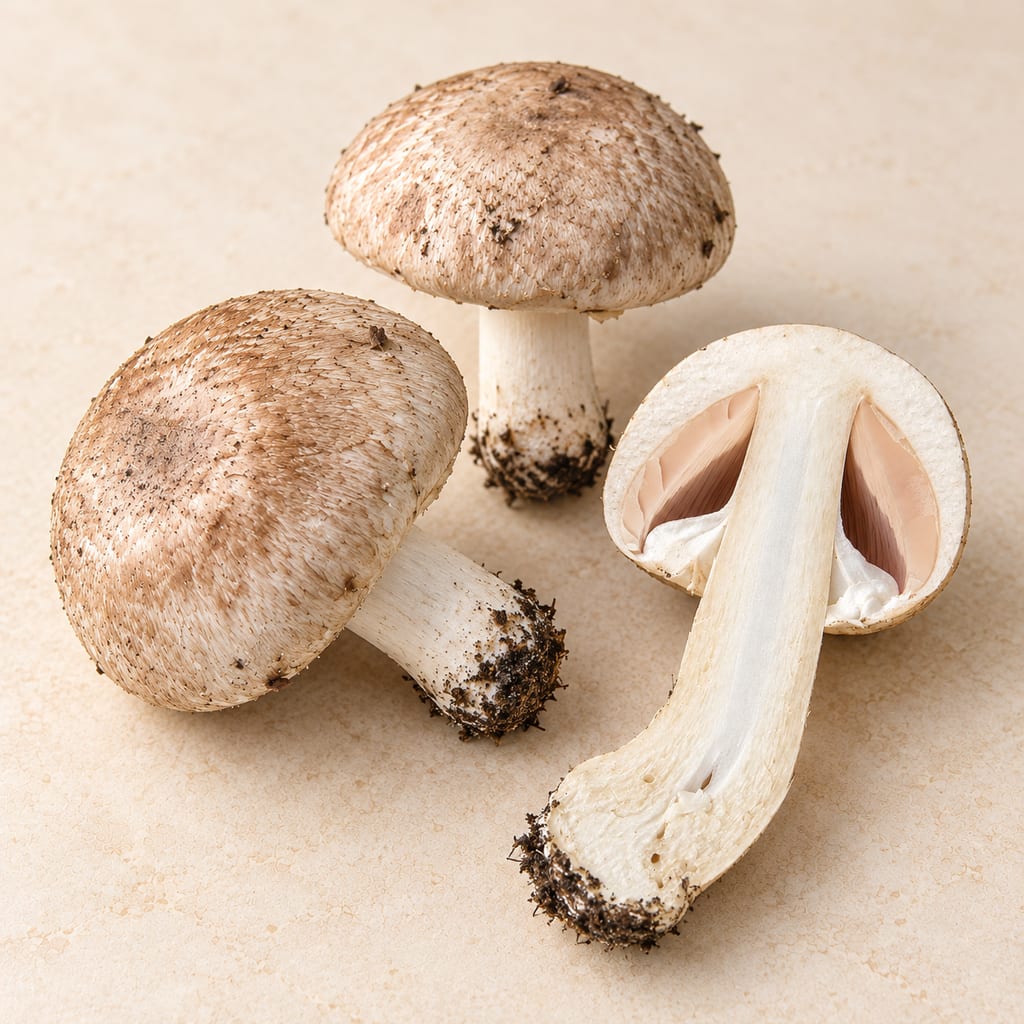
Agaricus langei is a wild mushroom of the genus Agaricus, the genus that also contains the cultivated button mushroom. Field references describe a cap covered in brown scales and flesh that reddens or pinkens when cut or bruised.
In older literature the same mushroom is often called Agaricus haemorrhoidarius. The common name scaly wood mushroom is applied in some sources to Agaricus silvaticus as well, so the name alone does not identify the species.
Sources for this section
Naming and taxonomy
UK species records treat Agaricus langei as the accepted name, with Agaricus haemorrhoidarius sensu Lange listed as a synonym. The authority for the name is given differently in different databases.
Other treatments place Agaricus haemorrhoidarius within Agaricus silvaticus, or treat it as a distinct species. The catalogue keeps Agaricus langei as a research name and does not treat it as a validated current name.
Sources for this section
Habitat
The mushroom grows in coniferous and mixed woodland, often under spruce, and decomposes forest litter. Its close relative Agaricus silvaticus usually has a bulbous stem base, which helps separate the two in the field.
Sources for this section
Food use
The Nordic guidance on mushrooms traded as food places this group of non-yellowing Agaricus species in its list 2, wild edible mushrooms whose identity has to be documented by recognised experts before they are suitable for commercial marketing.
The supplied catalogue records its use as a cooked woodland mushroom in Europe. The record describes local food use; it does not show how the mushroom is prepared, or how much is safe to eat.
Safety
The Nordic guidance says that other non-yellowing Agaricus species, including the scaly wood mushroom and the blushing wood mushroom, should not be eaten in larger amounts because of potentially high levels of phenylhydrazine derivatives. It refers to its risk assessment of the button mushroom for that reasoning.
Field guides warn against confusing young specimens with Amanita species, which have light scales on a dark cap. The catalogue caution is that older synonym use varies and that identification should rely on regional taxonomic resources.
Nothing on this page is an identification or edibility verdict. A mushroom must be identified by a competent expert before it is eaten.
Places
Europe
Documented use · Region evidenceCatalogue food-use record for Europe; the species is wild.
Community
No community contributions have been published for this entry yet.
Share what you made
Sign in to contribute. Published comments and photos are free to read.
Sources
Safety · Method
Mushrooms traded as food, Vol II sec. 1: Nordic risk assessments and background on edible mushroomsGuidance list 2 placement of Agaricus langei and related non-yellowing Agaricus species
Larger-amount caution citing phenylhydrazine derivatives
Cited in: Food use; Safety
NBN AtlasTaxonomy
Agaricus langei: Scaly Wood MushroomAccepted name Agaricus langei in UK species record, with Agaricus haemorrhoidarius sensu Lange as synonym
Cited in: Overview; Naming and taxonomy
Wild Food UKIdentification · Safety
Scaly Wood Mushroom: wild food guideBrown scales, reddening flesh, coniferous and mixed woods, look-alike Agaricus silvaticus
Caution against confusion with Amanita
Cited in: Overview; Habitat; Safety