
Mushrooms
Shaggy mane
Shaggy mane is an inky cap with scaly white caps that is eaten only when young. Its gills blacken quickly after picking, and it has a poisonous green-gilled lookalike.
Identity
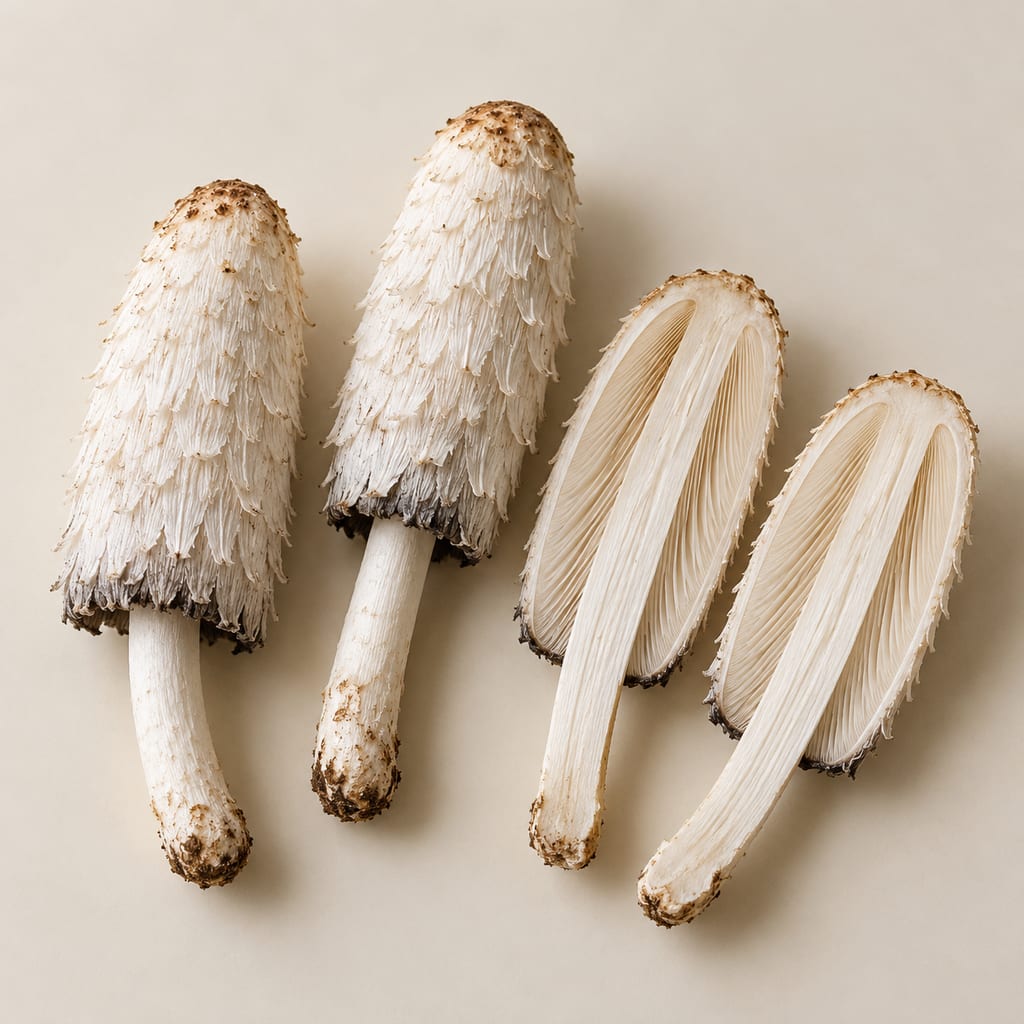
Shaggy mane is the common name for Coprinus comatus, a mushroom that grows in groups on lawns, gardens, cemeteries and disturbed ground. The British Columbia guide describes a cap 2.5 to 7 cm wide and 5 to 20 cm tall, cylindrical when young and expanding flat with a rolled-up margin. It is white with flat light-brown scales and a brown patch on top. The gills are very crowded and white at first, then pink and finally black. The stem is hollow with a small movable ring.
Sources for this section
Edibility and timing
The UBC guide says that young specimens are eaten, and that they should be consumed as soon as possible after collection, before they turn black. As the mushroom matures the gills self-destruct into a black ink that carries the spores, a process known as autolysis. The guide gives no cooking method and no storage advice beyond eating the mushroom quickly.
Sources for this section
Lookalikes and contamination
The common inky cap, Coprinopsis atramentaria, is shorter, usually under 8 cm, grey to brown, smooth and without scales. It contains coprine, which causes a reaction with alcohol, so it should not be eaten with alcohol before or after. The green-gill parasol, Chlorophyllum molybdites, is poisonous; its cap margin does not roll up and its gills do not liquefy.
The guide advises against eating mushrooms from disturbed or contaminated soil, because they can accumulate mercury and other heavy metals.
Sources for this section
Safety record
The UBC guide says shaggy mane has no known human toxins but has been linked to some cases of gastrointestinal upset, some of which may have involved misidentified inky caps or green-gill parasols. The catalogue's caution is that the species is very perishable and must not be merged with the alcohol-reactive inky cap. The sources read do not establish whether alcohol affects shaggy mane itself, and this page makes no claim on that point.
Sources for this section
Places
Europe
Documented use · Region evidenceThe catalogue records European use and cultivation; the UBC guide documents the species in British Columbia, not a European food tradition.
Community
No community contributions have been published for this entry yet.
Share what you made
Sign in to contribute. Published comments and photos are free to read.
Sources
UBC Beaty Biodiversity Museum, Mushrooms of British ColumbiaIdentity · Edibility · Lookalikes · Safety
Coprinus comatus - Shaggy maneYoung specimens are eaten and should be consumed before the gills turn black; the gills autolyse into black ink carrying the spores.
The common inky cap is shorter, grey to brown, smooth, and alcohol should be avoided around it; the green-gill parasol is poisonous.
Mushrooms from contaminated soil may accumulate mercury and heavy metals; no known human toxins, but linked to some gastrointestinal upset.
Cited in: Identity; Edibility and timing; Lookalikes and contamination; Safety record