
Mushrooms
Shrimp brittlegill
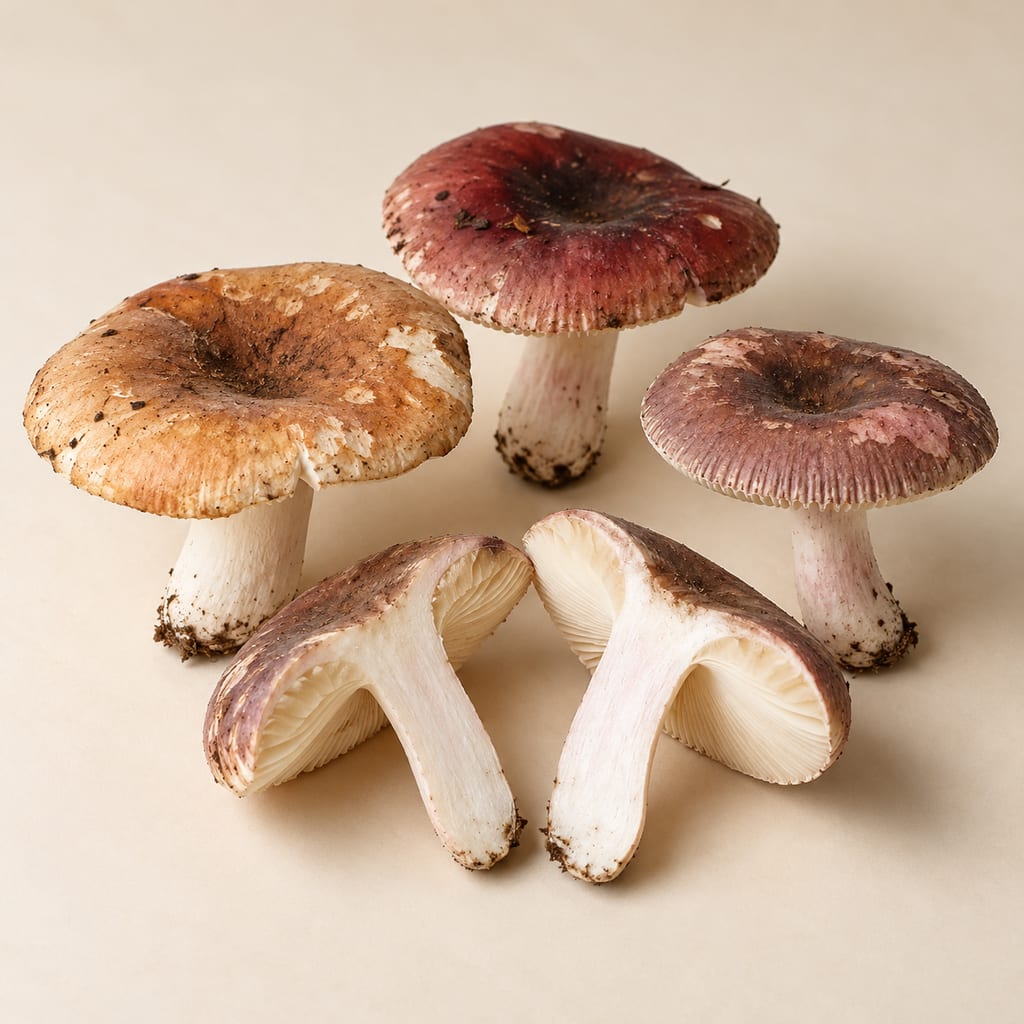
Russula xerampelina, the shrimp brittlegill, is a wild mushroom of conifer and mixed woods with a shellfish smell. Guides rate it edible and mild-tasting, but its red relatives include acrid look-alikes.
What it is
Shrimp brittlegill is a gilled mushroom in the genus Russula, a group whose members have brittle flesh. Its name comes from a distinctive smell that many guides describe as shrimp-like or shellfish-like. MushroomExpert describes the odour as fishlike or shrimplike, most strongly in older specimens and in dried ones.
The Latin name is used for a group of close relatives, and sources that discuss the species note that some identifications under the name may cover more than one species. The record keeps the name Russula xerampelina used by the catalogue.
Sources for this section
Eating qualities
The Swedish guide Svampguiden lists the crab brittlegill as edible and calls it one of the best edible species of its genus and one of the most sought after. MushroomExpert describes the taste as mild, but notes that the gills can be mild to rather bitter, so a small piece should be tasted and spat out before a larger portion is eaten.
Cooks who have eaten it report that the shellfish smell is less pronounced after cooking, and one account says it is not necessarily gone. Sources do not give a standard preparation for it.
Sources for this section
Look-alikes and identification
The main risk is confusion with other red-capped and sickener-type Russulas. MushroomExpert warns that the taste test is not safe for every species in the group, since some red russulas are acrid. Testing by tasting is therefore advised only as a nibble-and-spit check, never by swallowing.
This record is not a guide to identifying wild mushrooms. Confirm any identification with an experienced local mycologist before eating.
Sources for this section
How to recognise a brittlegill
A mushroom is a brittlegill, a Russula, only when several features line up. The cap is usually brightly coloured. The gills are brittle: they snap when you try to bend them, and the flesh breaks cleanly like chalk instead of tearing into fibres. The stem carries no ring and no cup or sack at its base, and there are no veil remnants on the cap. The gills are attached to the stem, and a spore print is white, cream or dark yellow.
Two checks separate Russula from its look-alikes. Break a gill or cut the flesh: a brittlegill gives no milky juice, while a milkcap (Lactarius or Lactifluus) weeps latex. Then look at the stem. A ring on the stem, a cup or a sack or bulb with torn remnants at its base, or flesh that tears in fibres points away from Russula and towards Amanita, a genus that includes the deadly death cap and many other poisonous species. A mushroom with a ring or a cup at the base is not a Russula, whatever colour its cap is.
Recognising the genus is much easier than naming the species. Cap colour varies widely inside one species, so experts rely on the colour of the spore print, the taste, colour changes in the flesh, how far the cap skin peels, chemical tests and the microscope. A collector who is sure of the genus but not of the species should treat the species as unidentified.
Sources for this section
The taste test, and what it cannot tell you
Foragers have long sorted brittlegills by taste. Break off a small piece of cap flesh or gill, chew it for several seconds and spit it out without swallowing; the burn of an acrid species can take half a minute to build. Brittlegills that taste mild are the traditional edibles. Those that taste hot, peppery or acrid, and many bitter ones, are left alone because they irritate the stomach and bowel and can cause vomiting and diarrhoea.
The method works only inside the genus. Use it once the mushroom is positively a Russula, never to decide whether an unknown mushroom is safe: the deadliest mushrooms do not taste unpleasant, and a mild taste says nothing about an Amanita, a Cortinarius or any other family. Within Russula it is a screen for rejecting species, not proof of safety. Some mild species are poor eating, rare species are poorly documented, and a few brittlegills have been linked with poisoning. Cook what you eat, start with a small portion, and identify to species where you can. This record is not a field guide.
Sources for this section
Places
Europe
Documented use · Region evidenceRegion-level record from the Swedish guide. The sources reviewed do not give a single origin.
Community
No community contributions have been published for this entry yet.
Share what you made
Sign in to contribute. Published comments and photos are free to read.
Sources
MushroomExpertIdentity · Food · Safety
Russula xerampelinaFishlike or shrimplike odour; mild taste; gills mild to rather bitter; nibble-and-spit testing only
Cited in: What it is; Eating qualities; Look-alikes and identification
SvampguidenFood · Identity
Crab brittlegillEdible; one of the best edible species of its genus
Cited in: What it is; Eating qualities
WikipediaIdentification · Food use
RussulaBrittle attached gills, no latex, no ring or volva; Lactarius weeps latex; taste (mild, bitter, acrid) as a diagnostic character; acrid species are toxic and mild species such as R. cyanoxantha and R. vesca are eaten; the genus is mostly free of deadly species.
Cited in: How to recognise a brittlegill; The taste test, and what it cannot tell you