
Mushrooms
Slimy spike
The slimy spike, Gomphidius glutinosus, is a sticky gilled mushroom of conifer woods with a slime-covered cap. Sources rate it edible but not recommended, note heavy-metal accumulation, and advise removing the slime after picking.
Overview
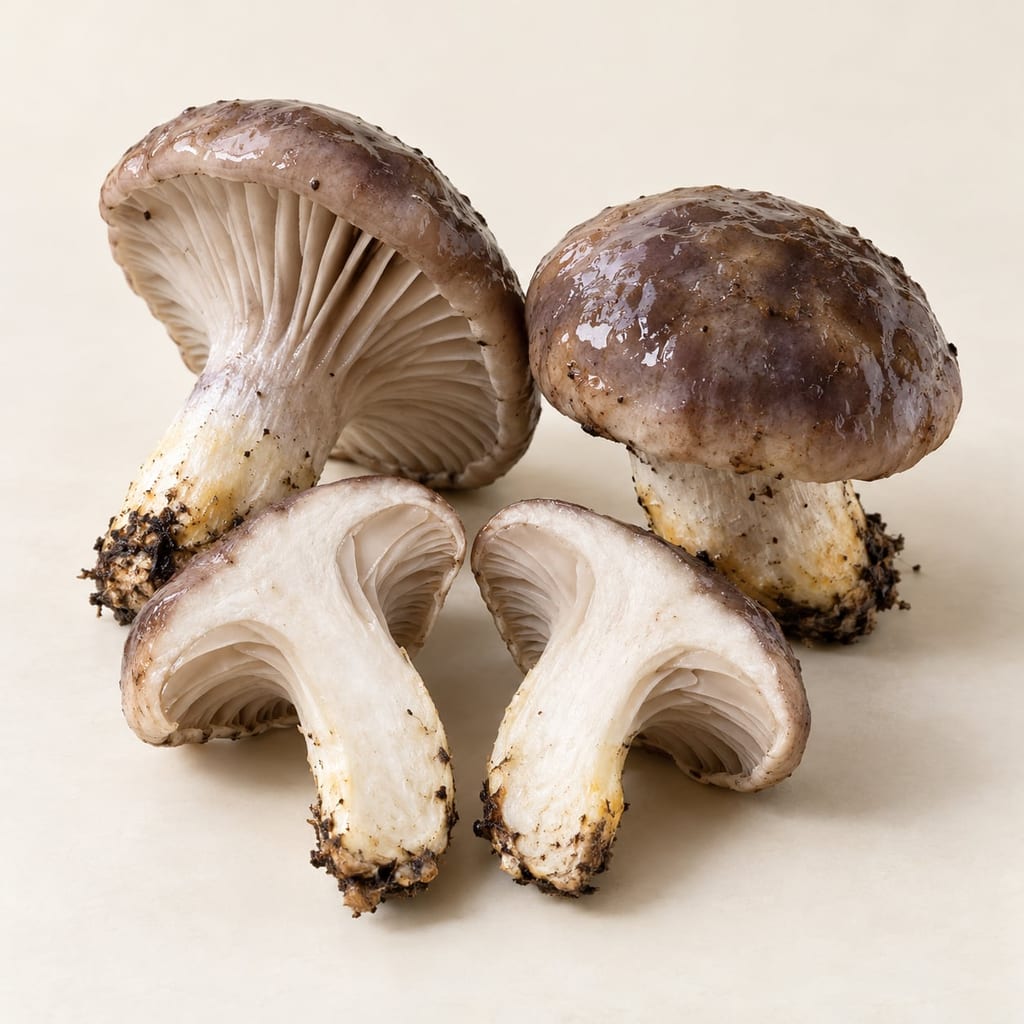
The slimy spike, Gomphidius glutinosus, is a gilled mushroom of the order Boletales, the group that includes the boletes. Its whole young fruit body is covered in a slimy veil, and the cap stays sticky. It grows under conifers in woods and plantations, and it occurs up to 2,900 metres.
The species is recorded as a cooked woodland mushroom in northern Europe. The sources describe it as edible, but they do not recommend it as a regular food, and they note that it accumulates heavy metals.
Sources for this section
Taxonomy and names
Jacob Christian Schaffer described the species as Agaricus glutinosus in 1774. Elias Magnus Fries placed it in Gomphidius in 1838, giving the authority (Schaeff.) Fr. Synonyms include Agaricus mucosus and Cortinaria viscida. Orson Miller described two varieties in 1971, purpureus and salmoneus. The catalogue records the scientific name as a research label rather than a reconciled accepted name, so records should be checked against current taxonomy.
Sources for this section
Description
The cap is 3 to 12 cm across, dull dark purple, brownish or grey, smooth, sticky, with a central boss and an inrolled margin. The stipe is white, 4 to 10 cm tall, with a yellow base that stains dark green to black with Melzer's reagent. The gills are widely spaced, decurrent, waxy, whitish when young and grey as they darken with spores. The spore print is brownish-black, and the spores are spindle-shaped, 17 to 20 by 5.5 to 6 micrometres.
Sources for this section
Habitat, ecology and season
The species grows under conifers such as balsam fir, Norway spruce and grand fir, in natural woods and plantations, singly, scattered or in clusters. It occurs up to 2,900 metres and fruits in autumn, sometimes as late as December in northern California.
Gomphidius species were once thought to be ectomycorrhizal. Wikipedia now says that many, possibly all, species of the family are parasitic on ectomycorrhizal boletes. For this species the sources say it is possibly a parasite on Suillus and Rhizopogon mycelium, and it has been found under pines where Suillus grevillei was present.
Sources for this section
Look-alikes
Brownish specimens can resemble Suillus luteus, but Gomphidius has gills where Suillus has pores. Hygrophorus hypothejus has yellow gills that do not separate from the cap. G. smithii of North America has a paler purple to wine-coloured cap, and G. oregonensis and G. subroseus are also similar. The sources do not treat Gomphidius roseus or Chroogomphus rutilus as dangerous.
Sources for this section
Preparation and quality
The Wikipedia article describes the flavour as mild and suited to mixed dishes, soups and stews, and it says the species is not suited to drying. It advises removing the slime and the skin of the cap as soon as possible after picking. Opinions on its table quality differ: some guides hold it in high regard, while others view it with caution.
The sources reviewed do not give a cooking time or a method beyond the slime and skin removal advice.
Sources for this section
Safety
The Wikipedia infobox rates the slimy spike as edible but not recommended. The article records that the species accumulates heavy metals, and it contains no explicit toxicity statement. No safe quantity is given.
Appearance, smell and taste do not establish that a mushroom is safe to eat. Confirm the identification by checking gills against pores with an experienced local expert, and follow official food safety advice before eating any wild mushroom.
Sources for this section
Open questions
The sources do not give a regional cooking tradition, a dated food history, a local name, or the level of heavy metals in a typical specimen. These are unknown, not negative findings.
Sources for this section
Places
Northern Europe
Documented use · Region evidenceThe catalogue records it as a cooked woodland mushroom in northern Europe. Wikipedia says opinions differ on its suitability for the table.
North America
Relationship not established · Region evidenceWikipedia lists North American distribution. The sources reviewed do not record food use there, so the relationship is unknown.
Community
No community contributions have been published for this entry yet.
Share what you made
Sign in to contribute. Published comments and photos are free to read.
Sources
WikipediaTaxonomy · Description · Habitat · Ecology · Distribution · Edibility · Safety
Gomphidius glutinosusDescribed as Agaricus glutinosus by Schaeffer in 1774; placed in Gomphidius by Fries in 1838
Cap 3 to 12 cm, dull dark purple, brownish or grey, sticky; whole young fruit body under a slimy veil; stipe white with a yellow base
Gills widely spaced, decurrent, whitish then grey, blackening with spores; spore print brownish-black
Grows under conifers such as balsam fir, Norway spruce and grand fir; once thought ectomycorrhizal, now thought parasitic on boletes such as Suillus
Infobox: edible but not recommended; opinions differ; removing the slime and skin of the cap is recommended soon after picking; accumulates heavy metals
Look-alikes include Suillus luteus (brownish caps, but pores not gills), Hygrophorus hypothejus, and G. smithii, G. oregonensis, G. subroseus
Cited in: Overview; Taxonomy and names; Description; Habitat, ecology and season; Look-alikes; Preparation and quality; Safety; Open questions