
Mushrooms
Southern Grifola
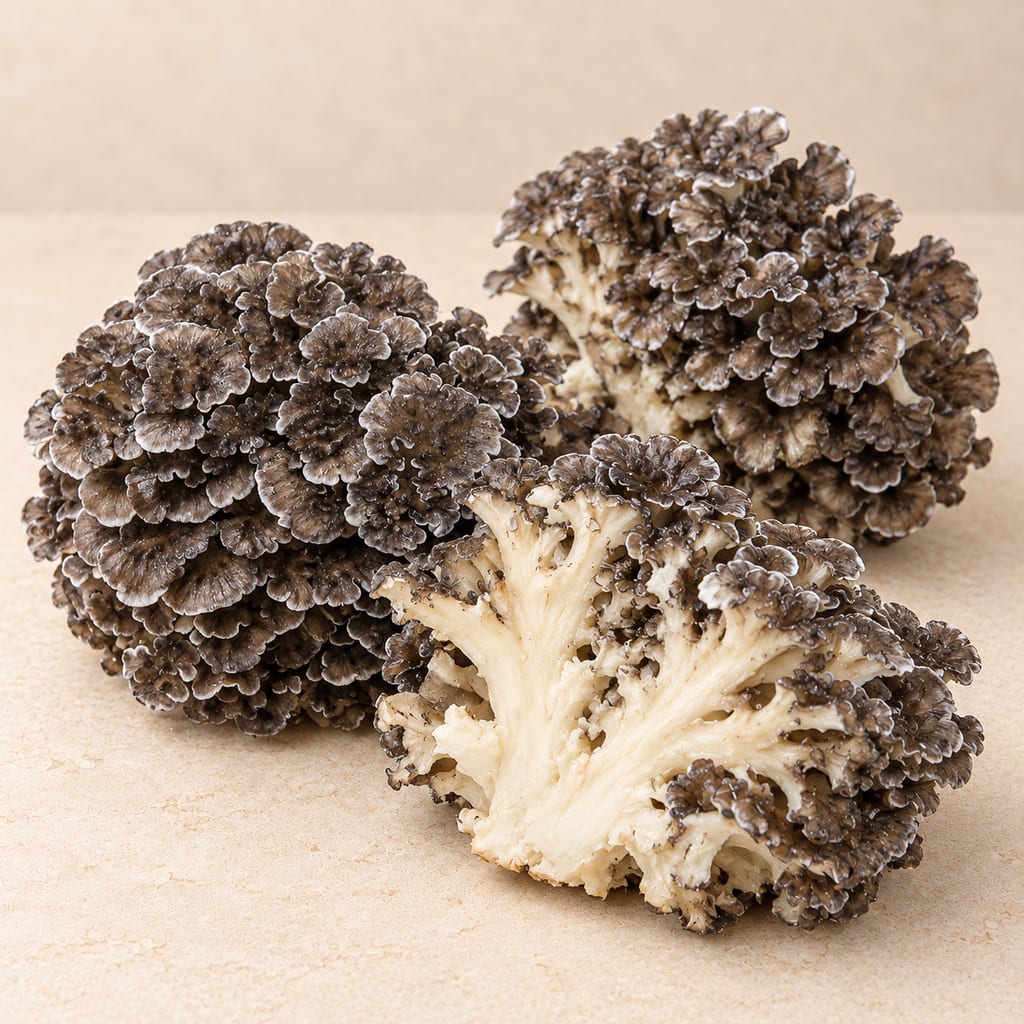
Grifola sordulenta is a wild polypore of Nothofagus forests in Patagonia, recorded as a regional food fungus with an almond-like flavour and little modern cultivation.
Identity and name
Grifola sordulenta is a polypore in the same genus as maitake (Grifola frondosa). The catalogue records it under the common name Southern Grifola and treats the scientific name as a research label, not a reconciled accepted name.
A Springer taxonomic paper places it as a sister species of G. colensoi, which is known from New Zealand and Australia. Its close relative G. gargal is also recorded from the same Andean-Patagonian forests, and the sources separate the two. Confirming the local species concept is still required before any record is attributed to G. sordulenta.
Habitat and ecology
The fungus grows in the Andean forests of Argentina and Chile, where Nothofagus is the dominant tree. A Springer taxonomic paper associates it with Nothofagus dombeyi. The catalogue describes it as a wood-associated fungus of Nothofagus forest.
A 2015 review by Postemsky notes that these forests face growing pressure, which has led to interest in alternative sources of the fungus. The catalogue records the supply as unknown.
Food use and flavour
The main recorded role of Grifola sordulenta is culinary. Reviews describe a characteristic almond flavour, and the catalogue records it as a regional consumption record that has been studied as a food fungus.
The catalogue states that this food-use record is not a comprehensive toxicity evaluation. No preparation method specific to this species is recorded in the sources reviewed, so none is given here.
Chemistry and research
A 2022 Foods study gave the first chemical analysis of G. sordulenta, alongside other wild Patagonian species from Nothofagus forests. Separate work on submerged cultures found high antioxidant activity in the mycelia of G. sordulenta and G. gargal.
These are laboratory and culture results. They do not establish health effects of eating the fruiting body, and the sources do not make that claim.
Cultivation
Studies on growing the fungus on agar, in liquid media and by solid-state fermentation on cereal grains are ongoing. A 2015 review reports that neither industrial application nor commercial production had been undertaken at that time. The catalogue records supply as unknown.
Safety and limits
Identification and safety: a name, a photograph or one regional guide does not confirm that a wild specimen is this species. This page is not a collection key. Edibility statements refer to the named species as understood by each source, not any particular specimen. The catalogue states that the regional food-use record is not a comprehensive toxicity evaluation and that the local species concept must be verified. Because G. sordulenta and G. gargal are separated only at the specialist level, a record of "Grifola" from this region does not identify which species was eaten.
Places
Patagonia (Argentina and/or Chile)
Documented use · Region evidenceRegional consumption record from Nothofagus forests; the country-level split is not established by the sources.
Community
No community contributions have been published for this entry yet.
Share what you made
Sign in to contribute. Published comments and photos are free to read.
Sources
Foods (MDPI), via PubMed CentralFood use · Chemistry · Cultivation
Nutritional Composition and Bioactive Properties of Wild Edible Mushrooms from Native Nothofagus Patagonian ForestsFirst chemical analysis of G. sordulenta among wild Patagonian Nothofagus-forest mushrooms (2022).
Antioxidant activity of G. sordulenta and G. gargal mycelia in submerged culture.
Cited in: Identity and name; Habitat and ecology; Food use and flavour; Chemistry and research; Cultivation; Safety and limits
SpringerTaxonomy · Host
Grifola taxonomy paper (Springer)Places G. sordulenta on Nothofagus dombeyi and as sister to G. colensoi.
Cited in: Identity and name; Habitat and ecology; Safety and limits
MDPIFood use · Caution
Food journal article on Patagonian wild fungi (supplied catalogue source S146)Catalogue entry: regional consumption record; food-use record is not a comprehensive toxicity evaluation; verify the local species concept.