
Spices and aromatics
Spruce tips
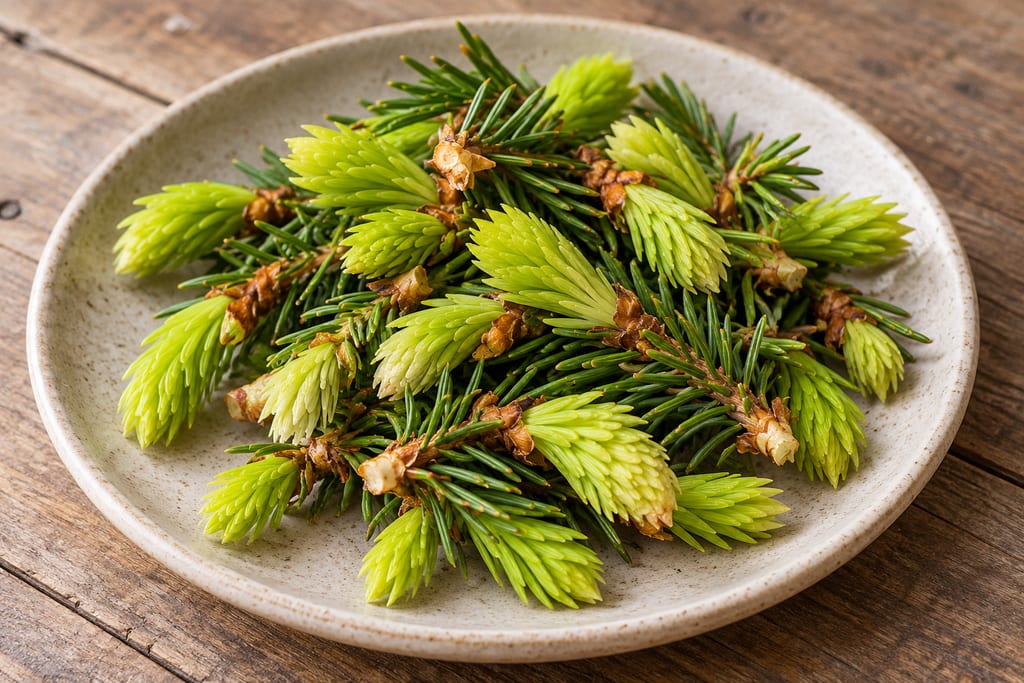
Spruce tips are the soft, light-green new shoots at spruce twig ends, used as a seasonal aromatic in some regional foods. The Jezersko preserves record does not identify its spruce species.
What the name describes
“Spruce tips” names the fresh new growth at the ends of spruce branches, rather than one botanical species. Spruces belong to the genus Picea. The existing Jezersko preserves record names spruce tips but does not identify a species, so this entry keeps that ambiguity: its plant identity is Picea spp., not Norway spruce or any other single species.
Mature spruce foliage provides a useful botanical contrast, but not a safe-foraging key by itself. Spruce needles are generally stiff and sharp, attached one at a time to small woody pegs on the twig; fir needles are softer and differently attached. The young growth is a distinct, tender stage, typically light green before it hardens. These traits help describe what sources call spruce, but do not replace local species-level identification. A name on a recipe or a resemblance to a photograph is not enough to establish what was gathered.
The researched food sources vary in taxonomic precision. A Finnish wild-herb profile specifically covers Picea abies, Norway spruce, while the Coast Salish guide uses Picea spp. for spruce as a group and discusses species in its own region. Neither can identify the plant behind the Jezersko mention. Flavour, shoot shape, harvest time and potential composition may vary with species, site and growth stage; generalizing a species-specific account to every spruce would overstate the evidence.
A seasonal aromatic in different kitchens
The documented uses here are regional examples, not one universal tradition. The Slovenian Radol’ca account describes bright-green soft tips gathered in spring and used fresh in a curd-cheese spread with raisins and honey. It also mentions spruce-tip vinegar on a restaurant menu without giving a recipe or process. That is evidence of contemporary culinary use in its local food setting; it does not establish the age or origin of the practice, nor that the same formula is customary throughout Slovenia.
The Jezersko atlas record that prompted this ingredient entry places spruce tips alongside fruit in preserves. It supplies no species, quantity, preparation, date, or independent account of how the tips affect the preserve. The associated candidate recipe is a descriptive record of jams and jellies, not a validated formula. This page therefore records the ingredient relationship but does not turn it into instructions for a spruce preserve.
In the Finnish profile, Norway spruce shoots are described as mildly resinous and are listed for salads, bread, soups, stews, casseroles, jams, syrups, sweets and garnish. These are uses reported for Picea abies in a Finnish wild-food resource. The Salish Country Cookbook documents different regional uses and foods; those accounts belong to their own cultural and ecological contexts. The examples show that tender spruce growth can be treated as an aromatic ingredient, but not that every species, preparation or cultural use is interchangeable.
The word “tip” can obscure what a source actually means. Here, the Finnish profile distinguishes young annual shoots from mature needles and twig material. The Jezersko note gives only “spruce tips”; it does not clarify whether the gathered material was the entire tender shoot, needles alone, or another part. The page should not silently make that choice for the source.
Sources for this section
Growth stage and gathering
Spruce tips are seasonal because they refer to a brief stage of annual growth. The Finnish profile describes new shoots as pliable and light green, gathered by hand from spring until mid-summer before hardening into needles. The Coast Salish guide describes young bright-green tips as a late-spring gather in its Pacific Northwest context. These calendars are tied to different places and source contexts; neither date range should be used as a universal schedule.
Collection also has ecological and legal context. The Finnish resource explicitly says landowner permission is needed there to collect shoots or twigs. The Coast Salish guide's advice and seasonal description should be read within its regional setting. A visitor elsewhere must follow local access, conservation and land-management rules. These pages are not a harvest permit or a site-specific assessment of whether gathering is sustainable.
The new growth is tender compared with hardened foliage, but the sources inspected do not provide a standard cleaning method, storage limit, drying schedule or preservation control for this broadly named ingredient. Nor does the Jezersko source state how the shoots were handled before they were preserved. A reader should not infer an established shelf life or food-safety process from the ingredient name.
Sources for this section
Identification and safety limits
Species identification matters before any wild plant is eaten. Spruce, fir, hemlock and other needle-bearing trees can be confused by inexperienced gatherers; broad genus descriptions and images are not a substitute for a competent local identification. The extension guidance consulted recommends certainty about identity before eating wild plants and notes that edibility of one part does not establish that all parts are edible.
The sources do not agree in emphasis on eating conifer needles. A Finnish wild-herb profile presents young Norway spruce shoots as a food ingredient and separately warns that spruce can cause allergic symptoms. The Missouri Poison Center says spruce and some other conifers are often low risk if swallowed, while advising against intentional eating; it also notes sharp needles can injure and that volatile oils in some evergreen species can cause symptoms. These are not a species-by-species safety assessment and do not establish a safe amount, preparation or risk-free population.
Research on Norway spruce has compared developing shoots and older needles and raised questions about constituent levels and exposure in food products. Its findings are specific to Picea abies and do not resolve the safety of unidentified spruce tips or provide a general serving limit. This ingredient entry therefore makes no medicinal, nutritional or therapeutic claim and offers no assurance that an unidentified shoot is safe to eat. Allergy risk and the limits of species-level evidence remain explicit.
History, places and what remains unknown
Spruce has documented food uses in several regions, but the available sources do not establish one continuous history for the ingredient named here. The Salish Country Cookbook includes specific Indigenous uses in the Pacific Northwest. The Finnish profile records modern culinary applications for Norway spruce, and the Slovenian tourism account describes present-day restaurant use of spruce tips. These sources document distinct settings; they do not date the Jezersko preserves or prove that the uses share a common origin.
The preservation record locates the named use in Jezersko, Slovenia, but the spruce as an ingredient cannot be assigned a single place of origin or a wider range from that mention. No inspected source dates the Jezersko practice or names its species. Its history period is therefore unknown. The account keeps these limits visible rather than filling them with a guessed species, harvest tradition or chronology.
Sources for this section
Sources and research limits
The source set supports the ingredient's general botanical identity, several geographically distinct culinary examples, and a cautious statement of safety uncertainty. It does not identify the Jezersko plant, supply a recipe, or settle species-specific safety, storage or dosage. Further research should prioritize a source describing the original Jezersko preparation or a locally identified plant.
Sources for this section
- Spruce →
- Taste Radol'ca in the flavours of the forest →
- Salish Country Cookbook →
- Pine Needles →
- Forgotten Foods: Introduction to Wild Edible Plants →
- Sprouts and Needles of Norway Spruce (Picea abies (L.) Karst.) as Nordic Specialty—Consumer Acceptance, Stability of Nutrients, and Bioactivities during Storage →
- Spruces (Picea) →
Allergens
Spruce can cause allergic symptoms according to the Finnish wild-herb profile; broader species-specific allergen evidence was not established.
Places
Unknown
Relationship not established · Place not establishedThe source records a Jezersko preserves use, but does not establish the plant's species, sourcing area or geographic range; no origin is inferred.
Community
No community contributions have been published for this entry yet.
Share what you made
Sign in to contribute. Published comments and photos are free to read.
Sources
Arktiset Aromit ryIdentity · Harvest · Use · Safety
SpruceThis profile treats Picea abies (Norway spruce), describing young annual shoots as pliable, light green growth harvested before hardening.
It describes mild resinous flavour and use in salads, bread, soups, stews, casseroles, jams, syrups, sweets and as garnish.
It notes spruce can cause allergic symptoms and that landowner permission is needed for shoot collection in Finland.
Cited in: What the name describes; A seasonal aromatic in different kitchens; Growth stage and gathering; Identification and safety limits; Sources and research limits
Turizem RadovljicaUse · Preparation
Taste Radol'ca in the flavours of the forestReports spring gathering of bright-green soft spruce tips for local dishes.
Documents a curd-cheese spread with fresh spruce tips, raisins and honey.
Mentions spruce-tip vinegar as a menu ingredient but gives no method.
Cited in: A seasonal aromatic in different kitchens; History, places and what remains unknown; Sources and research limits
Coast Salish InstituteIdentity · Harvest · Regional use
Salish Country CookbookUses Picea spp. when naming spruce as a group and describes species common to the Pacific Northwest; it does not identify the tree used in the Jezersko record.
Describes spring shoots in particular regional food practices; those uses should not be generalized across spruce species or cultures.
Cited in: What the name describes; A seasonal aromatic in different kitchens; Growth stage and gathering; History, places and what remains unknown; Sources and research limits
Coast Salish InstituteIdentity · Botany
Salish Country CookbookDescribes adult spruce needles as stiff and sharp, attached individually to small woody projections; its botanical details concern the Pacific Northwest species it discusses.
Cited in: What the name describes; A seasonal aromatic in different kitchens; Growth stage and gathering; History, places and what remains unknown; Sources and research limits
Missouri Poison CenterSafety
Pine NeedlesNotes that spruce and other conifers are often low risk if swallowed but says intentional eating is not recommended.
Warns that needles can cause physical injury and that some evergreen species contain irritating volatile oils; it does not establish safety for a named spruce species, dose or preparation.
Cited in: Identification and safety limits; Sources and research limits
Mississippi State University Extension ServiceSafety · Identification
Forgotten Foods: Introduction to Wild Edible PlantsAdvises confident, accurate identification before eating wild plants and cautions that edibility does not imply every plant part is edible.
Cited in: Identification and safety limits; Sources and research limits
PubMedResearch · Safety
Sprouts and Needles of Norway Spruce (Picea abies (L.) Karst.) as Nordic Specialty—Consumer Acceptance, Stability of Nutrients, and Bioactivities during StorageStudy concerns Norway spruce, Picea abies, and distinguishes developing shoots from older needles in composition and microbiological quality.
The study frames some compound and exposure questions as unresolved; it does not establish a generally safe quantity or transfer its results to unidentified Picea species.
Cited in: What the name describes; Identification and safety limits; Sources and research limits
Oregon State University College of ForestryIdentity · Botany
Spruces (Picea)Explains that spruce needles attach singly to woody pegs and are generally stiff and sharp; the genus includes multiple species, so a genus-level name does not identify a particular species.
Cited in: Sources and research limits