
Sumac
Sumac is the tart fruit seasoning of several shrubs in the genus Rhus; Mediterranean spice is usually Rhus coriaria, while North American sumac berries also make a sour drink.
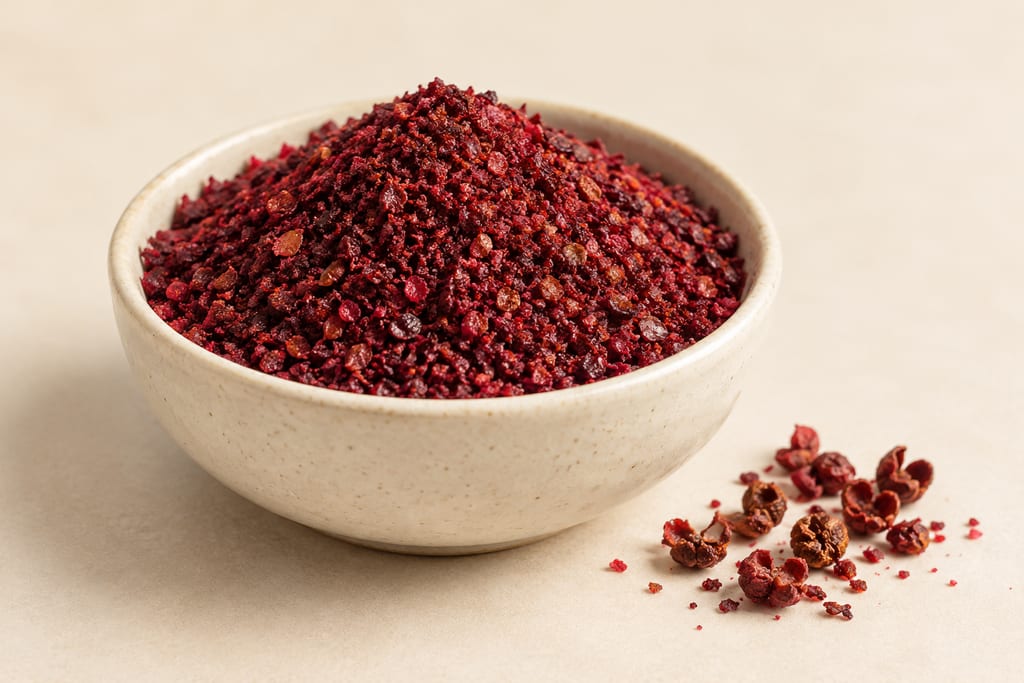
A sour red fruit, not one single plant
Sumac is a culinary name shared by several shrubs in the cashew family, Anacardiaceae. The spice most often meant in Mediterranean and Middle Eastern kitchens is the fruit of Rhus coriaria, also called Sicilian or elm-leaved sumac. Kew accepts R. coriaria as a species native from Macaronesia and the Mediterranean east to Afghanistan. Other Rhus species are used regionally, so the word on a recipe or market label does not by itself identify the plant.
Ripe sumac fruit is a small drupe, a fleshy fruit around a hard seed, borne in dense clusters. Dried R. coriaria fruit is sold whole or ground to a coarse red, burgundy or purple-red seasoning. Its flavour is tart and fruity, with a dry, slightly astringent edge; colour and texture vary with the fruit, drying and grind. In North American food traditions, red-fruited species such as smooth sumac (R. glabra) and staghorn sumac (R. typhina) are used for drinks. Those fruits and preparations are related culinary subjects, but they are not the same species or product as the familiar Mediterranean spice powder.
The spice name is therefore less precise than a botanical label. A jar marked Rhus coriaria refers to the Mediterranean species; the same word, sumac, can describe other Rhus fruits in regional food traditions. The form matters too: dried fruit clusters are a raw material that can be infused, while ground spice is ready for seasoning. The fruit is not a fermented product, and milling it does not make it one.
The Mediterranean spice and its wider history
Rhus coriaria grows across a broad Mediterranean and western Asian range. In Lebanon, a field account describes wild shrubs that people tend and harvest, as well as semi-cultivated plants on steep or otherwise less-farmed land. Local markets sell fruit clusters and ground spice. This is a useful example of how a plant may be gathered from semi-wild stands and managed without being an intensively planted orchard crop; it should not be generalized to every growing region.
Sumac has travelled as a seasoning and as a useful plant material. Its sour fruits appear in classical accounts of food, and medieval records cited by historians place sumac among Syrian goods imported into Barcelona. Leaves and branches are rich in tannins and were valued in leather tanning, an important use that sits alongside the food history. In Central Asian archaeological contexts, researchers discuss sumac as a possible food spice and as a dye plant; the remains alone do not settle which role they served.
The modern spice is especially familiar across the eastern Mediterranean and Middle East. It appears as a table seasoning and in regional combinations such as za'atar, where it adds sourness and red colour beside herbs and sesame. Recipes differ: some use ground sumac by itself, others combine it with salt or other seasonings. A blend that includes sumac is not a separate botanical variety.
In Lebanon, people collect and tend spontaneous plants rather than relying only on planted orchards. The American University of Beirut account describes growers transplanting young shoots to suitable places and harvesting fruit clusters from semi-wild shrubs. It records the local belief that fruit quality improves with altitude, but gives no measured comparison; this remains a reported farming belief, not a guarantee that a higher-grown product tastes better.
The same Lebanese account describes sumac growing wild on sunny, dry slopes and uncultivated parcels, where it tolerates poor soils. Farmers sometimes transplant its shoots and tend plants that appeared near terrace walls or field edges. That mix of wild growth and deliberate care matters to the ingredient's story: a harvest can come from a managed landscape without the shrub being grown as a conventional orchard crop. It is evidence about one regional production system, not a rule for every Rhus species or every sumac-growing country.
Sources for this section
How cooks use the dried spice
Ground sumac is a ready-to-use ingredient. Cooks sprinkle it over salads, vegetables, rice, fish and meat, or stir it into dressings, sauces and marinades. It is often added near serving so its sharp fruit character remains distinct; it can also season food during cooking. In Lebanon it is closely associated with fattoush and is used with olive oil in dressings and marinades. In za'atar, the sour fruit balances sesame and dried herbs. These are documented patterns, not a fixed formula for every household or region.
The tart impression comes from organic acids in the fruit; malic acid is reported among them. Tannins contribute a drying, astringent quality, while fruit pigments help explain the reddish to purple colour. These compounds help explain why sumac can brighten and colour a dish, but the concentration changes with source material and preparation. The presence of organic acids does not tell a cook the finished food's pH.
Sumac brings tartness from the fruit itself rather than from a fermented ingredient. It can brighten a dish in the way cooks use citrus or vinegar, but it is not a dependable substitute for either in preserving or fermentation. Its acidity and tannin content vary by product; a spoonful cannot be treated as a tested pH adjustment, preservation control or starter culture. In fermentation, use it as a flavouring only where a recipe calls for it and keep the recipe's salt, acidification and process controls unchanged.
The powder's texture matters. Coarse ground fruit leaves small flakes and a noticeable grain on the tongue; finer powder disperses more evenly. Sumac can colour pale foods and sauces pink to reddish-purple. Some packaged products may contain added salt, so read the ingredient label before seasoning. The source record does not establish one grind, salt level or strength as a universal standard.
North American sumac drinks
Across North America, Indigenous food traditions use the red fruit clusters of native sumacs for a tart, lemonade-like drink. The Great Lakes Indian Fish & Wildlife Commission's Anishinaabe food article identifies staghorn and smooth sumac and describes their fruits as a seasonal food. A contemporary recipe by Cherokee chef Nico Albert documents a sumac lemonade. These sources show living and contemporary culinary uses; they do not authorize treating every shrub called sumac as the same ingredient.
The drink draws sourness from the outer fruit rather than from fermentation. Published methods generally steep or agitate the clusters in water, then strain them; the GLIFWC article describes a cool-water infusion and notes that heating can draw out bitterness. No single ratio, steep time or sweetener applies across all versions. The berry clusters may be used fresh or dried, and a recipe's own instructions should govern the amount and handling.
This is a different culinary form from buying ground R. coriaria as a spice. The North American beverage uses harvested fruit clusters, often with little processing beyond infusion and straining. It is not a fermented lemonade unless a particular recipe explicitly adds a fermentation stage. The linked Sumac water recipe on this site points to this drink tradition.
In the Great Lakes source, the two plants are distinguished in terms of their visible stems: staghorn sumac has fine hairs, while smooth sumac does not. The article is a community food account, not a taxonomy for all North American species; regional names and plant ranges still matter. A drink prepared from gathered fruit also has a different shopping and kitchen use from a shaker of imported spice, even though both are called sumac.
Choosing and storing sumac
For everyday cooking, buy a food-grade spice from a source that names its ingredients. If a label says only sumac, it may not tell you the species; do not assume it is R. coriaria unless the seller or producer identifies it. Ground spice is the convenient form for seasoning, while whole dried clusters are useful where a drink method calls for infusing the fruit. A product may be pure sumac or a seasoned mixture, so check whether salt or other ingredients have been added.
Keep the product dry, closed and away from direct light and heat. These are ordinary pantry practices, not a sumac-specific shelf-life guarantee: the sources reviewed here do not establish a precise keeping time or a validated freshness test. If a product becomes damp, smells musty or shows visible spoilage, discard it. Smell or appearance cannot prove that an unknown wild plant or a contaminated food is safe.
Fresh or dried native berries used for drinks have their own local harvest and handling practices. The cited Anishinaabe and Cherokee sources document particular traditions rather than a universal foraging manual. Harvesters need accurate local plant identification, permission and knowledge of the gathering place; this page is about culinary use and is not a guide to identifying wild plants.
The fruit clusters of R. coriaria are harvested and dried before they are sold as spice. In Lebanon the market includes whole clusters as well as ground material, so a buyer can choose the form for a particular use. The sources do not specify a single drying temperature, grind size, or seed-removal standard shared by producers. A cook should use the form described by the recipe and avoid assuming that powder from two suppliers has identical sourness.
Keep poison sumac separate
The plant called poison sumac in eastern North America is Toxicodendron vernix, not a culinary Rhus sumac. Penn State and UNH Extension describe it as an urushiol-bearing wetland shrub with pale or whitish fruit in loose clusters. Its leaves have smooth-edged leaflets; the edible staghorn and smooth sumacs described by Penn State bear red fruit clusters, and their leaflet edges are toothed. These are useful contrasts in extension guidance, not a complete identification key.
Do not taste a wild plant to identify it, and do not rely on berry colour or any single feature when gathering. Similar common names and resemblance among shrubs make confident identification a local botanical task. Use commercially labelled food-grade spice, or learn directly from a qualified local expert before considering any wild harvest. The culinary term 'sumac' does not make an unidentified plant edible.
Penn State Extension notes that several non-poisonous native Rhus species have red fruit and have been used in beverages, while the wetland poison sumac has pale fruit and different leaflet margins. UNH Extension separately describes urushiol in poison sumac and the swamp and bog settings where it grows. These clues help explain why the common name causes confusion; neither source turns this page into a field key, and a single feature cannot establish that an unlabelled plant is safe.
Sources for this section
What the sources establish
The evidence is strongest for three distinct things: R. coriaria as the well-known dried Mediterranean spice; red fruits of several North American Rhus species as ingredients in tart drinks; and sumac plants' separate historical role in tanning and dyeing. A source that documents one species or preparation should not be used to assign its practices to all sumacs. Historical archaeological finds, modern commercial powders and Indigenous fruit drinks answer different questions, and the page keeps them apart. The available sources also show why the page keeps the forms together under a shared food name while naming the species wherever evidence permits: a fruit seasoning and a North American infusion overlap in sour taste, but differ in plant, regional history and preparation.
Sources for this section
Places
Eastern Mediterranean and western Asia
Traditional use · Region evidenceThis broad association refers chiefly to Rhus coriaria as a spice; it does not establish one birthplace or cover every species called sumac.
Lebanon
Documented use · Country evidenceThe field account describes wild and semi-cultivated Rhus coriaria and its use as clusters and ground spice; it does not establish a unique origin.
Great Lakes region
Traditional use · Region evidenceThe Anishinaabe food account names Rhus typhina and Rhus glabra for a tart drink; these are distinct from Mediterranean Rhus coriaria.
North America
Documented preparation · Region evidenceThe cited Cherokee chef recipe documents a contemporary sumac lemonade; it does not identify every sumac species or establish the drink's origin.
Community
No community contributions have been published for this entry yet.
Share what you made
Sign in to contribute. Published comments and photos are free to read.
Sources
Plants of the World Online, Royal Botanic Gardens, KewIdentity · Geography
Rhus coriaria L.Kew accepts Rhus coriaria as a species in Anacardiaceae.
Its native range extends from Macaronesia and the Mediterranean to Afghanistan.
Cited in: A sour red fruit, not one single plant
Antioxidants, via PubMed CentralIdentity · Culinary use · Flavour
Pharmacological and Antioxidant Activities of Rhus coriaria L. (Sumac)Rhus coriaria is a Mediterranean spice and flavouring agent.
The dried fruit is reduced to red powder with acidic, astringent flavour and used in Mediterranean and Middle Eastern cuisines.
Cited in: A sour red fruit, not one single plant; The Mediterranean spice and its wider history; How cooks use the dried spice; Choosing and storing sumac; What the sources establish
Handbook of Herbs and Spices, via PubMed CentralCulinary use · Varieties
Other herbs and spices: mango ginger to wasabiSeveral Rhus species are used as culinary sumac, with Rhus coriaria the most important spice species.
Sumac is used as a table seasoning and in meat, fish, vegetable, rice, salad, stew, sauce and za'atar preparations.
Cited in: A sour red fruit, not one single plant; The Mediterranean spice and its wider history; How cooks use the dried spice; What the sources establish
Anuario de Estudios Medievales, Consejo Superior de Investigaciones CientíficasHistory · Trade · Non food use
Sebestén y zumaque, dos frutos importados de Oriente durante la Edad MediaThe study records sumac fruits among goods arriving in Barcelona from Syria in the 14th and 15th centuries.
It surveys Greco-Roman, Andalusi and later written sources and describes sumac's traditional use in leather tanning.
Cited in: The Mediterranean spice and its wider history; What the sources establish
The Oxford Companion to Food, Alan Davidson, Oxford University PressHistory · Culinary use · Identity
SumacMiddle Eastern cookery chiefly uses Rhus coriaria, also called Sicilian or elm-leaved sumac.
The dried, powdered fruits are sour flavouring; the entry discusses their use in Roman cooking and later Middle Eastern cuisine.
American University of Beirut, Plants and PeopleCultivation · Handling · Culinary use
Rhus coriaria L. | SumacIn Lebanon, sumac grows wild and is semi-cultivated; farmers tend volunteer shrubs and harvest their fruits.
Lebanese markets sell it as fruit clusters and ground spice; it is used in za'atar, fattoush, dressings, marinades and sauces.
Cited in: The Mediterranean spice and its wider history; How cooks use the dried spice; Choosing and storing sumac
Penn State ExtensionSafety · Identity · North American species
Spectacular SumacsEdible native Rhus species include staghorn, smooth, winged and fragrant sumacs, whose red fruits are used for tea or lemonade-like drinks.
Poison sumac is Toxicodendron vernix, has white fruits and smooth leaflet margins, and grows in wetland habitats.
Cited in: North American sumac drinks; Choosing and storing sumac; Keep poison sumac separate; What the sources establish
UNH ExtensionSafety · Look alikes
Beware of Poison Sumac (Rhus vernix)Poison sumac contains urushiol and is associated with swamp and bog habitats.
Its fruit turns white; the source explains why the common name can mislead plant identification.
Cited in: North American sumac drinks; Choosing and storing sumac; Keep poison sumac separate
PBS FoodDocumented preparation · Indigenous culinary use
Sumac LemonadeCherokee chef Nico Albert documents sumac lemonade using sumac berries.
The recipe supports a contemporary Indigenous North American drink use, not a universal species identification.
Cited in: A sour red fruit, not one single plant; North American sumac drinks; Choosing and storing sumac; What the sources establish
Mazina’igan, Great Lakes Indian Fish & Wildlife Commission, Fall 2015North American species · Documented preparation · Indigenous culinary use
The great pumpkin and red sumac—nutritious & deliciousThe article names Rhus typhina and Rhus glabra as red-fruited sumacs used by Anishinaabe people for a lemonade-flavoured drink.
It distinguishes staghorn sumac's fine hairs from the smooth branches of smooth sumac and describes a cool-water infusion.
Cited in: The Mediterranean spice and its wider history; North American sumac drinks; What the sources establish
Archaeological and Anthropological Sciences, via PubMed CentralHistory · Archaeobotany
Food globalization in southern Central Asia: archaeobotany at Bukhara between antiquity and the Middle AgesThe article notes sumac remains at Neolithic, Bronze Age and Uluburun ship contexts but discusses uncertainty about whether finds represent spice use or another purpose.
It describes the later introduction of sumac to Central Asia and possible local cultivation, while cautioning that preservation and identification limit interpretation.