
Mushrooms
Cyclocybe chaxingu
Cyclocybe chaxingu is a cultivated edible wood-decaying mushroom best known in China, where related market names can blur species identity.
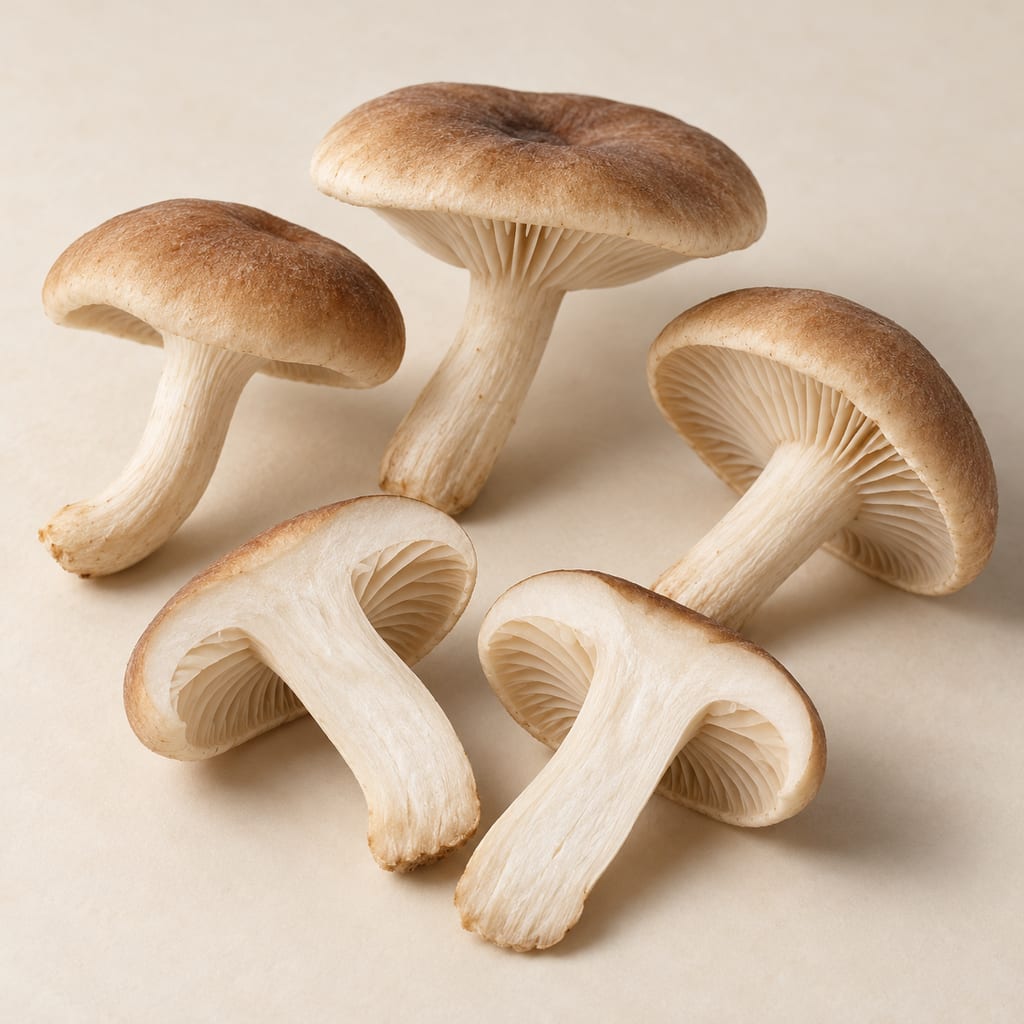
A cultivated mushroom with a complicated market name
Cyclocybe chaxingu is an edible, wood-decaying mushroom that has become a major cultivated crop in China. Its fruiting bodies may grow singly, but farmed mushrooms often appear in close clusters. The smooth caps are convex when young and flatten as they mature. In the neotype-linked cultivation study, young caps began dark brown and became brown or lighter brown, usually retaining a darker centre. The flesh was white, thickest beneath the centre of the cap; the gills began pale and darkened as spores matured. A central, fibrous pale stem and a thin ring complete the familiar form. These characters describe the studied strain, not every commercial cultivar.
The mushroom is sold under names translated as tea-tree mushroom, tea mushroom, tea-sawdust mushroom and oil-tea mushroom. In Chinese sources, 茶薪菇 (cháxīngū) and 油茶菇 (yóuchágū) occur alongside 茶树菇 (cháshùgū). The word “tea” is part of a vernacular and trade-name history; it does not mean the mushroom is tea leaf or that every item sold under that name is taxonomically verified. Fermentea’s supplied fungi catalogue lists Cyclocybe chaxingu as the scientific subject, with Agrocybe chaxingu as an important search name, and warns that commercial tea-tree names can conceal related species.
Sources for this section
- Genomic and Transcriptomic Analysis to Explore the Biological Characteristics of Cyclocybe chaxingu →
- Species concept of Cyclocybe chaxingu, an edible mushroom cultivated in China →
- White Agrocybe chaxingu strain and its selective breeding and industrial cultivation method →
- Chinese edible and medicinal fungi catalogue entry for tea-tree mushroom →
What the species name means
The mushroom was long treated in the genus Agrocybe as Agrocybe chaxingu. Taxonomic work later placed it in Cyclocybe, but the formal name history took several steps: the 2021 species-concept paper proposed the new combination while examining morphology and multiple DNA regions; a 2025 genomic paper notes that the proposed combination had not yet been validly published because registration details were missing, then validates Cyclocybe chaxingu (N.L. Huang) Q.M. Liu, Yang Gao & D.M. Hu with MycoBank number MB840094. The earlier Agrocybe name remains useful in older agronomy and food literature.
The 2021 taxonomic study treated C. chaxingu and C. cylindracea as distinct but closely related species. It discussed differences in cap colour, the oil-tea aroma described for chaxingu, the thin ring that readily breaks away, and microscopic characters, alongside multilocus phylogeny. Other literature also compares it with C. aegerita and related species. A 2025 genomic analysis reports close sequence similarity between study strains and calls for further taxonomic scrutiny. That uncertainty is a reason to retain strain and specimen information, not a reason to merge all three names in a food catalogue. A market label alone does not authenticate a specimen's identification as C. chaxingu.
The JAUCC1847 strain used in the 2025 cultivation and genome paper is a useful documented reference for the depicted brown cluster, but strains and dried herbarium specimens are not interchangeable identifiers. Keep the source's own designation beside any image or laboratory claim. For editorial purposes, the currently valid name is Cyclocybe chaxingu; Agrocybe chaxingu should remain an alias so that older Chinese cultivation reports can still be found.
Sources for this section
A wood-decayer cultivated far beyond its first described setting
Accounts of the species associate its first description with tea-tree forests in Jiangxi. Later Chinese agronomy describes tea-tree mushroom growing on decaying oil-tea tree trunks and roots, which fits its status as a wood-decaying fungus. Those observations identify a reported habitat association; they do not show that the fungus can grow only on one tree, that it parasitizes living trees, or that every wild specimen from a tea-growing area is this species. Identification in the wild still depends on a specimen and taxonomic examination.
Cultivation has made the ingredient much more available than its original wild setting would suggest. A 2017 study calls the mushroom a moderate-temperature fruiting type suitable for cultivation across a broad ambient range in southern China from late spring into autumn. That is a description of a regional production opportunity, not a universal phenology chart. A 2026 production review describes seasonal substitute cultivation by farmers, using indoor bags and outdoor bags subsequently covered with soil. These methods support seasonal market supply even where wild fruiting dates remain uncertain.
The available population evidence is wider than the initial Jiangxi description. A 2022 genetic-diversity paper describes cultivation in Jiangxi, Yunnan and Fujian. A later survey gathered one hundred strains from farms, culture collections and wild collections across twelve provinces and two municipalities. The latter sampling supports a broad Chinese cultivation and collection network, but it does not map continuous wild distribution or prove that every region produces the same strain. Jiangxi and Fujian recur as leading production provinces in a 2026 review; Jiangxi is also identified as a leading producer in a commercial pathogen survey.
Sources for this section
- Assessing genetic and phenotypic diversity to advance multi-trait selection in Cyclocybe chaxingu →
- Analysis of genetic diversity among Chinese Cyclocybe chaxingu strains using ISSR and SRAP markers →
- Cultivated edible fungi production in China: species, production and regional centres →
- Recycling spent Pleurotus eryngii substrate supplemented with Tenebrio molitor feces for cultivation of Agrocybe chaxingu →
- Pathogen Survey in Agrocybe chaxingu and Characterization of the Dominant Pathogen Fuligo gyrosa →
Cultivation, strains and the limits of the calendar
A cultivated mushroom's supply calendar depends on a grower's strain, substrate and production system, so crop timing must not be mistaken for an outdoor fruiting season. In one controlled bag trial, strain JAUCC1847 colonised the prepared substrate in about fifty days. Opening the fully colonised bags was followed by primordia after roughly fifteen days, and the visible mushrooms matured over another two to three days. These are observations from one research protocol. They are not a promise that every commercial bag follows the same schedule or an instruction for safe commercial production.
A separate standardized trial compared one hundred strains under common cultivation conditions. First harvest was recorded between roughly sixty-one and ninety-three days after inoculation, averaging about seventy-three days. The variation arose among strains and was accompanied by differences in size, number, cap colour and other measured traits. The researchers argue that practical breeding and distinctness trials should control the environment and compare enough specimens, because fruiting traits respond to conditions. That helps explain why a consumer may find darker or paler, larger or smaller clusters without those differences necessarily indicating another species.
Breeding continues to create named market material. A Chinese patent describes brown cultivars and a white strain called Zhongjun Baicha No. 1, selected from the Baicha No. 6 cultivar by single-spore crossing. The patent distinguishes the appearance and production claims for this white strain from common brown cultivars. These claims are useful evidence that growers select for colour and crop behaviour; they should not be treated as a peer-reviewed independent trial. In its 2025 study, the Jiangxi Agricultural University team also documented the morphology of JAUCC1847, providing a better anchored visual reference than a marketplace photograph labelled only “tea-tree mushroom.”
Sources for this section
Food use and the economics of a crop
Chinese edible-fungi literature describes chaxingu as a cultivated food mushroom, and the supplied Fermentea catalogue records it as a major crop. One modern review places tea-tree mushrooms among the important Chinese mushroom commodities and identifies Jiangxi and Fujian as primary production areas. A 2025 pathogen survey, drawing on China Edible Fungi Association figures, reports a large national crop and Jiangxi's leading contribution in 2023. Production statistics are estimates of a commercial category, however, and that category may include material traded under overlapping vernacular names. The figures should not be read as a verified count of taxonomically authenticated C. chaxingu fruit bodies.
The edible product is the mushroom fruit body. The cited research mainly studies genetics, breeding, cultivation and crop disease; it does not give a traditional dish with a tested household formula. The documented edible use therefore supports the ingredient account, but not a claim that one preparation is the traditional or universal way to cook it. A cook should expect a firm pale stem and a tender cap in the described strains, but the sources reviewed do not establish a precise flavour profile beyond the oil-tea aroma reported in the 2021 species paper. Avoid transferring composition figures or functional claims from C. cylindracea, C. aegerita or another cultivated mushroom to this species without a species-specific comparison.
The literature sometimes describes C. chaxingu as medicinal or repeats folk therapeutic uses. Those statements are not clinical evidence and do not show that eating the mushroom treats illness. This account treats it as a food ingredient and leaves therapeutic claims out. Likewise, research describing nutritional compounds is not a substitute for a specific, independently checked food-composition table; the selected sources do not support a numerical nutrient profile for every strain or market form.
Sources for this section
- Pathogen Survey in Agrocybe chaxingu and Characterization of the Dominant Pathogen Fuligo gyrosa →
- Cultivated edible fungi production in China: species, production and regional centres →
- Species concept of Cyclocybe chaxingu, an edible mushroom cultivated in China →
- Chinese edible and medicinal fungi catalogue entry for tea-tree mushroom →
A cultivation substrate is not a culinary use
C. chaxingu is described as a wood-decaying fungus, but farms do not have to reproduce its wild habitat exactly. Research trials use prepared plant-based materials in bags. One 2017 study tested spent Pleurotus eryngii substrate, with additions of wheat bran or mealworm frass, as a way to reuse nutrients after a previous mushroom crop. It measured the yield of C. chaxingu under that specific experimental setup. This is evidence about cultivation and agricultural by-product recycling, not a household ingredient formula and not evidence that the mushroom is fermented before sale.
The distinction matters in a fermentation catalogue. A mushroom used as a harvested food is an ingredient; its mycelium may grow through a cultivation substrate, but that fact does not make the fruit body a starter culture. None of the sources reviewed documents C. chaxingu as a culture for fermenting another food, or describes a species-specific chaxingu fermentation. Fermentation studies of shiitake, oyster mushroom or other fungi cannot be transferred to this ingredient without direct evidence. It may be eaten in foods that also contain fermented ingredients, but that is not the same as being a fermentation organism or substrate in a documented process.
No species-specific recipe or fermentation procedure is included here. This is deliberate: the research sources gathered for this record support edible use and cultivation, but do not provide a tested cooking method, preservation process, salt ratio, acidification schedule or storage life. A complete recipe should be sourced separately, with its own ingredient identity and process controls.
Choosing, handling and identifying the ingredient
For a reader buying the ingredient, the most useful distinction is between an identified cultivated product and an ambiguous common name. A package or market listing that says only “tea-tree mushroom” does not resolve whether it is C. chaxingu, C. aegerita, C. cylindracea or material sold under a broader trade category. Prefer a traceable cultivated product whose supplier gives a species name, and treat that name as a market assertion unless the producer can support it with strain or collection information. The neotype-linked photographs in the 2025 paper show one cultivated brown strain, not a visual key for every bagged mushroom.
The sources reviewed do not supply a specific home storage temperature, package life, drying endpoint or shelf-life test for C. chaxingu. Fresh and dried market forms are both mentioned in Chinese production material, but a commercial dried product is not a recipe for drying mushrooms at home. Follow the supplier's storage instructions and use a suitable food-preservation method if preserving it. Do not improvise a shelf life from the fact that the species is widely sold or cultivated.
These research papers are not a foraging guide. A smooth brown cap, pale stem and ring are not enough to identify a wild mushroom, particularly in a group whose species have been confused in trade and taxonomic literature. Do not collect or eat an unidentified mushroom based on an image, a common name or this account. The edible-use evidence concerns identified crop material; it does not establish the safety of an unknown lookalike, a contaminated bag or a spoiled product.
What is known about season and history
The literature establishes a modern cultivation history more clearly than it establishes a natural fruiting calendar. A commercial study describes a late-spring-to-autumn growing window for southern China under ambient cultivation; a review calls production seasonal and describes both indoor and outdoor bag systems. The 2025 research protocol gives a crop cycle for one controlled strain. These distinct kinds of evidence should stay distinct: seasonal cultivation may schedule harvests, but neither source is a systematic survey of wild fruiting dates across the species' range.
A 2025 pathogen paper says artificial cultivation began in the 1950s, while a 2026 genetic-diversity study says cultivation expanded substantially after the 1980s. The first statement is a recent secondary historical claim in the introduction to a disease survey, and the second is a broad review of industry development. No contemporary 1950s cultivation document or dated first food-use attestation was verified for this account. The scientific-name record reaches back to an invalidly published name in 1972 and an edible-fungi flora listing in 1991, but those taxonomic publications do not establish when people first ate the mushroom.
The historical period of food use is unknown. It is not converted from the date of a modern article, an old scientific name or a general word such as “traditional” into a food-history date. The known modern crop is distinct from a history whose date is not yet established.
Sources for this section
- Pathogen Survey in Agrocybe chaxingu and Characterization of the Dominant Pathogen Fuligo gyrosa →
- Assessing genetic and phenotypic diversity to advance multi-trait selection in Cyclocybe chaxingu →
- Cultivated edible fungi production in China: species, production and regional centres →
- Genomic and Transcriptomic Analysis to Explore the Biological Characteristics of Cyclocybe chaxingu →
Evidence limits
The strongest evidence here concerns the currently used name, one neotype-linked cultivated strain, genetic variation among Chinese strains, commercial production and selected cultivation trials. It is not a complete ethnomycological history, a regional dish survey, a food-safety monograph or a wild-distribution atlas. The 100-strain survey mixes farm, culture-collection and wild origins; it supports geographic breadth of sampled material, not continuous natural occurrence in every province. Crop statistics may use commercial categories whose species boundaries are less precise than this article's title.
A number of background statements about medicinal uses, nutritional value and disease treatment appear in cultivation papers and patents. They are reported as context rather than adopted as findings here. The page does not claim a therapeutic effect, a validated nutritional composition, an at-home cultivation protocol or a safe preservation method. If later sources establish a named regional dish, a better dated cultivation history, handling standards or an authenticated strain's sensory profile, those facts can be added with their own sources without expanding the claims beyond what those records show.
Sources for this section
Places
No source in this record establishes a place.
Community
No community contributions have been published for this entry yet.
Share what you made
Sign in to contribute. Published comments and photos are free to read.
Sources
MycosystemaTaxonomy · Identity · Food use · Geography
Species concept of Cyclocybe chaxingu, an edible mushroom cultivated in ChinaThe species is distinct from but closely related to C. cylindracea on combined morphology and multilocus phylogeny.
The study distinguishes the taxa by cap colour, oil-tea aroma, a thin readily detached ring and microscopic characters.
The revised study designated a neotype specimen deposited at Jiangxi Agricultural University.
Cited in: A cultivated mushroom with a complicated market name; What the species name means; Food use and the economics of a crop; Choosing, handling and identifying the ingredient
HorticulturaeTaxonomy · Morphology · Cultivation
Genomic and Transcriptomic Analysis to Explore the Biological Characteristics of Cyclocybe chaxinguThe valid combination Cyclocybe chaxingu was recorded with MycoBank MB840094; Agrocybe chaxingu is a synonym.
The paper describes the cultivated neotype reference strain JAUCC1847 and the pictured fruit bodies.
In this bag-cultivation trial, colonisation took about 50 days, primordia appeared roughly 15 days after opening, and mushrooms matured within 2 to 3 days.
The paper warns of confusion in commercial naming with C. aegerita and C. cylindracea.
Cited in: A cultivated mushroom with a complicated market name; What the species name means; Cultivation, strains and the limits of the calendar; A cultivation substrate is not a culinary use; Choosing, handling and identifying the ingredient; What is known about season and history; Evidence limits
IMA FungusCultivation · Geography · Strain diversity
Assessing genetic and phenotypic diversity to advance multi-trait selection in Cyclocybe chaxinguThe surveyed 100 strains came from farms, culture collections and wild collections across 12 Chinese provinces and two municipalities.
In standardized cultivation, first harvest ranged from about 61 to 93 days after inoculation, averaging about 73 days.
Fruit-body size, colour and harvest timing varied among strains.
Cited in: What the species name means; A wood-decayer cultivated far beyond its first described setting; Cultivation, strains and the limits of the calendar; What is known about season and history; Evidence limits
International Journal of Recycling of Organic Waste in AgricultureCultivation · Seasonal production · Substrate reuse
Recycling spent Pleurotus eryngii substrate supplemented with Tenebrio molitor feces for cultivation of Agrocybe chaxinguThe study treats A. chaxingu as a moderate-temperature fruiting crop suitable for cultivation from late spring to autumn in southern China; this is a cultivation window, not a wild-fruiting calendar.
It tests reuse of spent king-oyster mushroom substrate for chaxingu cultivation.
The study notes earlier naming confusion with A. cylindracea and A. aegerita.
Cited in: A wood-decayer cultivated far beyond its first described setting; A cultivation substrate is not a culinary use
PeerJGeography · Cultivation · Strain diversity
Analysis of genetic diversity among Chinese Cyclocybe chaxingu strains using ISSR and SRAP markersThe study describes C. chaxingu as commonly cultivated in Jiangxi, Yunnan and Fujian provinces of China.
It examines genetic diversity among Chinese cultivated strains; it is not a wild-range survey.
Cited in: A wood-decayer cultivated far beyond its first described setting
MycosphereModern production · Geography · Seasonal supply
Cultivated edible fungi production in China: species, production and regional centresThe review identifies C. chaxingu as the main tea-tree mushroom cultivated in China.
It describes seasonal substitute cultivation by farmers, including indoor bag production and outdoor bags covered with soil.
The review identifies Jiangxi and Fujian as primary production provinces.
Cited in: A wood-decayer cultivated far beyond its first described setting; Food use and the economics of a crop; What is known about season and history
HorticulturaeCommercial production context · Geography
Pathogen Survey in Agrocybe chaxingu and Characterization of the Dominant Pathogen Fuligo gyrosaThe study describes A. chaxingu as commercially important and reports Jiangxi as a leading production area, citing China Edible Fungi Association statistics.
The authors studied a commercial cultivar and cultivation enterprises in Guangchang County and Ganxian District, Jiangxi.
Its historical claim that cultivation began in the 1950s is background reporting, not an independently checked contemporary record.
Cited in: A wood-decayer cultivated far beyond its first described setting; Food use and the economics of a crop; What is known about season and history; Evidence limits
Google Patents / China National Intellectual Property Administration publicationCultivar example · Modern cultivation
White Agrocybe chaxingu strain and its selective breeding and industrial cultivation methodA Chinese patent describes named brown cultivars and a white ZJCXG001 strain selected from the white cultivar Baicha 6.
It shows that selected strains can differ in colour and production behaviour; patent performance claims are not treated as independent comparative evidence.
The patent uses tea-sawdust mushroom and oil-tea mushroom names and identifies tea-tree mushroom as a commercial name.
Cited in: A cultivated mushroom with a complicated market name; Cultivation, strains and the limits of the calendar; Choosing, handling and identifying the ingredient
Journal of Fungal Biology / Chinese Academy of Agricultural SciencesFood market context · Chinese name · Catalogue source
Chinese edible and medicinal fungi catalogue entry for tea-tree mushroomThe supplied Fermentea catalogue cites this entry for the Chinese cultivated-food context and regional market association.
Cited in: A cultivated mushroom with a complicated market name; Food use and the economics of a crop