
Mushrooms
The flirt
Russula vesca, the bare-toothed brittlegill, a mild, nutty wild mushroom of European beech and conifer woodland. Field sources call it edible and cook it with onions and garlic, but regional identification must be confirmed.
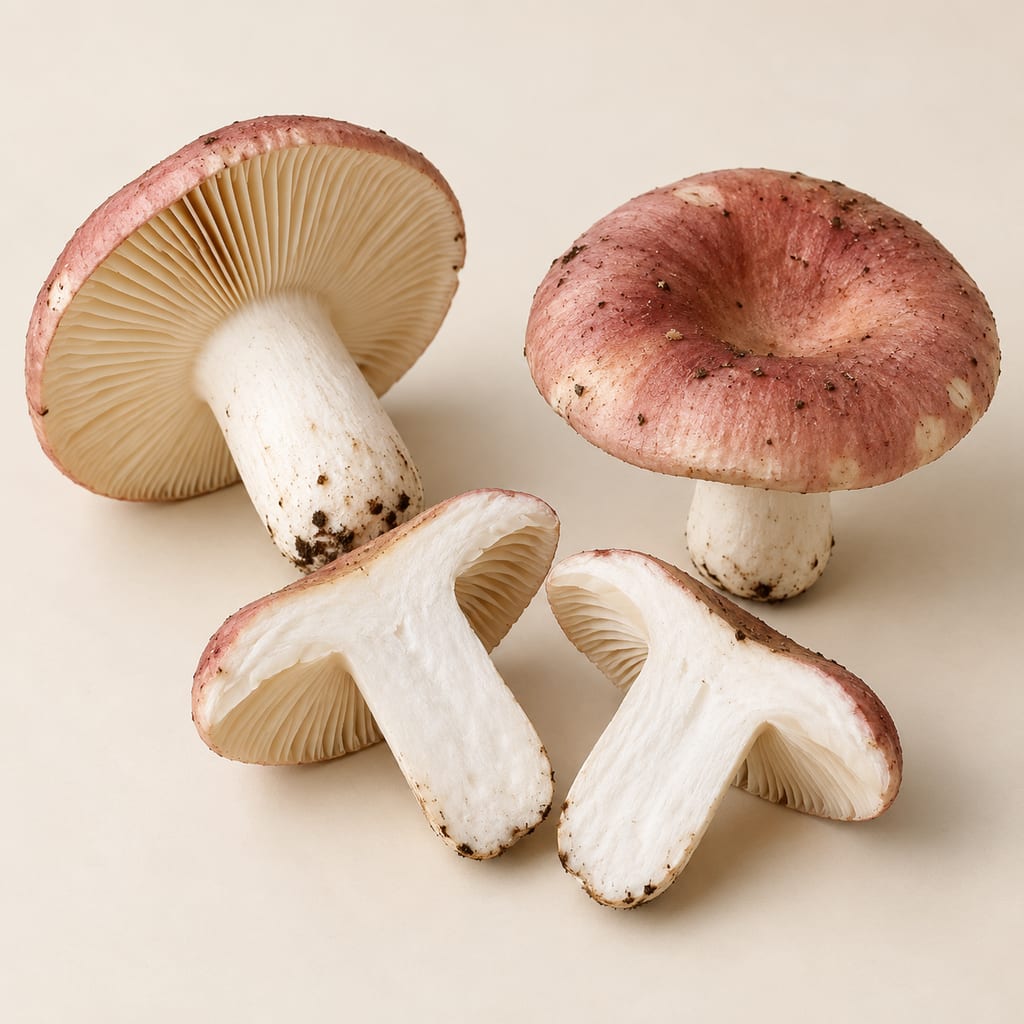
Overview
Russula vesca is a brittlegill, a mushroom of the genus Russula that has brittle flesh and white or cream gills. In English it is called the flirt or the bare-toothed brittlegill, after the bare rim of its cap.
The supplied catalogue lists it as a cooked mushroom in Europe, with a note that reliable regional identification is needed. The name is a research label, and the catalogue does not reconcile it with a current accepted name.
Sources for this section
Description
The cap is 5 to 10 centimetres across, smooth and globose when young, becoming convex with a sometimes shallow central depression. Its colour varies from wine red to buff. The cuticle stops about 1 millimetre short of the margin, leaving a bare rim that gives the common name.
The gills are white to very pale cream, fairly close, narrow and forked near the stem. The stem is 3 to 10 centimetres long and 1.5 to 2.5 centimetres thick, and white inside and out. The spore print is white. The taste is mild and nutty, with no distinctive odour.
Sources for this section
Habitat and season
The species is ectomycorrhizal and forms partnerships with tree roots. It is especially common in beech woodland in Britain and Ireland. On mainland Europe it also grows in spruce plantations on neutral or acidic soil.
In Britain and Ireland it fruits from July to October.
Sources for this section
Identification
Cap colour is too variable to be reliable. The source recommends field tests: iron salts turn the gills and stem surface a deep salmon or rusty pink, and guaiac tincture turns them blue.
The similar species named in the source is Russula xerampelina, the crab brittlegill. It is described as smelling strongly of fish or shellfish, which R. vesca does not.
Sources for this section
How to recognise a brittlegill
A mushroom is a brittlegill, a Russula, only when several features line up. The cap is usually brightly coloured. The gills are brittle: they snap when you try to bend them, and the flesh breaks cleanly like chalk instead of tearing into fibres. The stem carries no ring and no cup or sack at its base, and there are no veil remnants on the cap. The gills are attached to the stem, and a spore print is white, cream or dark yellow.
Two checks separate Russula from its look-alikes. Break a gill or cut the flesh: a brittlegill gives no milky juice, while a milkcap (Lactarius or Lactifluus) weeps latex. Then look at the stem. A ring on the stem, a cup or a sack or bulb with torn remnants at its base, or flesh that tears in fibres points away from Russula and towards Amanita, a genus that includes the deadly death cap and many other poisonous species. A mushroom with a ring or a cup at the base is not a Russula, whatever colour its cap is.
Recognising the genus is much easier than naming the species. Cap colour varies widely inside one species, so experts rely on the colour of the spore print, the taste, colour changes in the flesh, how far the cap skin peels, chemical tests and the microscope. A collector who is sure of the genus but not of the species should treat the species as unidentified.
Sources for this section
The taste test, and what it cannot tell you
Foragers have long sorted brittlegills by taste. Break off a small piece of cap flesh or gill, chew it for several seconds and spit it out without swallowing; the burn of an acrid species can take half a minute to build. Brittlegills that taste mild are the traditional edibles. Those that taste hot, peppery or acrid, and many bitter ones, are left alone because they irritate the stomach and bowel and can cause vomiting and diarrhoea.
The method works only inside the genus. Use it once the mushroom is positively a Russula, never to decide whether an unknown mushroom is safe: the deadliest mushrooms do not taste unpleasant, and a mild taste says nothing about an Amanita, a Cortinarius or any other family. Within Russula it is a screen for rejecting species, not proof of safety. Some mild species are poor eating, rare species are poorly documented, and a few brittlegills have been linked with poisoning. Cook what you eat, start with a small portion, and identify to species where you can. This record is not a field guide.
Sources for this section
Use in cooking
The source calls the species an edible brittlegill that many people consider among the finest wild mushrooms. It keeps a firm texture when cooked.
It is suggested to be sautéed with onions and garlic and served with meat, or used in omelettes, mushroom soups or stews. The catalogue records its supply as wild.
Sources for this section
Safety and identification
The main source gives no toxicity warning or bitterness caution for this species. That is not a safety assessment, and it does not establish that every collection of the name is the same species.
The catalogue states that reliable regional identification is needed before any use. Anyone considering a wild brittlegill should confirm the species with a regional expert, using the field tests above, and should compare it with R. xerampelina before eating it.
Sources for this section
Places
Europe
Documented use · Region evidenceThe source gives Britain, Ireland and mainland Europe as its range; no locality is given.
Community
No community contributions have been published for this entry yet.
Share what you made
Sign in to contribute. Published comments and photos are free to read.
Sources
First NatureIdentity · Method · Food use · Ecology
Russula vesca Fr. - The FlirtCap 5 to 10 cm; bare rim about 1 mm; gills white to pale cream; stem white; spore print white; mild, nutty taste.
Field tests: iron salts salmon or rusty pink; guaiac blue.
Season July to October in Britain and Ireland; beech woodland and spruce plantations on mainland Europe.
Cooking suggestions: sauté with onions and garlic; omelettes, soups and stews; firm texture when cooked.
Lookalike Russula xerampelina, which smells of fish or shellfish.
Cited in: Overview; Description; Habitat and season; Identification; Use in cooking; Safety and identification
Food use
Supplied catalogue source (diva-portal PDF)Listed in the supplied catalogue as a cooked mushroom; reliable regional identification needed. The PDF could not be read as text for this page.
Cited in: Overview; Description; Habitat and season; Identification; Use in cooking; Safety and identification
WikipediaIdentification · Food use
RussulaBrittle attached gills, no latex, no ring or volva; Lactarius weeps latex; taste (mild, bitter, acrid) as a diagnostic character; acrid species are toxic and mild species such as R. cyanoxantha and R. vesca are eaten; the genus is mostly free of deadly species.
Cited in: Overview; Description; Habitat and season; Identification; How to recognise a brittlegill; The taste test, and what it cannot tell you; Use in cooking; Safety and identification